

Before proceeding, make sure you are familiar with inverse trigonometric functions.
Inverse trigonometric identities involve inverse trigonometric functions such as sin-1(x), cos-1(x), and tan-1(x), etc. These functions provide the angles (or arcs) corresponding to a given trigonometric ratio.
Some important identities are:
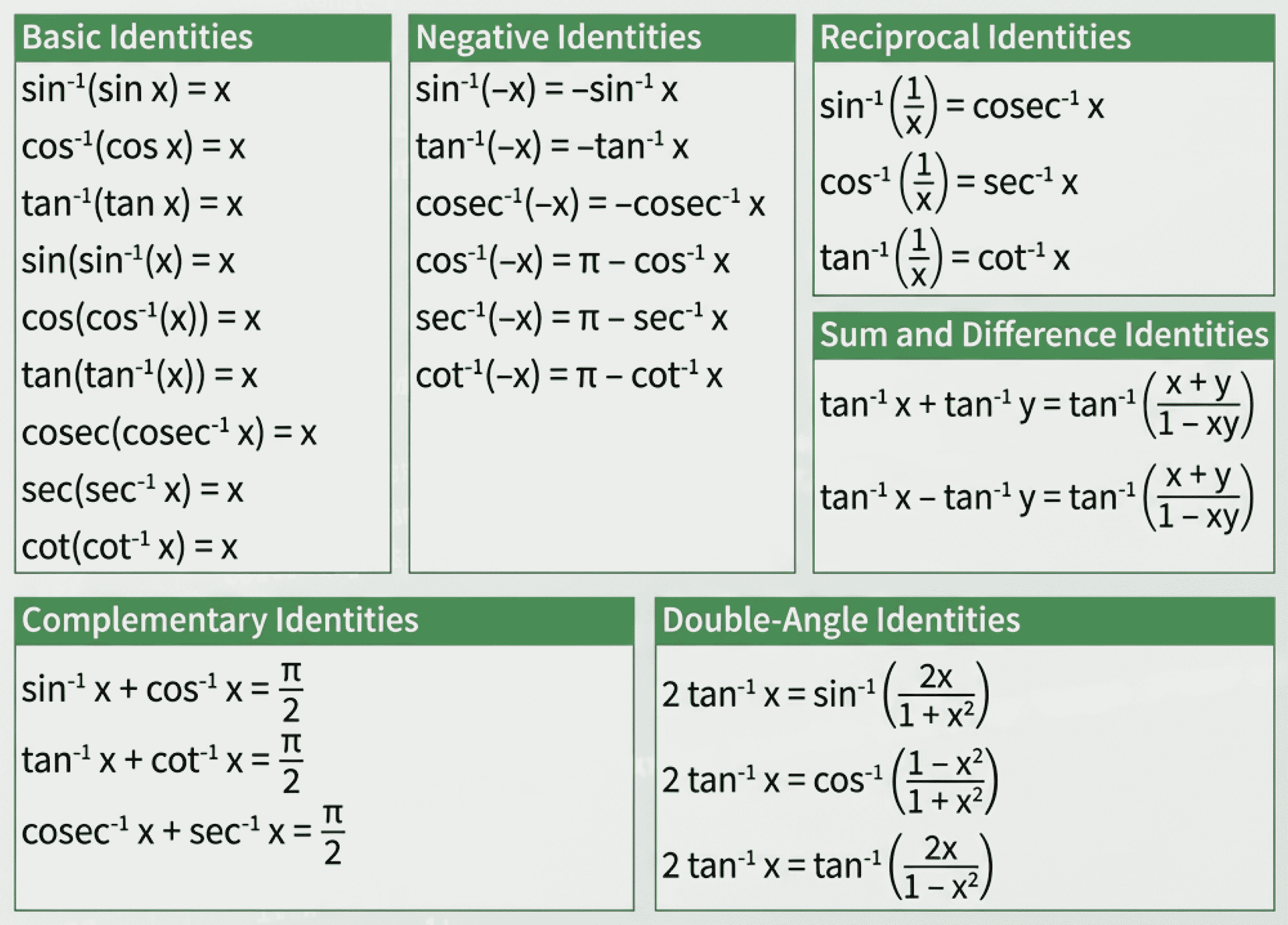
The inverse trigonometric identities help in simplifying complex expressions and solving equations involving trigonometric functions.
Properties of Inverse Trigonometric Functions
The following are the properties of inverse trigonometric functions:
Property 1:
- sin-1 (1/x) = cosec-1 x, for x ≥ 1 or x ≤ -1
- cos-1 (1/x) = sec-1 x, for x ≥ 1 or x ≤ -1
- tan-1 (1/x) = cot-1 x, for x > 0
Property 2:
- sin-1 (-x) = -sin-1 x, for x ∈ [-1 , 1]
- tan-1 (-x) = -tan-1 x, for x ∈ R
- cosec-1 (-x) = -cosec-1 x, for |x| ≥ 1
Property 3
- cos-1 (-x) = π - cos-1 x, for x ∈ [-1 , 1]
- sec-1 (-x) = π - sec-1 x, for |x| ≥ 1
- cot-1 (-x) = π - cot-1 x, for x ∈ R
Property 4
- sin-1 x + cos-1 x = π/2, for x ∈ [-1,1]
- tan-1 x + cot-1 x = π/2, for x ∈ R
- cosec-1 x + sec-1 x = π/2 , for |x| ≥ 1
Property 5
- tan-1 x + tan-1 y = tan-1 ( x + y )/(1 - xy), for xy < 1
- tan-1 x - tan-1 y = tan-1 (x - y)/(1 + xy), for xy > -1
- tan-1 x + tan-1 y = π + tan-1 (x + y)/(1 - xy), for xy >1 ; x, y >0
Property 6
- 2tan-1 x = sin-1 (2x)/(1 + x2), for |x| ≤ 1
- 2tan-1 x = cos-1 (1 - x2)/(1 + x2), for x ≥ 0
- 2tan-1 x = tan-1 (2x)/(1 - x2), for -1 < x <1
Identities of Inverse Trigonometric Function
The following are the identities of inverse trigonometric functions:
- sin-1 (sin x) = x provided -π/2 ≤ x ≤ π/2
- cos-1 (cos x) = x provided 0 ≤ x ≤ π
- tan-1 (tan x) = x provided -π/2 < x < π/2
- sin(sin-1 x) = x provided -1 ≤ x ≤ 1
- cos(cos-1 x) = x provided -1 ≤ x ≤ 1
- tan(tan-1 x) = x provided x ∈ R
- cosec(cosec-1 x) = x provided -1 ≤ x ≤ ∞ or -∞ < x ≤ 1
- sec(sec-1 x) = x provided 1 ≤ x ≤ ∞ or -∞ < x ≤ 1
- cot(cot-1 x) = x provided -∞ < x < ∞
sin^{-1}(\frac{2x}{1 + x^2}) = 2 tan^{-1}x cos^{-1}(\frac{1 - x^2}{1 + x^2}) = 2 tan^{-1}x tan^{-1}(\frac{2x}{1 - x^2}) = 2 tan^{-1}x - 2cos-1 x = cos-1 (2x2 - 1)
- 2sin-1x = sin-1 2x√(1 - x2)
- 3sin-1x = sin-1(3x - 4x3)
- 3cos-1 x = cos-1 (4x3 - 3x)
- 3tan-1x = tan-1((3x - x3/1 - 3x2))
- sin-1x + sin-1y = sin-1{ x√(1 - y2) + y√(1 - x2)}
- sin-1x - sin-1y = sin-1{ x√(1 - y2) - y√(1 - x2)}
- cos-1 x + cos-1 y = cos-1 [xy - √{(1 - x2)(1 - y2)}]
- cos-1 x - cos-1 y = cos-1 [xy + √{(1 - x2)(1 - y2)}
- tan-1 x + tan-1 y = tan-1(x + y/1 - xy)
- tan-1 x - tan-1 y = tan-1(x - y/1 + xy)
- tan-1 x + tan-1 y +tan-1 z = tan-1 (x + y + z - xyz)/(1 - xy - yz - zx)
➢Practice: Solved Examples