

An irrational number is a real number that cannot be written as a simple fraction of the form
- Its decimal expansion never ends (non-terminating)
- And it does not repeat in a pattern (non-recurring)
Some Examples:
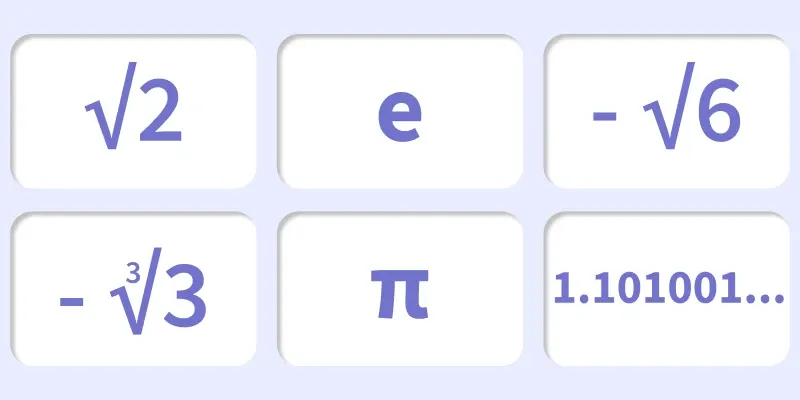
These are various irrational numbers that are widely used in mathematics. Some of the most commonly used irrational numbers are discussed in the table below:
| Irrational Number | Approx. Value |
|---|---|
| √2 | 1.41421356... (non-terminating, non-repeating) |
| ( e ) | 2.718281828... Euler’s number, no repeating pattern |
| -√6 | Negative irrational; decimal never ends or repeats |
| Cube root of 3 is irrational; remains irrational even when negative | |
| π | 3.141592653 Famous irrational; used in geometry |
| 1.101001 | Non-terminating and non-repeating decimal |
Properties of Irrational Numbers
- Sum of two rational numbers is always rational.
- Sum of a rational number and an irrational number is an irrational number.
- Product of an irrational number with a non-zero rational number is an irrational number.
- Product of two irrational numbers may be rational or may be irrational.
- LCM of two irrational numbers may or may not exist.
- Set of irrational numbers is not closed under the multiplication process, but a set of rational numbers is closed.
Operation on Irrational Numbers
Operations like addition, subtraction, multiplication, and division can be done with irrational numbers, but the result may be rational or irrational depending on the numbers involved.
Product of Two Irrational Numbers
Product of two rational numbers may be either rational or irrational. For example:
- π × π = π2 is irrational
- √2 × √2 = 2 is rational
So Product of two Irrational Numbers can result in a Rational or Irrational Number accordingly.
Product of Irrational Number and Non-zero Rational Number
The product of any irrational number with any non-zero rational number is an irrational number.
For example, 3 × √2 is an irrational number as it can not be represented as p/q.
Sum of Irrational Numbers
The sum of irrational numbers is sometimes rational sometimes irrational.
- 3√2 + 4√3 is irrational.
- (3√2 + 6) + (- 3√2) = 6, is rational.
Steps to Find Irrational Numbers
- Check if the number can be written as a fraction - If it cannot be written in the form p/q, it is an irrational number.
- Look at the decimal form of the number - If the decimal is non-terminating and non-repeating, the number is irrational.
- Check square roots. - Square root of a non-perfect square (like 2, 3, 5, 7) is always irrational. Example: √2, √3, √5.
- Numbers like π or e are always irrational - They cannot be expressed as fractions and their decimals do not repeat.
Example: Is 0.123456789101112… is irrational number?
Solution :
The digit 0.123456789101112… keep changing and never repeat soo it is Irrational Number.
Related Articles
Solved Questions
Question 1: Find Rational Numbers or Irrational Numbers among the following.
2, 3, √3, √2, 1.33333..., 1.1121231234...
Solution:
- Rational Numbers: 2, 3, 1.3333.... are rational number
- Irrational Numbers: √3, √2, 1.1121231234... are irrational numbers
Question 2: Find the sum of the following irrational numbers.
a) √2, √2 b) √2, √3
Solution:
a) √2 + √2 = 2√2 (they are added as two like variables)
b) √2 + √3 = √2 + √3 (they can't be added as unlike variables)
Question 3: Find the product of the following rational numbers.
a) √2, √2 b) √2, √3
Solution:
a) √2 × √2 = 2
b) √2 × √3 = √6
Practice Problems
Question 1: Find whether the sum √5 + √7 is rational or irrational.
Question 2: Is the sum (3√2 + 5) + (–3√2) rational or irrational?
Question 3: Check whether the product √3 × √12 is rational or irrational.
Question 4: Determine whether (2√6 + 4√6) is rational or irrational.
Question 5: Is the product √5 × √20 rational or irrational?
Question 6: Find whether √2 × (3 + √8) is rational or irrational.