

Matrix addition is an operation of adding two different matrices of the same order, with the same number of rows and columns.
Let's suppose two matrices A and B, such that A = [aij] and B = [bij], then their addition A + B is defined as [aij + bij], where ij represents the element in the ith row and jth column.
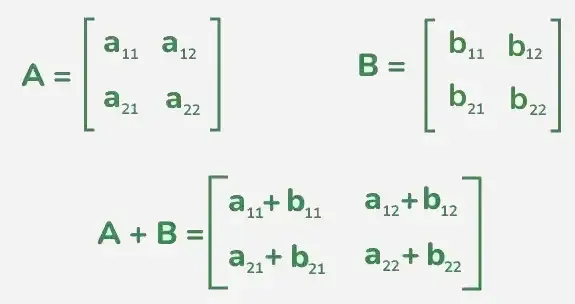
Matrix addition is done element-wise, and the resulting matrix has the same dimensions as the original matrices.
Example: For matrix
Solution:
A + B =
\begin{bmatrix} 1 + 7 & 2 + 8 & 3 + 9 \\ 4 + 10 & 5 + 11 & 6 + 12 \end{bmatrix}
\Rightarrow A + B = \begin{bmatrix} 8 & 10 & 12 \\ 14 & 16 & 18 \end{bmatrix}
Properties of Matrix Addition
There are various unique properties of matrix addition.
- Closure Property
- Commutative Property
- Associative Property
- Additive Identity Property
- Additive Inverse Property
Closure Property of Matrix Addition
A matrix can be added with another matrix if and only if the order of matrices is the same. The addition will take place between the elements of the matrices. The resultant matrix will also be of the same order, that is
[A]m×n + [B]m×n = [C]m×n
Example:
Commutative Property of Matrix Addition
Commutative Property states that any two matrices of the same order can be added in any way i.e., the result of the sum of two matrices doesn't depend on the order of the matrix in matrix addition. Suppose there are two matrices A and B of the same order m*n, then the commutative property of matrix addition states that:
A + B = B + A
Example: For matrix
A + B =\begin{bmatrix} 1 & 2 \\ 3 & 4 \end{bmatrix}+ \begin{bmatrix} 5 & 6 \\ 7 & 8 \end{bmatrix} \\ \Rightarrow A + B = \begin{bmatrix} 1 + 5 & 2 + 6 \\ 3 + 7 & 4 + 8 \end{bmatrix} = \begin{bmatrix} 6 & 8 \\ 10 & 12 \end{bmatrix}
B + A = \begin{bmatrix} 5 & 6 \\ 7 & 8 \end{bmatrix} + \begin{bmatrix} 1 & 2 \\ 3 & 4 \end{bmatrix}\\ \Rightarrow B + A = \begin{bmatrix} (5 + 1) & (6 + 2) \\ (7 + 3) & (8 + 4) \end{bmatrix} = \begin{bmatrix} 6 & 8 \\ 10 & 12 \end{bmatrix}
Thus, A + B = B + A., which demonstrates the commutative property of matrix addition.
Associative Property of Matrix Addition
Similarly, If three matrices have the same order then their position does not matter in addition. Suppose there are three matrices A, B, and C of order m*n, then the associative property of matrix addition states that:
A + (B + C) = (A + B) + C
Example: For
(A + B) + C = \begin{bmatrix} (a_{11} + b_{11}) & (a_{12} + b_{12}) \\ (a_{21} + b_{21}) & (a_{22} + b_{22}) \\ \end{bmatrix} + \begin{bmatrix} c_{11} & c_{12} \\ c_{21} & c_{22} \\ \end{bmatrix} \\ \Rightarrow (A + B) + C= \begin{bmatrix} [(a_{11} + b_{11}) + c_{11}] & [(a_{12} + b_{12}) + c_{12}] \\ [(a_{21} + b_{21}) + c_{21}] & [(a_{22} + b_{22}) + c_{22}] \\ \end{bmatrix}
A + (B + C)= \begin{bmatrix} a_{11} & a_{12} \\ a_{21} & a_{22} \\ \end{bmatrix} + \begin{bmatrix} (b_{11} + c_{11}) & (b_{12} + c_{12}) \\ (b_{21} + c_{21}) & (b_{22} + c_{22}) \\ \end{bmatrix}\\ \Rightarrow A + (B + C) = \begin{bmatrix} [(a_{11} + b_{11}) + c_{11}] & [(a_{12} + b_{12}) + c_{12}] \\ [(a_{21} + b_{21}) + c_{21}] & [(a_{22} + b_{22}) + c_{22}] \\ \end{bmatrix}
Therefore, (A + B) + C = A + (B + C), which demonstrates the associative property of matrix addition.
Additive Identity Property of Matrix Addition
We have discussed zero Matrix that O matrix can be added to any matrix for the same result. According to the additive identity property of matrix addition, for a given matrix A of order m*n, there exists an m×n matrix O such that:
A + O = A = O + A
Here, O is the m×n order zero Matrix.
Example: Let A be a 2×2 matrix, and let I be the 2×2 identity matrix. We want to show that A + O = A = O + A.
A = \begin{bmatrix} a_{11} & a_{12} \\ a_{21} & a_{22} \\ \end{bmatrix} \text{and } O = \begin{bmatrix} 0 & 0 \\ 0 & 0 \\ \end{bmatrix}
A + O = \begin{bmatrix} a_{11} & a_{12} \\ a_{21} & a_{22} \\ \end{bmatrix} + \begin{bmatrix} 0 & 0 \\ 0 & 0 \\ \end{bmatrix} \\ \Rightarrow A + O = \begin{bmatrix} (a_{11} + 0) & (a_{12} + 0) \\ (a_{21} + 0) & (a_{22} + 0) \\ \end{bmatrix} \\ \Rightarrow A + O = \begin{bmatrix} a_{11} & a_{12} \\ a_{21} & a_{22} \\ \end{bmatrix}
O + A = \begin{bmatrix} 0 & 0 \\ 0 & 0 \\ \end{bmatrix} + \begin{bmatrix} a_{11} & a_{12} \\ a_{21} & a_{22} \\ \end{bmatrix}\\ \Rightarrow O + A = \begin{bmatrix} (0 + a_{11}) & (0 + a_{12}) \\ (0 + a_{21}) & (0 + a_{22}) \\ \end{bmatrix} \\ \Rightarrow O + A = \begin{bmatrix} a_{11} & a_{12} \\ a_{21} & a_{22} \\ \end{bmatrix}
So, if you add a matrix to a zero matrix, then you get the original Matrix.
Additive Inverse Property of Matrix Addition
There is a rule in Matrix that the inverse of any matrix A is –A of the same order. In simple words, for a given matrix A of order m*n, there exists a unique matrix B such that:
A + B = O
Note: This matrix B is equal to –A i.e. B = -A Therefore, A + (-A) = O
Example: Let A be a 2×2 matrix, and let -A be the additive inverse of A. We want to show that A + (-A) = O, where O is the 2×2 zero matrix.
A = \begin{bmatrix} a_{11} & a_{12} \\ a_{21} & a_{22} \\ \end{bmatrix} The additive inverse of A, denoted -A, is given by:
-A = \begin{bmatrix} -a_{11} & -a_{12} \\ -a_{21} & -a_{22} \\ \end{bmatrix} Now, let's compute A + (-A).
A + (-A) = \begin{bmatrix} a_{11} & a_{12} \\ a_{21} & a_{22} \\ \end{bmatrix} + \begin{bmatrix} -a_{11} & -a_{12} \\-a_{21} & -a_{22} \\ \end{bmatrix}
\Rightarrow A + (-A) = \begin{bmatrix} (a_{11} + (-a_{11})) & (a_{12} + (-a_{12})) \\ (a_{21} + (-a_{21})) & (a_{22} + (-a_{22})) \\ \end{bmatrix} \\
\Rightarrow A + (-A) = \begin{bmatrix} 0 & 0 \\ 0 & 0 \\ \end{bmatrix} = O The inverse
Therefore, A + (-A) = O, which demonstrates the additive inverse property of matrix addition.
Matrix Subtraction
As we add two or more matrices in the same way we can subtract two matrices, if they are square matrices of the same order. Matrix addition is similar to matrix subtraction, we can assume that matrix subtraction is the addition of one matrix with the additive inverse of the second matrix.
If we have two matrices A and B the subtraction of A and B can be understood as, the addition of A and (-B), i.e.
A - B = A + (-B)
For further understanding study the following example,
Example: Let A and B be 2×2 matrices, where
Given,
A = \begin{bmatrix} 2 & 4 \\ 6 & 8 \\ \end{bmatrix}
B = \begin{bmatrix} 1 & 3 \\ 5 & 7 \\ \end{bmatrix}
-B = \begin{bmatrix} -1 & -3 \\ -5 & -7 \\ \end{bmatrix} Now, A - B = A + (-B)
Let's compute A + (-B).
A + (-B) = \begin{bmatrix} 2 & 4 \\ 6 & 8 \\ \end{bmatrix} + \begin{bmatrix} -1 & -3 \\ -5 & -7 \\ \end{bmatrix} \\ \Rightarrow A + (-B) = \begin{bmatrix} (2 + (-1)) & (4 + (-3)) \\ (6 + (-5)) & (8 + (-7)) \\ \end{bmatrix} \\ \Rightarrow A + (-B) = \begin{bmatrix} 1 & 1 \\ 1 & 1 \\ \end{bmatrix}
Related Articles:
Solved Problems on Matrix Addition
Problem 1: Perform the addition of the following matrices:
and
Solution:
To add matrices A and B, we need to add the corresponding elements of each matrix.
A + B =
\begin{bmatrix} 2 + 1&3 + (-1)\\ 4 + (-3)& 5 + 2\end{bmatrix}
\Rightarrow A + B = \begin{bmatrix}3& 2\\1& 7\end{bmatrix} Therefore, the sum of matrices A and B is
\begin{bmatrix}3& 2\\1& 7\end{bmatrix}.
Problem 2: Given the matrices:
Calculate the sum of matrices X and Y.
Solution:
To add matrices X and Y, we add the corresponding elements of each matrix.
X + Y = \begin{bmatrix} 5 + (-2) & 2 + 7 & -1 + 3 \\ 3 + 1 & 0 + (-1) & 4 + 2 \end{bmatrix}
\Rightarrow X + Y = \begin{bmatrix} 3 & 9 & 2 \\ 4 & -1 & 6 \end{bmatrix} Therefore, the sum of matrices X and Y is
\begin{bmatrix} 3 & 9 & 2 \\ 4 & -1 & 6 \end{bmatrix}.
Problem 3: For matrix P and Q given as follows:
Compute the sum of matrices P and Q.
Solution:
P + Q =
\begin{bmatrix} 1 + (-1) & 2 + 0 \\ 3 + 2 & 4 + (-2) \\ 5 + (-3) & 6 + 1 \end{bmatrix}
\Rightarrow P + Q = \begin{bmatrix} 0 & 2 \\ 5 & 2 \\ 2 & 7 \end{bmatrix} Therefore, the sum of matrices P and Q is
\begin{bmatrix} 0 & 2 \\ 5 & 2 \\ 2 & 7 \end{bmatrix}.