

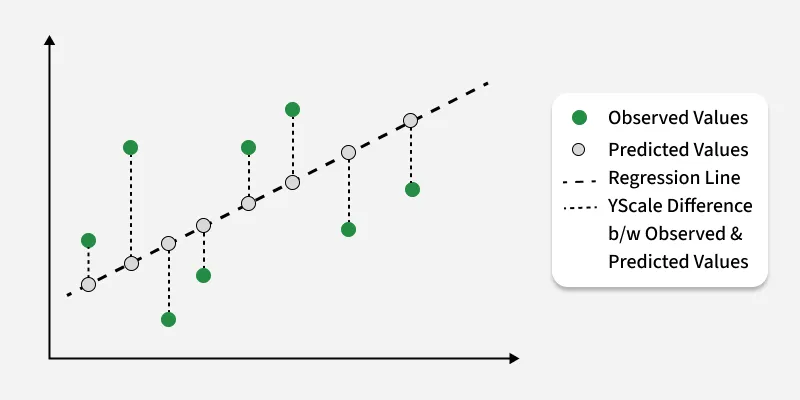
Mean Squared Error (MSE) is a metric used to measure how well a model's predictions match the actual values. It calculates the average of the squared differences between predicted and actual values.
MSE is calculated by taking the average of the squared residuals, where the residual is the difference between the predicted value and the actual value for each data point.
Formula
The formula for the mean squared error is:
Mean Squared Error =
\frac{1}{n}\sum_{i = 1}^{n}(Y_i - \hat Y_i)^2
Where:
- n is the number of observations in the dataset.
- yi is the actual value of the observation.
\hat Y_i is the predicted value of the ith observation.
Example: Suppose we have a dataset consisting of the actual and predicted values for the regression problem
- Actual Values: [10, 20, 30, 40, 50]
- Predicted Values: [12, 18, 32, 38, 48]
Solution:
To calculate MSE we first compute the squared differences between the each actual and predicted value:
Squared Differences: [(10-12)2, (20-18)2, (30-32)2, (40-38)2, (50-48)2]
= [4, 4, 4, 4, 4]Next, we take the average of these squared differences to the obtain the MSE:
MSE = (4 + 4 + 4 + 4 + 4) / 5
= 20 / 5
= 4Therefore, the MSE for this regression model is 4.
Interpretation
The Interpreting MSE involves understanding the magnitude of the error and its implications for the model's performance.
- A lower MSE indicates that the model's predictions are closer to the actual values, signifying better accuracy.
- Conversely, a higher MSE suggests that the model's predictions deviate further from the true value, indicating poorer performance.
Significance
The Mean Squared Error is widely used in various fields, including statistics, machine learning, and econometrics, due to its several important properties:
- It provides the quantitative measure of the accuracy of the predictive models.
- It penalizes large errors more heavily than small errors, making it sensitive to the outliers.
- It is mathematically convenient and easy to interpret, making it a preferred choice for evaluating model performance.
Applications
The Mean Squared Error is extensively used in various applications, including:
- Regression analysis: Assessing the goodness of fit of the regression models.
- Model evaluation: Comparing the performance of the different machine learning algorithms.
- Optimization: Minimizing MSE during the model training to improve predictive accuracy.
- Predictive modeling: Evaluating the accuracy of the regression and forecasting models.
- Image processing: Assessing the quality of the image reconstruction and restoration algorithms.
- Financial modeling: Analyzing the performance of the investment strategies and risk models.
How to Minimize Mean Squared Error in Model Training
To minimize Mean Squared Error during the model training, several strategies can be employed, including:
- Feature selection: Choosing relevant features that contribute most to reducing prediction errors.
- Model selection: Experimenting with the different algorithms and model architectures to identify the best-performing model.
- Hyperparameter tuning: The Optimizing model hyperparameters such as the learning rate, regularization strength, and network depth to improve predictive accuracy.
Root Mean Square Error
The Root Mean Squared Error (RMSE) is a variant of MSE that calculates the square root of the average squared difference between actual and predicted values. It is often preferred over MSE, as it provides an interpretable measure of the error in the same units as the original data. The RMSE formula is
RMSE = √(MSE)
Example: Given the actual and predicted values for the regression problem, calculate the MSE and RMSE.
- Actual Values: [15, 25, 35, 45, 55]
- Predicted Values: [18, 22, 38, 42, 52]
Solution:
The Calculate the squared differences between the actual and predicted values:
Squared Differences: [(15-18)2, (25-22)2, (35-38)2, (45-42)2, (55-52)2]
= [9, 9, 9, 9, 9]Compute the MSE
MSE = (9 + 9 + 9 + 9 + 9) / 5
= 45 / 5
= 9Calculate the RMSE:
RMSE = √(9)
= 3
MSE vs RMSE vs MAE
Mean squared error is often compared with other error metrics, such as the mean absolute error (MAE) and root mean squared error (RMSE), to evaluate model performance.
- While MAE measures the average absolute difference between predicted and actual values,
- RMSE measures the square root of the average squared difference.
- The MSE and RMSE penalize large errors more heavily than MAE, making them more sensitive to the outliers.