

The LCM (Least Common Multiple) of two or more numbers is the smallest number that is divisible by each of the given numbers (we get a remainder of 0 when we divide the LCM by the given numbers).
The LCM of two or more numbers can also be found by taking the highest powers of all their prime factors.
Various methods, such as prime factorization, listing multiples, the division method, and the LCM–GCD formula, are also used to find the LCM.
LCM by Listing Multiples (Listing Method)
In this method, we need to list the multiples of each number until at least one of the multiples appears on all the lists. Then, the LCM is the smallest number that is on all of the lists.
Example: Find the LCM of 6, 7, and 21 by listing multiples.
Solution:
LCM of 6, 7, 21
Multiples of 6 = 6, 12, 18, 24, 30, 36, 42, 48, 54, 60.
Multiples of 7 = 7, 14, 21, 28, 35, 42, 49, 56, 63, 70.
Multiples of 21 = 21, 42, 63, 84, 105, 126, 147, 168, 189, 210.Now, the smallest number that is common in all the lists is 42.
Hence,
LCM(6, 7, 21) = 42
LCM using Prime Factorization Method
In this method, we need to write all numbers as a product of their prime factors. Then, LCM will be the product of the highest powers of all prime numbers.
Steps to find LCM Using Prime Factorization Method
Step 1: Write the prime factors of P and Q.
Step 2: Write all the factors of P and Q in exponent form.
Step 3: Then we find the products of the factors with the highest exponents.
Example: Find the LCM of 15 and 8 using the Prime Factorization Method.
Solution:
To Find LCM of 15, 8
Prime factorization of 15 = 3 × 5
Prime factorization of 8 = 2 × 2 × 2Since, the highest power of 2, 3, and 5 was 23 ,31, and 51, so the lcm will be:
LCM = 23 × 3 × 5 = 120
LCM by Division Method
The division method is the method that is used to find the LCM of two numbers quickly.
Steps to calculate LCM by Division Method:
Step 1: Write the number in a row.
Step 2: Starting from the first prime number write a prime number that is a factor of any of the number.
Step 3: Continue the same pattern and then start increasing to next prime number as required.
Step 4: Continue the step 2 with next prime till we reduce all the numbers to 1.
Step 5: Multiply the divisions. The product gives the LCM of the numbers.
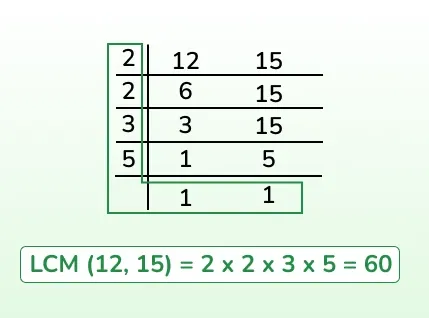
Example: Find the LCM of 12 and 15
Solution:
LCM of 12 and 15 is calculated as,
Thus, LCM of 12 and 15 = 2 × 2 × 3 × 5 = 60
LCM by Cake / Ladder Method
Steps to find LCM using the Cake/Ladder method
Step 1: Write down the numbers in the row.
Start by writing the numbers you want to find the LCM in the topmost row.Step 2: Divide the numbers by a prime number which divides at least two or more of the numbers in the row.
- Write the prime factor to the left of the row.
- Divide each divisible number by this prime factor and write the results in the next row.
- If a number is not divisible by the chosen prime, simply bring it down to the next row unchanged.
Step 3: Continue dividing the row by prime numbers.
Repeat the process with subsequent rows, dividing by prime factors that divide at least two numbers in the row.Step 4: Stop when there are no common factors that can divide two or more numbers in the row.
Example: Find the LCM of 24 and 36 using Cake/Ladder Method.
Solution:
LCM of 24 and 36
\begin{array}{|c|c|c|} \hline 2 & 24 & 36 \\ \hline 2 & 12 & 18 \\ \hline 3 & 6 & 9 \\ \hline & 2 & 3 \\ \hline \end{array} the LCM of 24 and 36 is 2×2×2×3×3 = 72
LCM of Three Numbers
LCM of three numbers can also be found using the same methods mentioned above. We know that LCM or Least Common Multiple is the smallest number that is a multiple of all the given numbers. Suppose we have to find the LCM of A, B, and C, then we should follow the following steps,
Step 1: Find and list some of the multiples of the given three numbers A, B, and C.
Step 2: Observe the multiples of A, B, and C to find the lowest common multiple among them.
Step 3: Now the smallest common multiple of these A, B, and C is the LCM of A, B, and C.
Example: Find the LCM of 3, 4, and 6.
Solution:
List the multiple of3, 4 and 6
• Multiples of 3 = 3, 6, 9, 12, 15, ...
• Multiples of 6 = 6, 12, 18, 24, 30, ...
• Multiples of 4 = 4, 8, 12, 16, 20, ...The least common multiple of 3, 4 and 6, is 12
Thus, the LCM of 3, 4 and 6 is 12.
➢Practice: Solved Examples