

Multiplication is an arithmetic operation that involves two or more numbers to produce a third number called the product. The numbers that are multiplied are called the factors.
It is a fundamental operation in mathematics, often described as repetitive addition. This means multiplication allows us to perform addition multiple times in a more efficient way.
As seen in the examples above, multiplication is essentially adding a number multiple times; it provides a shortcut for performing repeated addition. For example:
Simplify: 5 + 5 + 5 + 5 + 5
5 + 5 + 5 + 5 + 5 = 5 × 5 = 25
Similarly, when multiplying 2 × 4, you can think of it as adding 2 four times: (2 + 2 + 2 + 2), and you will get your answer.
We can also see the following illustration for the repetitive addition of 3 up to 9 times.

For single-digit numbers, we can use the multiplication table. For larger numbers, we use methods such as multiplication with regrouping and multiplication without regrouping. Which we will be discussing below.
Real Life Uses of Multiplication
We use multiplication when the same thing is repeated. For example, monthly salary is repeated for 12 months and we compute annual salary by multiplying with 12.
There are many aspects of daily life where we use multiplication. Some such scenarios are:
- Cooking and Baking: Adjusting ingredient quantities in recipes. For instance, if a recipe for 4 servings calls for 2 cups of flour, making it for 8 servings requires 2 × 2 = 4 cups.
- Budgeting: Calculating total expenses for multiple items. If you buy 3 shirts at $20 each, the total cost is 3 × 20 = 60.
- Shopping Discounts: Determining savings from percentage discounts. If an item costs $50 with a 20% discount, the savings are 50 × 0.20 = 10, making the final price 50 − 10 = 40.
- Travel: Calculating distance based on speed and time. If a car travels 60 miles per hour for 3 hours, the distance covered is 60 × 3 = 180 miles.
- Construction: Finding areas of space, like gardens. A rectangular garden measuring 10 feet by 15 feet has an area of 10 × 15 = 150 square feet.
Parts of Multiplication
There are various parts of multiplication.
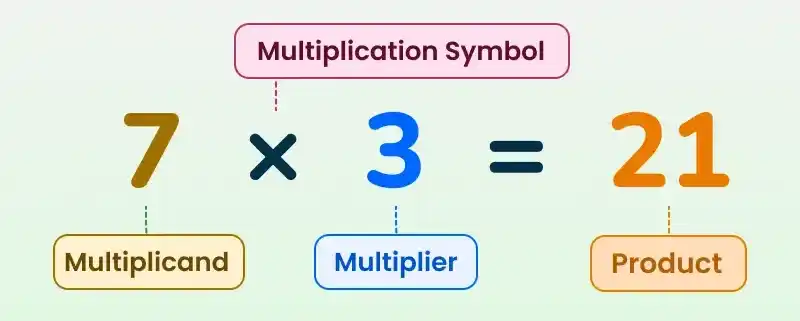
- Multiplicand: In a multiplication operation, the first numbers that is multiplied is called the multiplicand. For example in the multiplication of 11 and 3, (11 × 3), 11 is multiplicand.
- Multiplier: In multiplication operation, the second numbers that is multiplied is called the multiplier. For example in the multiplication of 11 and 3, (11 × 3), 3 is multiplier.
- Product: In multiplication operation, the final result after multiplying multiplicand and multiplier is called product. For example in the multiplication of 11 and 3, (11 × 3 = 33) 33 is product.
How to Perform Multiplication of Numbers?
To solve multiplication problems, we have various methods, and some of the methods used to solve multiplication problems are,
1. Multiplication without Regrouping
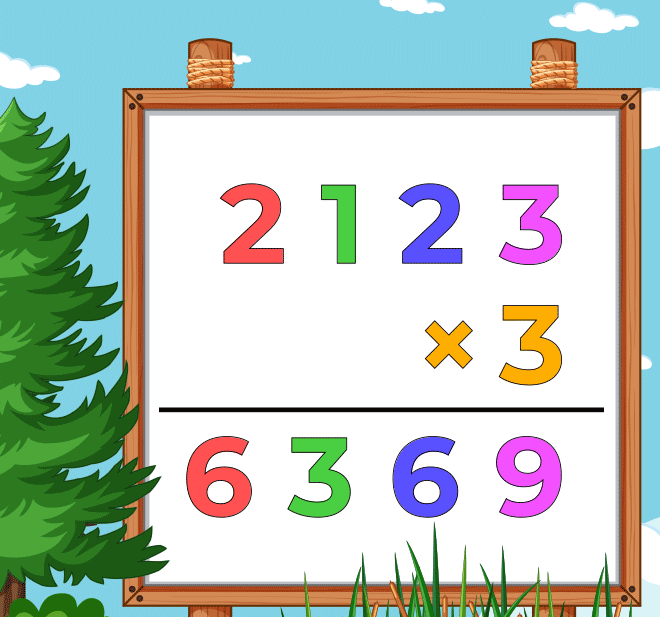
Multiplication without regrouping is a straightforward process used when multiplying numbers whose individual digit products do not exceed 9, meaning no carrying is needed.
Each digit in one number is multiplied directly by each digit in the other, column by column, and the results are written in their respective places without any additional steps for carrying over.
The image added below shows the multiplication without regrouping. Here, we multiply 2123 by 3 to get the answer as 6369.
2. Multiplication with Regrouping
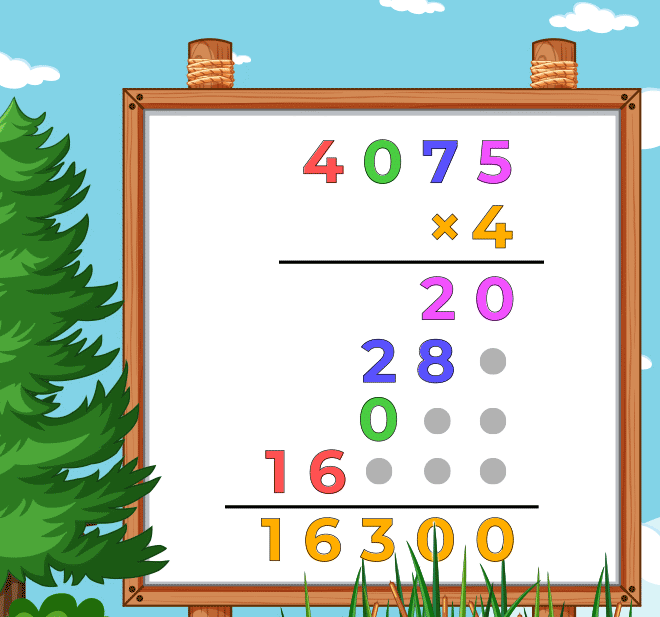
We multiply two number by regrouping numbers using the concept of the carry. This is explained by the example added below.
Example: Multiply 4075 and 4.
Solution:
To multiply 4075 by 4 using carrying, multiply each digit by 4 from right to left. Start with 4 × 5 = 20; write 0 and carry 2. Next, 4 × 7 = 28, add the carry to get 30; write 0 and carry 3. Continue this process with each digit to get the final product.
Here, this is explained as,
- 5 × 4 = 20 (2 Carry)
- 7 × 4 = 28 + 2(carry value) = 30 (3 Carry)
- 0 × 4 = 0 + 3(carry value) = 3
- 4 × 4 = 16 (No Carry as Last Number)
Thus, we can multiply two numbers by regrouping them.
3. Multiplication On the Number Line
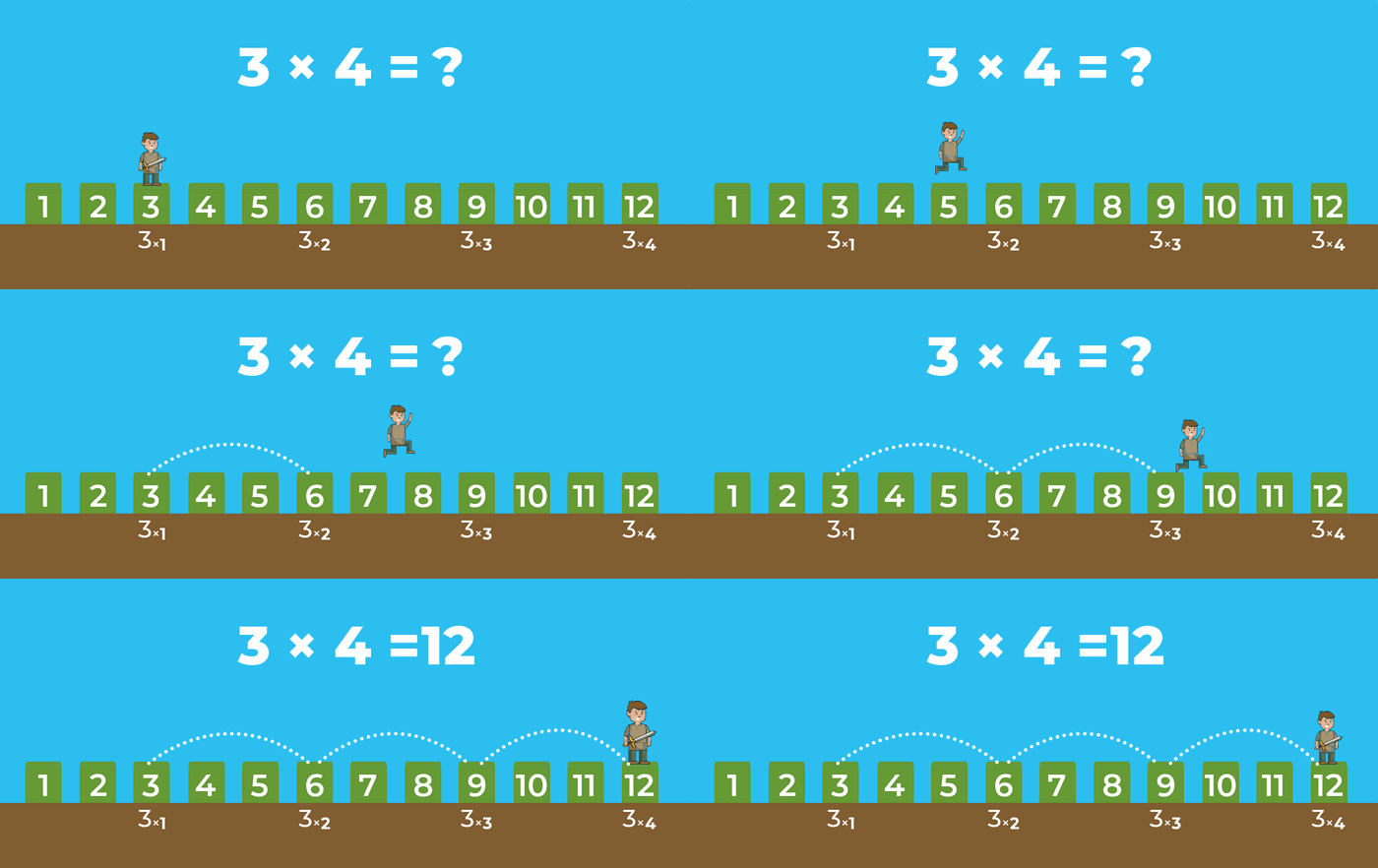
A Number line can be used for multiplication by marking the starting point as 0 and making jumps equal to one factor, repeated as many times as the other factor.
For example, to find the product of 3 and 4, start at 0 and take four jumps of 3; you land on 12, which is the product of 3 and 4. The same is explained in the image added below.
Note: But for large numbers, finding multiplication using a number line is not convenient.
This table is a basic tool for learning and practicing multiplication, commonly used in elementary mathematics education.
Multiplication of Integers
Multiplication for two integers is the same as normal multiplication, but the sign of the result depends on the Multiplicand and Multiplier. The following table can be used to find the sign of the product of any two integers.
Rules | |
|---|---|
Multiplication Rule | Examples |
(-) × (-) = (+) | (-3) × (-5) = 15 |
(-) × (+) = (-) | (-3) × (5) = -15 |
(+) × (+) = (+) | 3 × 5 = 15 |
(+) × (-) = (-) | 3 × (-5) = -15 |
Multiplication of 2 Digits
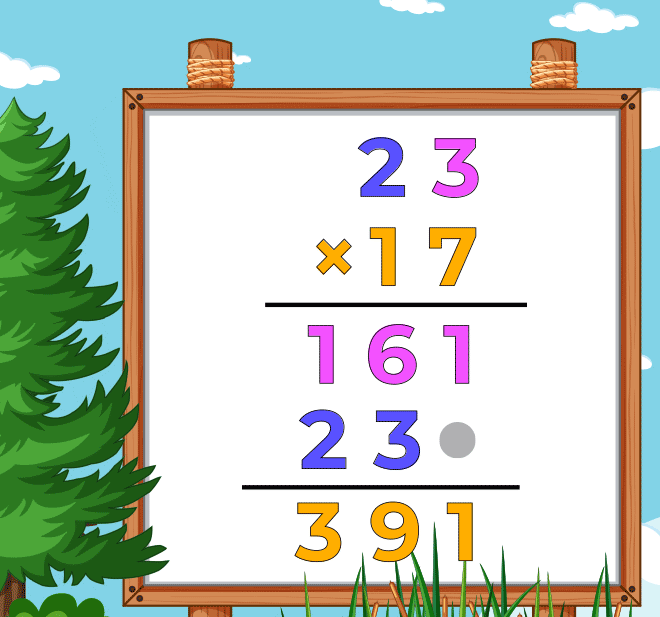
Multiplication of two-digit numbers can be easily achieved by the following steps:
Step 1: Multiply the ones digit of the bottom number by the entire top number.
Step 2: Multiply the tens digit of the bottom number by the entire top number, shifting the result one position to the left.
Step 3: Combine the two products to obtain the final result.
Multiplication of 3 Digits
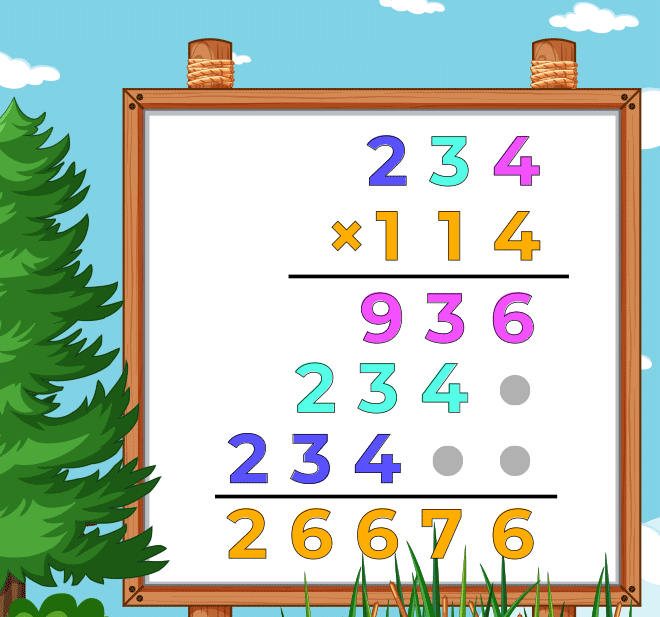
Multiplication of three-digit numbers can be easily achieved using the following steps:
Step 1: Write the numbers vertically.
Step 2: Multiply the bottom units digit by the top number and write the result below.
Step 3: Multiply the bottom tens digit by the top number, shifting the result one position to the left.
Step 4: Multiply the bottom hundreds digit by the top number, shifting the result two positions to the left.
Step 5: Add all the results together for the final product.
➢Practice: Solved Examples