

A negative exponent is an exponent with a negative value. It indicates that the base should be written as its reciprocal with a positive exponent.

Example: Simplify
- 2-3
- (2/3)-3
Solution:
Example 1:
3^{-2} = \frac{1}{3^2} = \frac{1}{(3 \times 3)}
= \frac{1}{9} = 0.111\ldots Example 2:
\left(\frac{3}{5}\right)^{-2} = \left(\frac{5}{3}\right)^2
= \left(\frac{5}{3}\right)^2= \frac{5^2}{3^2} = \frac{25}{9} \approx 2.78
Negative Exponent Rules
There are two basic rules for simplifying negative exponents.
Rule 1: Negative Exponent in the Numerator
A negative exponent can be converted into a positive exponent by taking the reciprocal of the base.
a(-n) = 1/a × 1/a × ... n times = 1/an
Rule 2: Negative Exponent in the Denominator
A negative exponent in the denominator can be moved to the numerator by changing its exponent to positive.
1/a(-n) = a × a × ... .n times = an
The negative exponent's rule can be easily understood with the example discussed in the image below,

These rules can be easily understood by the example discussed below,
Example: Simplify 3-3 × 1/(4-2)
Solution:
Using the above rule for solving negative exponents,
a-n = 1/an and 1/a(-n) = an
3-3 = 1/33
= 1/27
1/(4-2) = 42
= 16
Now, 3-3 × 1/(4-2)
= 1/27 × 16
= 16/27
Negative Fraction Exponents
A negative fractional exponent represents the reciprocal of a root.
Simplify:
Solution:
125^{-\frac{1}{3}}
= \frac{1}{\sqrt[3]{125}} = \frac{1}{5}
Multiplying Negative Exponents
Negative exponents follow the same multiplication and division rules as positive exponents.
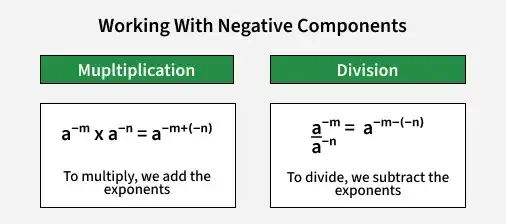
- Multiplication Rule: When multiplying powers with the same base, add their exponents.
- Division Rule: When dividing powers with the same base, subtract the denominator's exponent from the numerator's exponent.
Simplify:
- 2⁻³ × 2⁻²
- 3⁻² ÷ 3⁻⁴
Solution:
Example 1: (Formula used: aᵐ × aⁿ = aᵐ⁺ⁿ)
2-3 + (-2)
= 2⁻⁵
= 1/2⁵
= 1/32Example 2: (Formula used: aᵐ ÷ aⁿ = aᵐ⁻ⁿ)
3-2-(-4)
= 3²
= 9