

Here are some interesting facts about Perfect Squares or Square Numbers.
- If the original number is even, the perfect square will also be even. Similarly, if the number is odd, the perfect square is odd. For example 16 is even because 4 is even and 9 is odd because 3 is odd. Below are some perfect squares for your reference.
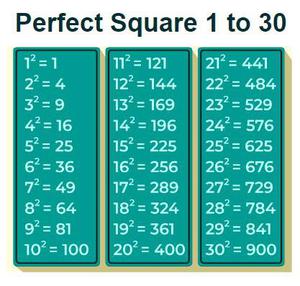
- Perfect Squares are the only numbers that have odd number of distinct divisors. For example, 9 has divisors as 1, 3 and 9. 4 has divisors as 1, 2 and 4. For all other numbers, divisors appear in pair, so the total number of divisors is always even for other numbers.
- The difference between consecutive perfect squares is always an odd number.
(n + 1)^2 - n^2 = 2n + 1 which is always an odd number, and the pattern of these odd numbers is 1 - 0 = 1, 4 - 1 = 3, 9 - 4 = 5, 16 - 9 = 7, 25 - 16 = 9, and so on. - Every Perfect Square n2 can be obtained by adding first n consecutive odd numbers starting from 1 to n
1 = 1
1 + 3 = 4
1 + 3 + 5 = 9
1 + 3 + 5 + 7 = 16
............................
How does this work?
1 + 3 + 5 + … (2n-1) =
\sum_{i = 1}^{n} (2 \times i - 1)
=2 \times \sum_{i=1}^{n}(i) - \sum_{i=1}^{n}(1)
= 2n(n+1)/2 – n [As we know,\sum_{i=1}^{n}(i) = \frac{n(n + 1)}{2} ]
= n(n+1) – n
= n2
- The sum of two consecutive Triangular Numbers is always a perfect square. The nth triangular number is sum of first n natural numbers. For example 1 + 3 = 4, 3 + 6 = 9.
We can simply prove it by taking sum of sum of nth and (n+1)th
which is n x (n + 1)/2 + (n + 1) (n + 2)/2 = (n + 1)/2 [ n + n + 2] = (n + 1)2 - As per Lagrange’s four square theorem, every natural number can be written as sum of squares of four non-negative integers. For example, 7 can be written as 1 + 1 + 4 + 1.
- The number of trailing 0s in a perfect square is always even. For example, 100 and 10000. The reason is simple, if there is a 0 in square root, then it would result in two 0's in the square.
- A perfect square always ends in one of these digits: 0, 1, 4, 5, 6, or 9. It will never end in 2, 3, 7, or 8.
Read More,