
An integer that can be written as the product of two equal integers is called a perfect square. For example, 36 is a perfect square because it is the product of 6 ⨉ 6. In other words, a perfect square is n raised to the power 2, where n is an integer.
A perfect square can also be visualized in real life through square-shaped objects like these
Other examples of perfect square:
- 9 is a perfect square as we can write it as 3 x 3
- 16 is a perfect square as we can write it as 4 x 4
18 is NOT a perfect square as we cannot write as x2 for an integer x
Properties of Perfect Squares
Perfect squares have unique characteristics that differentiate them from other numbers.
- Perfect Squares are the only numbers that have odd number of distinct divisors. For example, 9 has divisors as 1, 3, and 9. 4 has divisors as 1, 2 and 4. For all other numbers, divisors appear in pair, so the total number of divisors is always even for other numbers.
- A perfect square always ends in one of these digits: 0, 1, 4, 5, 6, or 9. It will never end in 2, 3, 7, or 8.
- Consecutive perfect squares increase by odd numbers pattern of differences is: 1, 3, 5, 7, 9, …
Please refer Perfect Square Interesting Facts for details.
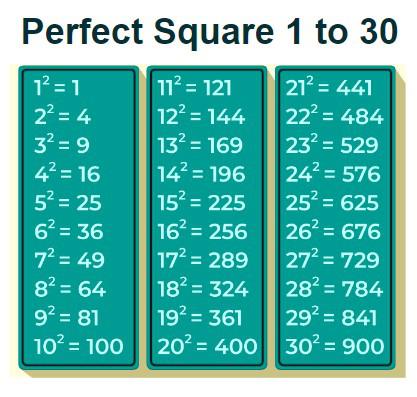
Perfect Squares of 1 to 30
Chart for Perfect Square from 1 to 30 is added below as:
Perfect Square Formula
The formula for a perfect square is expressed as n2, where 'n' is a whole number. In this formula, n is multiplied by itself, resulting in a perfect square. For example, if n is 3, the perfect square is 32, which equals 9.
Other formulas used for perfect square are,
- n2 − (n − 1)2 = 2n − 1
- n2 = (n − 1)2 + (n − 1) + n
Algebraic Identities as perfect squares:
- a2 + 2ab + b2 = (a + b)2
- a2 – 2ab + b2 = (a – b)2
Tips and Tricks to Identify Perfect Square Numbers
Identifying perfect square numbers can be simplified with some handy tips and tricks. These methods can help you quickly determine whether a number is a perfect square, even without a calculator.
1. Check the Last Digit
Perfect squares end in specific digits: Perfect square numbers always end in 0, 1, 4, 5, 6, or 9. If a number ends in 2, 3, 7, or 8, it cannot be a perfect square. This is a quick way to eliminate many numbers from consideration.
2. Find Perfect Squares by Adding Odd Numbers
Sum of Odd Numbers: Addition of first n odd numbers is always perfect square. For example 1 + 3 = 4, 1 + 3 + 5 = 9,
1 + 3 + 5 + 7 = 16 1 + 3 + 5 + 7 + 9 + 11 = 36 ...
This pattern shows that the sum of the first (n) odd numbers is always a perfect square equal to (n^2). This is a useful trick for quickly identifying perfect squares, especially when dealing with smaller numbers.
Check here the explanation and proof of above approach.
3. Approximate the Square Root
Estimating the Square Root: You can estimate the square root of a number and check if the result is an integer. If the square root of a number is an integer, then the number is a perfect square. For example, the square root of 49 is 7, which confirms that 49 is a perfect square.
4. Identify the Number of Zeros
Even Number of Zeros: If a number has an even number of zeros at the end, it might be a perfect square. For instance, 100 (which is (10^2)) and 400 (which is (20^2)) have even numbers of zeros and are perfect squares. A number like 1000, with an odd number of zeros, cannot be a perfect square.
5. Apply Factorization
Prime Factorization: If a number's prime factors all have even exponents, then it is a perfect square. For example, the prime factorization of 36 is (2^2 times 3^2), where both exponents are even, confirming that 36 is a perfect square.
6. Use Special Number Patterns
Square of a Number Ending in 5: To find square of a number ending in 5, multiply the digit before 5 with next digit and append 25. For example, 752= 7×8(25) = 5625
Square of Numbers Close to 100: For numbers close to 100, express the square as (100 - x)2= 1002 - 200x + x2. This simplifies calculations, especially for mentally calculating squares.
Odd Number Squares: Square of any odd number is an odd number. If n is an odd number, then n2 is odd.
Even Number Squares: Square of any even number is an even number. If m is an even number, then m2 is even.
Difference of Squares: Use difference of squares formula, a2− b2= (a+b)(a−b). This can help in factoring or simplifying expressions.
Square of a Sum: (a+b)2 = a2 + 2ab + b2
Square of a Difference: (a−b)2 = a2 − 2ab + b2
7. Consider Modulo Properties
Modulo 4 and 3 Properties: A perfect square, when divided by 4, leaves a remainder of 0 or 1. Similarly, when divided by 3, a perfect square leaves a remainder of 0 or 1. These properties help to quickly determine whether a number could be a perfect square.
8. Use the Digital Root Method
Digital Root of Perfect Squares: The digital root of a perfect square is always 1, 4, 7, or 9. The digital root is found by summing all the digits of the number repeatedly until a single-digit number is obtained. For example, the digital root of 81 is 9 (since (8 + 1 = 9)), which is one of the valid digital roots for a perfect square.
Related Articles:
Perfect Square Solved Examples
Example 1: Identify the first two perfect squares.
Solution:
First two perfect squares are obtained by squaring the first two whole numbers:
- 12=1 (Square of 1 is 1)
- 22= 42 (Square of 2 is 4)
Therefore, first two perfect squares are 1 and 4.
Example 2: If a number is a perfect square and its square root is 9, what is the number?
Solution:
If a number is a perfect square and its square root is 9, we can find the number by squaring the square root:
92 = 81
So, required number is 81, as it is a perfect square, and its square root is 9.
Example 3: If a number is a perfect square and its square root is a prime number, find the number.
Solution:
Take the prime number 5. The square of 5 is 25 (52=25). Here, 25 is a perfect square, and 5 is a prime number.
So, the number we're looking for is 25, where the square root (5) is a prime number
Practice Questions on Perfect Square
Some questions on perfect square are:
Question 1: Find the square of 5.
Question 2: Is 36 a perfect square?
Question 3:. Determine the square root of 49.
Question 4: Write next two perfect squares after 16.
Question 5: Identify the perfect square closest to 150.