
Geometry is a branch of mathematics that studies shapes, sizes, and the properties of figures.
- It focuses on understanding how points, lines, angles, and surfaces relate to each other.
- Helps in solving problems systematically.
- Widely applied in real-world fields like design, construction, and engineering.
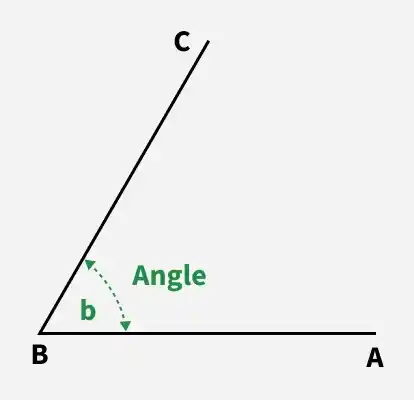
Example: An angle is formed when two rays meet at a common point (called the vertex); this is a precise definition used in geometry.
Basic Elements of Geometry
To understand geometry theorems, we first need to know the basic elements of geometry, such as points, lines, rays, and line segments.
- Point: A point is the smallest figure in geometry with no size or area.
- Line: A line is a straight path that extends infinitely in both directions.
- Ray: A ray is a part of a line that starts at one point and extends infinitely in one direction.
- Line Segment: A line segment is a part of a line that has two endpoints.
Pair of Lines and Angles

A pair of lines refers to two lines considered together in a plane, which may intersect, be parallel, or form different angles depending on their position.

1. Angle: It is formed when two rays meet at a common point.
2. Linear Pair: It is formed when two adjacent angles lie on a straight line and sum to 180°.
3. Parallel Lines: Parallel lines are lines that never meet and remain at a constant distance from each other.
4. Vertically Opposite Angles: When two lines intersect, the opposite angles formed are equal.
Postulates
Postulates are basic statements in geometry that are accepted as true without proof. They form the foundation for understanding and proving other concepts. For example, through any two points, exactly one straight line can be drawn.
Here are some examples of common postulates in geometry:
- Postulate 1: A straight line can be drawn from any one point to any other point.
- Postulate 2: A circle can be drawn with any center and any radius.
- Postulate 3: All right angles are equal to each other.
Key Postulates in Geometry
Some of the important postulates in geometry are
1. Euclid's Postulates
Euclid, a Greek mathematician, stated five simple postulates that form the foundation of geometry. These basic truths are accepted without proof and are used to develop further concepts:
- A straight line can be drawn joining any two points.
- A line segment can be extended indefinitely in a straight line.
- A circle can be drawn with any given center and radius.
- All right angles are equal.
- If a straight line intersects two lines and the interior angles on the same side are less than 180°, the two lines will meet on that side when extended.
2. Parallel Postulate
The Parallel Postulate is one of Euclid’s postulates, but it is so important that it is often stated separately. It explains the conditions under which two lines will intersect or remain parallel:
- If a straight line intersects two other lines, it forms interior angles on the same side.
- If the sum of these interior angles is less than 180°, the two lines will meet on that side when extended.
- If the sum is equal to 180°, the two lines remain parallel and do not intersect.
3. Postulates of Congruence
The postulates of congruence help us determine when two shapes are congruent, meaning they have the same size and shape. These postulates provide conditions to prove triangle congruence:
- Side–Side–Side (SSS) Postulate: If the three sides of one triangle are equal to the three sides of another triangle, then the triangles are congruent.
- Side–Angle–Side (SAS) Postulate: If two sides and the included angle of one triangle are equal to the corresponding two sides and included angle of another triangle, then the triangles are congruent.
Theorems in Geometry
Theorems are statements in geometry that are proven true using definitions, postulates, and previously known results.

These theorems describe important relationships between angles, lines, and shapes and are used to solve various geometric problems.
Fundamental Theorems in Geometry
Some of the fundamental theorems in geometry are:
1. Pythagorean Theorem
The Pythagorean Theorem is a fundamental result in geometry that applies to right-angled triangles. It states that the square of the hypotenuse (the side opposite the right angle) is equal to the sum of the squares of the other two sides.
This relationship is expressed as
a^2 + b^2 = c^2 Where, c is the hypotenuse, and a and b are the other two sides.
2. Theorems on Congruence and Similarity
The theorems on congruence and similarity help determine when two triangles have the same shape or the same shape and size:
- Angle–Angle (AA) Theorem: If two angles of one triangle are equal to two angles of another triangle, then the triangles are similar.
- Side–Angle–Side (SAS) Theorem for Similarity: If two sides of one triangle are proportional to two sides of another triangle and the included angles are equal, then the triangles are similar
3. Theorems on Angles and Triangles
These theorems explain important relationships between angles formed by lines and triangles:
- Vertical Angles Theorem: Vertically opposite angles formed by two intersecting lines are equal.
- Alternate Interior Angles Theorem: When two parallel lines are intersected by a transversal, the alternate interior angles are equal.

- Sum of Angles in a Triangle Theorem: The sum of the interior angles of a triangle is always 180°.

- Exterior Angle Theorem: The measure of an exterior angle of a triangle is equal to the sum of its two non-adjacent interior angles.
Solved Examples
Example 1: Use the Pythagorean Theorem to find the length of the hypotenuse in a right-angled triangle with sides of length 3 cm and 4 cm.
Solution:
Using the Pythagorean Theorem:
c^2 = 3^2 + 4^2
c^2 = 9 + 16
c^2 = 25
c = \sqrt{25} \text{ cm}
c = 5 cm
Example 2: Prove that the sum of the angles in a triangle is 180 degrees using the Exterior Angle Theorem.
Solution:
According to the Exterior Angle Theorem, the exterior angle is equal to the sum of the two opposite interior angles. Since the exterior angle and its adjacent interior angle form a linear pair (which adds up to 180 degrees), the sum of the angles in a triangle must also be 180 degrees.
Practice Problems
Problems 1. Use the Pythagorean Theorem to find the length of the third side of a right-angled triangle where the hypotenuse is 10 cm, and one side is 6 cm.
Problems 2. Prove that two triangles are congruent using the Side-Angle-Side (SAS) Postulate.
Problems 3. Find the missing angle in a triangle if two of its angles are 50 degrees and 60 degrees.