
Probability is a branch of mathematics that deals with the chance or likelihood of a random event occurring. In statistics, joint probability is a measure that tells us the likelihood of two events happening together at the same time, along with marginal and conditional probabilities.
Joint Probability
Joint probability is the probability of two (or more) events happening simultaneously. It is denoted as P(A∩B) for two events A and B, which reads as the probability of both A and B occurring.
For two events A and B, the joint probability is defined as:
P(A \cap B) = P(\text{both } A \text{ and } B \text{ occur})
Note: If A and B are dependent, the joint probability is calculated using conditional probability
Example: Two fair dice are rolled at the same time. Find the probability that the first die shows 3 and the second die shows 5.

Solution:
The joint probability P(A∩B) is the probability that the first die shows 3 and the second die shows 5.
Since the two dice are independent,
P(A∩B) = P(A)×P(B).
Here, P(A) = 1/6 and P(B) = 1/6.
So,
P(A \cap B) = \frac{1}{6} \times \frac{1}{6} = \frac{1}{36}.
Marginal Probability
Marginal probability is the probability of an event occurring without considering other variables. It is found by adding up the joint probabilities of that event over all possible values of the other variables.
For two events A and B, the marginal probability of event A is defined as:
P(A) = \sum_{B} P(A, B)
Where P(A, B) is the joint probability of both events A and B occurring together. If the variables are continuous, the summation is replaced by integration:
P(A) = \int_{B} P(A, B) \, dB
Example: Consider a table showing the joint probability distribution of two discrete random variables X and Y:
X/Y | Y = 1 | Y = 2 |
|---|---|---|
X = 1 | 0.1 | 0.2 |
X = 2 | 0.3 | 0.4 |
To find the marginal probability of X = 1:
P(X = 1) = P(X = 1, Y = 1) + P(X = 1, Y = 2) = 0.1 + 0.2 = 0.3
Read More about Marginal Distribution.
Conditional Probability
Conditional probability is the probability of an event happening when another event has already occurred. It helps us adjust our prediction of an event using the information we already know.
The conditional probability of event A given event B is denoted as P(A∣B) and is defined by the formula:
P(A|B) = \frac{P(A \cap B)}{P(B)}
Where:
- P(A∩B) is the joint probability of both events A and B occurring.
- P(B) is the probability of event B occurring.
Example: Suppose a card is drawn at random from a standard deck of 52 playing cards. Find the probability of drawing an Ace given that the card drawn is red.
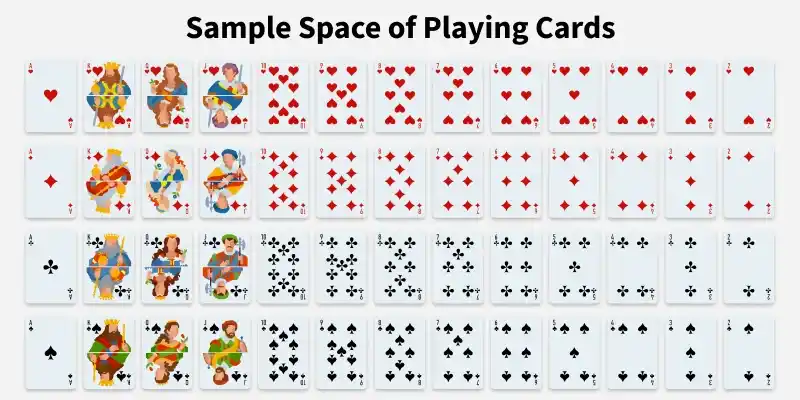
Solution:
Let A be the event of drawing an Ace and B be the event of drawing a red card.
In a standard deck of 52 cards, there are 26 red cards. Out of these, 2 are red Aces (Ace of Hearts and Ace of Diamonds).
The required probability is:
P(A|B) = P(A ∩ B) / P(B)
Here,
P(A ∩ B) = 2/52 and P(B) = 26/52So,
P(A|B) = (2/52) / (26/52) = 2/26 = 1/13.