

Properties of integers are the fundamental rules that define how integers behave under various operations such as addition, subtraction, multiplication, and division.
- Integers include natural numbers, 0, and negative numbers.
- Integers are a subset of rational numbers, where the denominator is always 1 for integers. Therefore, many of the properties that hold for rational numbers also hold true for integers.
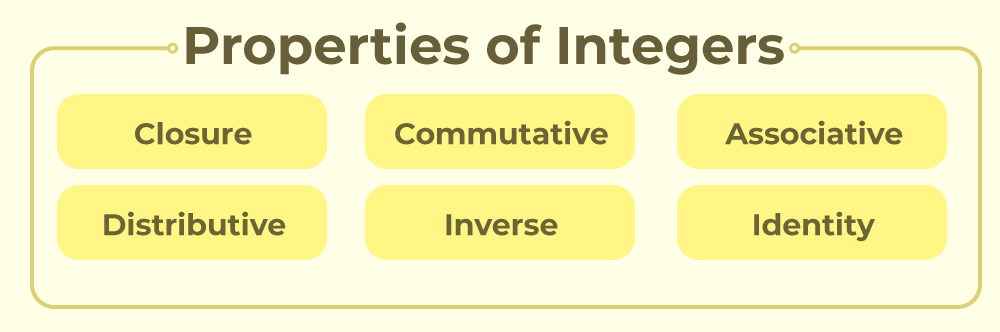
The following table covers all the properties in brief:
Property | Addition | Subtraction | Multiplication | Division |
|---|---|---|---|---|
Closure | a + b ∈ Z | a - b ∈ Z | a × b ∈ Z | a ÷ b ∈ Z |
Commutative | a + b = b + a | a - b ≠ b - a | a × b = b × a | a ÷ b ≠ b ÷ a |
Associative | (a + b) + c = a + (b + c) | (a - b) - c ≠ a - (b - c) | (a × b) × c = a × (b × c) | (a ÷ b) ÷ c ≠ a ÷ (b ÷ c) |
Distributive | a × (b + c) = a × b + a × c | a × (b - c) = a × b - a× c | - | - |
Identity | a + 0 = 0 + a = a | - | 1 × a = a × 1 = a | - |
Inverse | a + a-1 = a-1 + a = 0 | - | a-1 × a = a × a-1 = 1 | - |
Closure Property
Two integers added together, subtracted from one another, or multiplied together always produce an integer.
- x + y = z
- x - y = z
- x × y = z
So, if x and y ∈ Z, then z ∈ Z.
Note: Since the result of dividing two integers may occasionally not be an integer, the closure property of integers does not apply to the division of integers. For instance, we know that the numbers 3 and 5 are integers, but the result of 3 /5 is 0.60, which is not an integer.
The division of integers falls outside the scope of the closure property. It applies to addition, subtraction, and multiplication of integers.
Let's examine some of the examples of the integer closure attribute that are provided below:
- -10+ 7 = -3, where {-10, -3, 7} ∈ Z.
- -10- (-8) = -2, where {-10, -8, -2} ∈ Z.
- -7 × 1 = -7, where {-7, 1} ∈ Z.
Associative Property
Integers under addition and multiplication states that no matter how the integers are grouped, the outcome of addition and multiplication of more than two integers is always the same. This suggests that we have, for any three integers x, y, and z.
- x + (y + z) = (x + y) + z = (x + z) + y
- x × (y × z) = (x × y) × z = (x × z) × y
Note: Since the order of the numbers is crucial in subtraction and division and cannot be modified, the associative feature of integers does not apply to these operations.
For example, 3 - (8 - 9) = 3 - (-1) = 4. Now, if we change the order to 8 - (3 - 9) = 8 - (-6) = 14. Therefore, 3 - (8 - 9) ≠ 8 - (3 - 9).
Example: Mention which operation satisfies the associative property.
Solution:
- Addition: Satisfy the associative property.
- Subtraction: Do not satisfy the associative property.
- Multiplication: Satisfy the associative property.
- Division: Do not satisfy the associative property.
Commutative Property
The only distinction between the commutative and associative properties of integers is that only two integers are used in the former. According to the commutative property of integers under addition and multiplication, the outcome of adding and multiplying two integers is always the same, regardless of the sequence in which they are added.
This implies, if there are two integers x and y, we have,
- x + y = y + x
- x × y = y × x
Note: This property does not hold true with subtraction and division operations.
Example: Which operation performing with 2 and 5 holds true for a commutative property? Explain with an example.
Solution:
| Operation | Calculation | Result |
|---|---|---|
| Addition | 2 + 5 = 5 + 2 = 7 | Verify Commutative property |
| Subtraction | 2 - 5 ≠ 5 -2 | Not Verify Commutative property |
| Multiplication | 2 × 5 = 5 × 2 = 10 | Verify Commutative property |
| Division | 2/5 ≠ 5/2 | Not Verify Commutative property |
Distributive Property
According to the distributive property of integers, calculations can be made simpler by distributing the multiplication operation over addition and subtraction. This implies that we have for any three integers, x, y, and z.
- x × (y + z) = (x × y) + (x × z)
- x × (y - z) = (x × y) - (x × z)
For example, what is the value of -5 × 98? This can be written as -5 × (100 - 2). Now by applying the distributive property of integers on this to get (-5 × 100) - (-5 × 2) = -500 - (-10) = - 600 + 10 = -590.
Identity Property
The outcome of adding any number to 0 is the same number. For example, if 'a' is any number, then a + 0 = 0 + a = a .
Let's use the negative integer -3 as an example. The result of adding 0 to -3 is -3. The outcome remains unchanged. Therefore, we can state that 0 is the identical element of an integer addition.
Also if 1 is multiplied with an integer, it would result in the same integer. So, 1 is the multiplicative identity element for integers. Any integer can be multiplied by 1 to obtain the same result. As an illustration, a ×1 = 1× a = a.
Note: Integers' identity property does not apply to division and subtraction operations. If we subtract any integer from 0 in the case of subtraction, we shall obtain that number's additive inverse. Since 'a' can be any integer, a - 0 = a, while 0 - a = -a. If 'm' is any integer, then m / 1 = m in the case of division of integers, but 1/ m not equal to m. As a result, there is no identity element for integer division and subtraction.
Inverse Property
Inverse property of integer is the property in which the by performing the inverse operation we get the inverse of the integer. It is valid for only Addition and Multiplication operation but not for subtraction and division.
Two integers whose sum is zero are called additive inverse of each other. By reversing the integer's sign, one can derive the additive inverse of an integer. For instance, the additive inverse of a number +5 is -5 and a number -3 is +3.
Example: Find the additive inverse of 56.
Solution:
To find the additive inverse of a number we need to reverse its sign
So, additive inverse of 56 is -56.
Two integers whose product is one are called multiplicative inverses of each other. Thus, the multiplicative inverse of any negative number is its reciprocal.
For example, (-3) × (-1/3) = 1, therefore, the multiplicative inverse of -3 is -1/3.
➢Practice: Solved Examples