

A Real Number is any number that can be placed on a continuous number line, including natural numbers, integers, fractions, decimals, and irrational numbers like √2 and π, essentially every number that isn't an imaginary number.
Closure Property
The closure property of Real Numbers states that when you add, subtract, or multiply any two real numbers, the result is always a real number too.
For any two real numbers a and b:
- Addition: a + b ∈ ℝ
- Subtraction: a-b ∈ ℝ
- Multiplication: a × b ∈ ℝ
Closure Property for Addition
2 + 5 = 7 and √2 + 5√2 = 6√2
Where, 2 and 5 (both real numbers) added to get 7(real number) and √2 and 5√2(both real numbers) to get 6√2 (real number).
Closure Property for Subtraction
10 - 4 = 6 and 5√3 - √3 = 4√3
Where 10 and 4 (both real numbers) are subtracted to get 6 (real number), and 5√3 - √3 are subtracted to get 4√3 (real number).
Closure Property for Multiplication
6× 5 = 30 and √3 ×2√5 = 2√(15)
Where, 6 and 5 (both real numbers) multiply together to get 30(real number) and √3 & 2√5 (both real numbers) are multiplied together to get 2√(15)(real number).
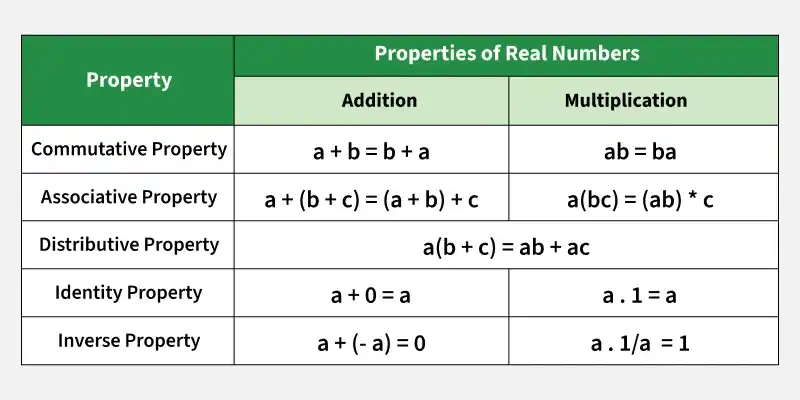
Commutative Property
The order in which you add or multiply two real numbers does not affect the result. Swapping the numbers around gives the same answer.
This property is only valid for addition and multiplication not for subtraction and division.
For addition a + b = b + a
Example: If we add 6 to 2 or add 2 to 6 results will be the same i.e.,
6 + 2 = 8 = 2 + 6
For multiplication a × b = b × a
Example: If we multiply both the real number (6 and 5) the results will be same i.e.,
6 × 5 = 30 = 5 × 6
Where, a and b are any two real numbers.
Associative Property
When adding or multiplying three or more real numbers, changing the grouping does not change the result. That is, rearranging the numbers in such a manner that only the grouping changes, not the order of the numbers.
For addition (a + b) + c = a + (b + c)
Example: Grouping 4, 5 and 6 differently gives the same sum:
(4 + 5) + 6 = 15 = 4 + (5 + 6)
For multiplication (a × b) × c = a × (b × c)
Example: Grouping 2, 5 and 6 differently gives the same product:
(2 × 5) × 6 = 60 = 2 × (5 × 6)
Where a, b, and c are any three real numbers.
Distributive Property
This property helps us to simplify the multiplication of a number as it allows you to multiply a number by each term inside a bracket separately, instead of solving the bracket first.
Over Addition: a × (b + c) = a × b + a × c
Example: 4 × (5 + 6)
4 × 5 + 4 × 6 = 44 = 4 × 11
Over Subtraction: a × (b − c) = a × b − a × c
Example: 4 × (6 − 2)
4 × 6 − 4 × 2 = 16 = 4 × 4
Identity Element Property
This is an element that leaves other elements unchanged when combined with them.
For addition, 0 is the identity element for the Real Numbers i.e.,
a + 0 = a = 0 + a
For multiplication, 1 is the identity element for the Real Numbers i.e.,
a × 1 = a = 1 × a
Note: 0 is the additive identity and 1 is the multiplicative identity.
Inverse Element Property
Every real number has an inverse, a corresponding number that when operated together, gives back the identity element (0 for addition, 1 for multiplication).
For addition: a + (-a) = 0,
-a and a are inverses of each other under Addition.
For Multiplication: a×1/a = 1 ,
a and 1/a are inverse of each other under multiplication.
Note: Multiplicative inverse is not defined for 0, since division by 0 is undefined.
Example: Find the additive inverse of 1/5.
Solution:
Let the inverse of 1/5 be x, then using the property of inverse
1/5 + x =0
x = -1/5
Example: Find the multiplicative inverse of √2.
Solution:
Let the inverse of √2 be x, then using the property of inverse
√2 × x = 1
x = 1/√2
Related Articles:
Solved Problems
Problem 1: Give some examples of Commutative properties.
Solution:
For addition
- 8 + 3 = 3 + 8 = 11
- 26 + 11 = 11 + 26 = 37
For multiplication
- 12 × 5 = 5 × 12 = 60
- 2 × 5 = 5 × 2 = 10
Problem 2: Simplify 70 × (20 + 9) by distributive property.
Solution:
As per the distributive property
⇒ 70 × (20 + 9) = 70 × 20 + 70 × 9
⇒ 70 × (20 + 9) = 1400 + 630
⇒ 70 × (20 + 9) = 2030
Problem 3: Verify the associative property for the following: (30 + 60) + 7 = 30 + (60 + 7)
Solution:
To verify the given expression, calculate the LHS and RHS separately,
LHS = (30 + 60) + 7
⇒ LHS = 90 + 7
⇒ LHS = 97
RHS = 30 + (60 + 7)
⇒ RHS= 30 + 67
⇒ RHS= 97
⇒ LHS = RHS [Hence, verified.]
Practice Problems
1. Use the commutative property of addition to simplify: 12 + (-8)
2. Apply the associative property of multiplication: (3 × 2) × 5
3. Use the distributive property to expand: 4(x + 3)
4. Identify the additive identity in the equation: y + __ = y
5. Find the multiplicative inverse of 6.
6. Use the commutative property of multiplication to rewrite: 3ab
7. Apply the associative property of addition: (15 + (-7)) + 2
8. Use the distributive property to factor: 6x + 12
9. Find the additive inverse of -3.5.
10. Determine if the following is an example of the closure property of multiplication for real numbers: √2 × √3