

Rank and Nullity are essential concepts in linear algebra, particularly in the context of matrices and linear transformations. They help describe the number of linearly independent vectors and the dimension of the kernel of a linear mapping.
- The rank of a Matrix is defined as the number of linearly independent row or column vectors of a matrix. It represents the number of non-zero eigenvalues of the matrix. The rank of a matrix is denoted as ρ(A).
- Nullity of a Matrix is the dimension of its kernel, which is the number of independent solutions of the equation x = 0. It represents the number of zero eigenvalues of the matrix. The nullity of a matrix is denoted as N(A).
For the following matrix A of order 5 × 5, the rank of A is 4, and the nullity of A is 1.

Properties of Rank
- 0 ≤ rank(A) ≤ min(m,n), A ∈ Rm×n
- If rank(A) = min(m,n), the matrix is said to have full rank.
- For any matrix A, row rank = column rank = rank(A)
- A square matrix A is invertible ⟺ rank(A) = n, the rank of an invertible matrix is equal to the order of the matrix.
- rank(AB) ≤ min( rank(A), rank(B)).
- rank(A) = rank(A⊤).
- rank(A+B) ≤ rank(A) + rank(B).
- rank(A⊤A) = rank(A)
- Row operations do not change rank.
Properties of Nullity
- 0 ≤ nullity(A) ≤ n
- If rank(A)=n, then nullity(A)=0
- A square matrix A is invertible ⟺ nullity(A)=0
- If nullity > 0, then Ax=0 has infinitely many nontrivial solutions.
- If nullity = 0, the only solution is the trivial one (x=0).
Nullspace
Nullspace of any matrix is defined as the solution associated with the system of homogenous equation AX = O where A is any real matrix of order, m × n.
Nullspace of A = { x ∈ Rn | Ax = O}. Then the nullity of A is the dimension of the Nullspace of A.
Calculating Rank and Nullity
The rank and nullity of a matrix can be calculated using the following steps:
- Row Reduction: Reduce the matrix to its row-reduced echelon form (RREF) using elementary row operations.
- Counting Linearly Independent Vectors: Rank of a matrix is the number of linearly independent row or column vectors in the RREF.
- Calculating Nullity: Nullity of a matrix is calculated by subtracting its rank from the total number of columns in the matrix.
Rank-Nullity Theorem
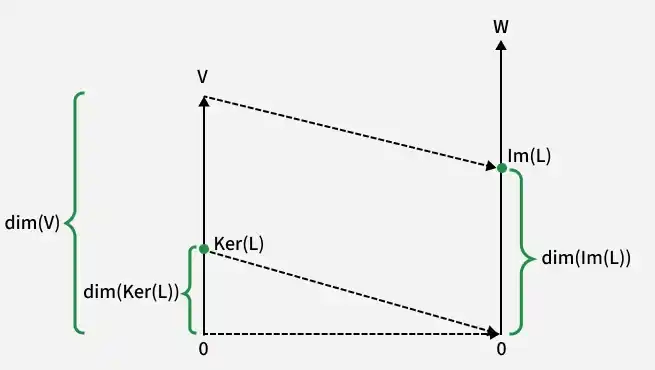
Let T: V → W be a linear transformation, where V is a finite-dimensional vector space. Then,
rank(T) + nullity(T) = dim(V)
Equivalently, dim(V) = dim(Ker(T)) + dim(Im(T))
For a matrix A with n columns, Rank(A) + Nullity(A) = n
where Rank(A) is the dimension of the image (column space) and Nullity(A) is the dimension of the null space (kernel).
Proof
Let N = Ker(T). Since N is a subspace of V and V is finite-dimensional, N is also finite-dimensional.
Let dim(N) = k and let {α₁, α₂, ..., αₖ} be a basis of N.
Since these vectors are linearly independent in V, they can be extended to form a basis of V: {α₁, α₂, ..., αₖ, αₖ₊₁, ..., αₙ}
where dim(V) = n.
Now consider the vectors: T(αₖ₊₁), T(αₖ₊₂), ..., T(αₙ)
We will show that these vectors form a basis for Im(T).
Step 1: They span Im(T).
Let β be any vector in Im(T). Then there exists a vector α in V such that:
T(α) = β
Since the α's form a basis of V,
α = a₁α₁ + a₂α₂ + ... + aₙαₙ
Applying T,
β = a₁T(α₁) + a₂T(α₂) + ... + aₙT(αₙ)
Because α₁, α₂, ..., αₖ belong to Ker(T),
T(α₁) = T(α₂) = ... = T(αₖ) = 0
Therefore, β = aₖ₊₁T(αₖ₊₁) + ... + aₙT(αₙ)
Hence, T(αₖ₊₁), ..., T(αₙ) span Im(T).
Step 2: They are linearly independent.
Suppose, cₖ₊₁T(αₖ₊₁) + ... + cₙT(αₙ) = 0
Using linearity of T,
T(cₖ₊₁αₖ₊₁ + ... + cₙαₙ) = 0
So, cₖ₊₁αₖ₊₁ + ... + cₙαₙ ∈ Ker(T)
Since every vector in Ker(T) can be written as a linear combination of α₁, α₂, ..., αₖ,
cₖ₊₁αₖ₊₁ + ... + cₙαₙ = b₁α₁ + ... + bₖαₖ
Rearranging, b₁α₁ + ... + bₖαₖ − cₖ₊₁αₖ₊₁ − ... − cₙαₙ = 0
Since {α₁, α₂, ..., αₙ} is a basis of V, these vectors are linearly independent. Therefore,
b₁ = b₂ = ... = bₖ = cₖ₊₁ = ... = cₙ = 0
Hence, T(αₖ₊₁), ..., T(αₙ) are linearly independent.
Therefore, T(αₖ₊₁), ..., T(αₙ) form a basis of Im(T).
So, Rank(T) = dim(Im(T)) = n − k and Nullity(T) = k.
Adding them,
Rank(T) + Nullity(T) = (n − k) + k = n
Since n = dim(V),
Rank(T) + Nullity(T) = dim(V)
Hence proved.
Applications of Rank and Nullity
The rank and nullity of a matrix have various applications in linear algebra, including:
- Solving Systems of Linear Equations: The rank and nullity of a matrix are used to determine the dimension of the kernel of a linear transformation, which in turn helps in solving systems of linear equations.
- Determining Dimension of Image and Kernel of a Linear Transformation: These concepts are essential for finding the dimensions of the image and kernel of a linear transformation, which is crucial in understanding the properties of the transformation.
- Matrix Theory: The rank and nullity of a matrix are fundamental in matrix theory, providing insights into the properties of the matrix, such as invertibility and eigenvalues.
Solved Examples
Some examples on rank and nullity are,
Example 1: Given Matrix
Find the rank and nullity of B.
Solution:
B = \begin{pmatrix} 1 & 1 & 0 & -2\\2 & 0 & 2 & 2 \\4 & 1 & 3 & 1 \\ \end{pmatrix} Using Row Transformation in matrix B,
R2 → R3 - 2R2
B = \begin{pmatrix} 1 & 1 & 0 & -2\\0 & 1 & -1 & -3 \\4 & 1 & 3 & 1 \\ \end{pmatrix} Now, R3 → R3 - 4R1
B = \begin{pmatrix} 1 & 1 & 0 & -2\\0 & 1 & -1 & -3 \\0 & -3 & 3 & 9 \\ \end{pmatrix} Now, R3 → 3R2 + R3
B = \begin{pmatrix} 1 & 1 & 0 & -2\\0 & 1 & -1 & -3 \\0 & 0 & 0 & 0 \\ \end{pmatrix} ∴ r (B) = 2.
n (B) = n (columns) - r (B) = 4 - 2 = 2.
∴ Rank of matrix B is 2 and the nullity of matrix B is 2.
Example 2: Given Matrix
Find the rank of matrix A.
Solution:
A = \begin{pmatrix} 1 & -2 & 0 & 4\\3 & 1 & 1 & 0 \\-1 & -5 & -1 & 8 \\ \end{pmatrix} Using Row Transformation in matrix A,
R3 → R3 + R1
A = \begin{pmatrix} 1 & -2 & 0 & 4\\3 & 1 & 1 & 0 \\0 & -7 & -1 & 12 \\ \end{pmatrix} Now, R2 → R2 - 3R1
A = \begin{pmatrix} 1 & -2 & 0 & 4\\0 & 7 & 1 & -12 \\0 & -7 & -1 & 12 \\ \end{pmatrix} Now, R3 → R3 + R2
A = \begin{pmatrix} 1 & -2 & 0 & 4\\0 & 7 & 1 & -12 \\0 & 0 & 0 & 0 \\ \end{pmatrix} r (A) = 2
∴ Rank of matrix A is 2.
Example 3: Given Matrix
Find the nullity of matrix D.
Solution:
D = \begin{pmatrix} 1 & 3\\0 & -2 \\5 & -1 \\-2 & 3 \\ \end{pmatrix} Using Row Transformation in matrix D,
R3 → R3 - 5R1
D = \begin{pmatrix} 1 & 3\\0 & -2 \\0 & -16 \\-2 & 3 \\ \end{pmatrix} Now, R4 → 2R1 + R4
D = \begin{pmatrix} 1 & 3\\0 & -2 \\0 & -16 \\0 & 9 \\ \end{pmatrix} Now, R3 → -8R2 + R3
D = \begin{pmatrix} 1 & 3\\0 & -2 \\0 & 0 \\0 & 9 \\ \end{pmatrix} Now, R4 → 9R2 + 2R4
D = \begin{pmatrix} 1 & 3\\0 & -2 \\0 & 0 \\0 & 0 \\ \end{pmatrix} Now, R2 → -1/2 R2
D = \begin{pmatrix} 1 & 3\\0 & 1 \\0 & 0 \\0 & 0 \\ \end{pmatrix} r (D) = 2
n (D) = n (columns) - r (D) = 2 - 2 = 0.
∴ Nullity of matrix D is 0.