
A composite number is a positive integer greater than 1 that has more than two different positive divisors. In simpler terms, a composite number is a number that, in addition to 1 and itself, can be divided evenly by at least one additional positive integer.
For example, 4 is a composite number because it can be divided evenly by 1, 2, and 4.
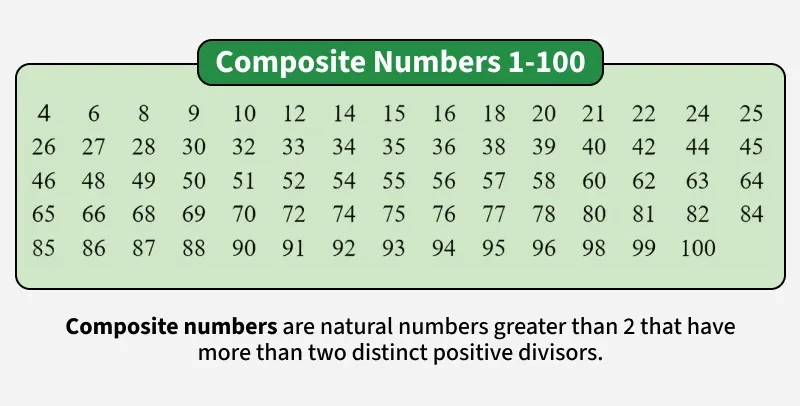
Various applications of composite numbers include:
1. Cryptographic Systems
Composite numbers form the backbone of many modern cryptographic systems, especially RSA encryption.
RSA Encryption:
- RSA uses a large composite number formed by multiplying two large prime numbers.
- The public key is based on this composite number, and security depends on the fact that factoring a very large composite number into its prime factors is extremely difficult.
- This protects online banking, emails, and secure websites.
- Key Idea: Easy to multiply primes → hard to factor the composite.
2. Time and Measurement Systems
Composite numbers are widely used in timekeeping and measurement because they have many factors.
Time Units:
- Units like 60 seconds in a minute, 60 minutes in an hour, 24 hours in a day, and 12 months in a year are all composite numbers.
- These can be easily divided into halves, thirds, quarters, etc., making time management practical.
- Key Idea: Composite numbers allow flexible division of time.
3. Grouping and Arrangement
Composite numbers are useful for arranging objects into equal groups or rectangular patterns.
Packaging and Seating:
- For example, 12 items can be arranged as 2×6 or 3×4, unlike prime numbers which allow only one arrangement.
- This is useful in packaging, seating plans, and layouts.
- Key Idea: More factors → more grouping options.
4. Data Encryption and Security
Composite numbers are fundamental to modern cryptography and secure communication.
Secure Communication and Encryption:
- For example, in SSL/TLS protocols used for secure websites, and in RSA encryption, large composite numbers are used to create public and private keys.
- The security relies on the fact that it is very difficult to factor a large composite number into its prime components.
- This protects sensitive data such as passwords, banking details, and private messages.
- Key Idea: Hard to factor → strong security.
5. Load Balancing in Cloud Computing
Composite numbers help in distributing tasks efficiently across multiple systems.
Task Distribution and Resource Management:
- For example, in cloud and grid computing, workloads can be divided among servers in multiple ways when the total number of tasks is composite (e.g., 12 tasks split as 3×4 or 2×6).
- This flexibility supports load balancing, data replication, and fault tolerance in distributed systems.
- Key Idea: More factors → more ways to divide workloads efficiently.