

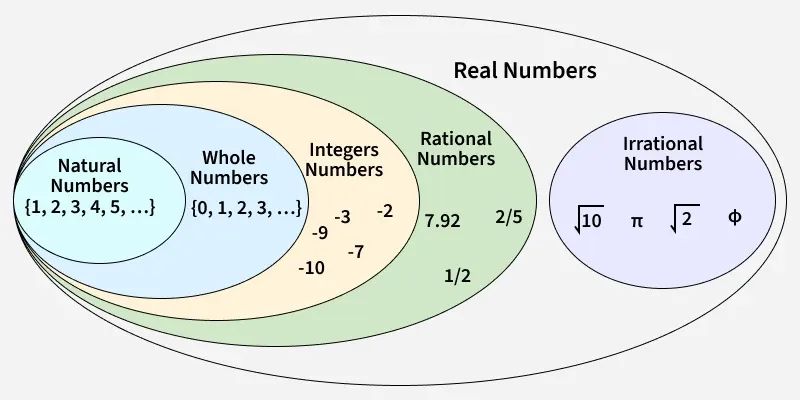
Real numbers are the set of numbers that can represent a quantity along a continuous number line. They include both rational and irrational numbers and can be positive, negative, or zero.
Key Points
- Real numbers can be added, subtracted, multiplied, and divided (except by zero).
- They are used to measure continuous quantities such as length, time, temperature, and distance.
- Every point on the number line corresponds to a real number.
Types of Real Numbers
Real numbers are divided into two main types:

1. Rational Numbers (ℚ): Numbers that can be expressed as a fraction (p/q) where both the numerator represented as p and the denominator represented as q are integers, and the denominator (q) is not zero. Rational numbers include integers, finite decimals, and repeating decimals (e.g., 1/2, -3, 0.75).
2. Irrational Numbers: Numbers that cannot be expressed in the form of a simple fraction p/q where 'p' and 'q' are integers and the denominator 'q' is not equal to zero (q≠0) and have non-terminating, non-repeating decimal expansions. They cannot be represented as a fraction of two integers (e.g., √2, π).
Real numbers can be further divided into the following subsets:
| Category | Description | Examples |
|---|---|---|
| Natural Numbers | Counting numbers used in daily life, starting from 1. | 1, 2, 3, 4, 5, ... |
| Whole Numbers | Natural numbers including 0. | 0, 1, 2, 3, 4, 5, ... |
| Integers | Whole numbers and negative natural numbers, including a neutral number (0). | ..., -3, -2, -1, 0, 1, 2, 3, ... |
Symbols
We use R to represent a set of real numbers, and other types of numbers can be represented using the symbol discussed below.
Natural Numbers | N |
|---|---|
Whole Numbers | W |
Integers | Z |
Rational Numbers | Q |
Irrational Numbers | Q' |
Real Numbers on a Number Line
When real numbers are placed on a number line, each value corresponds to a unique point on that line. The number line extends infinitely in both the positive and negative directions.

How Real Numbers Appear on a Number Line
- Zero (0) is at the center.
- Positive real numbers lie to the right of 0.
- Negative real numbers lie to the left of 0.
- The line continues forever on both sides.
Solved Examples
Example 1: Add √3 and √5
(√3 + √5)
Now answer is an irrational number.
Example 2: Multiply √3 and √3.
√3 × √3 = 3
Now answer is a rational number.
So we can say that result of mathematical operations on irrational numbers can be rational or irrational.
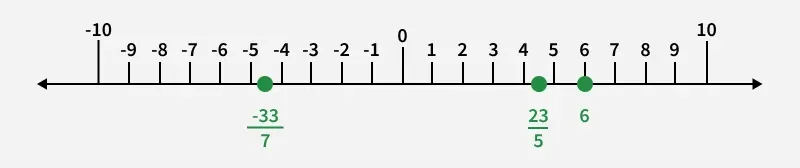
Example 3: Represent the following numbers on a number line: 23/5, 6, and -33/7.
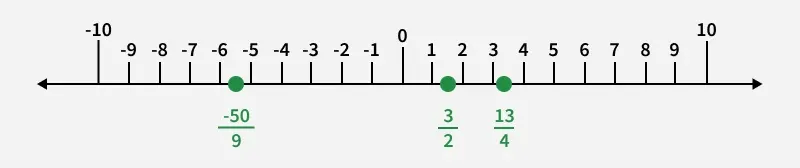
Question 4: Plot the following rational numbers on the number line: −50/9, 3/2, 13/4.
Practice Problems
Question 1: Add √2 and √8.
Question 2: Multiply √7 by √14.
Question 3: Add 5 to √9.
Question 4: Add 3/2 (a rational number) to √3 (an irrational number)
Question 5: Classify the Following Numbers as Rational or Irrational:
- a)
\sqrt{49} - b)
\pi - c)
0.75 - d)
\sqrt{2}
Question 6: Find the LCM and HCF of 24 and 36.
Question 7: Express 0.3333… (repeating) as a fraction.
Question 8: Prove that
Question 9: Find the Decimal Representation of
Question 10: Find the HCF of 75 and 105 using the Euclidean algorithm.
Question 11: Write the prime factorization of 420 and 252. Use it to find their LCM.
Question 12: Is 0.1010010001… a rational or irrational number? Justify your answer.