

Roman numerals are a numerical notation system that originated in ancient Rome. The Roman number system uses seven symbols, each with a fixed integer value, to represent numbers.
The symbols are I, V, X, L, C, D, and M, which represent 1, 5, 10, 50, 100, 500, and 1,000, respectively.
Different arrangements of these symbols represent different numbers. For example, the Roman number LX is equal to 60, which is (50 + 10). These Roman numerals are I, II, III, IV, V, VI, VII, VIII, IX, and X, representing 1, 2, 3, 4, 5, 6, 7, 8, 9, and 10, respectively.
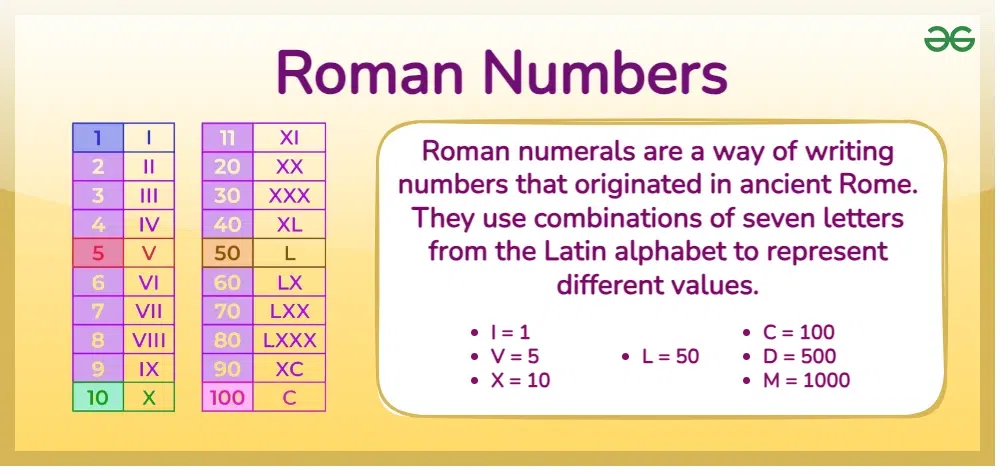
Roman Numeral Chart
Below is the chart of Roman Numerals:
List of Basic Roman Numerals
The list of all 7 basic Roman Numerals is given below:
| Roman Numeral | Arabic Numeral |
|---|---|
| I | 1 |
| V | 5 |
| X | 10 |
| L | 50 |
| C | 100 |
| D | 500 |
| M | 1000 |
Roman Numerals 1 to 100
Here is a list of Roman numbers from 1 to 100 and their conversion.
List of Roman Numbers from 1 to 100 | |||||||||
|---|---|---|---|---|---|---|---|---|---|
| Number | Roman Numeral | Number | Roman Numeral | Number | Roman Numeral | Number | Roman Numeral | Number | Roman Numeral |
1 | I | 21 | XXI | 41 | XLI | 61 | LXI | 81 | LXXXI |
2 | II | 22 | XXII | 42 | XLII | 62 | LXII | 82 | LXXXII |
3 | III | 23 | XXIII | 43 | XLIII | 63 | LXIII | 83 | LXXXIII |
4 | IV | 24 | XXIV | 44 | XLIV | 64 | LXIV | 84 | LXXXIV |
5 | V | 25 | XXV | 45 | XLV | 65 | LXV | 85 | LXXXV |
6 | VI | 26 | XXVI | 46 | XLVI | 66 | LXVI | 86 | LXXXVI |
7 | VII | 27 | XXVII | 47 | XLVII | 67 | LXVII | 87 | LXXXVII |
8 | VIII | 28 | XXVIII | 48 | XLVIII | 68 | LXVIII | 88 | LXXXVIII |
9 | IX | 29 | XXIX | 49 | XLIX | 69 | LXIX | 89 | LXXXIX |
10 | X | 30 | XXX | 50 | L | 70 | LXX | 90 | XC |
11 | XI | 31 | XXXI | 51 | LI | 71 | LXXI | 91 | XCI |
12 | XII | 32 | XXXII | 52 | LII | 72 | LXXII | 92 | XCII |
13 | XIII | 33 | XXXIII | 53 | LIII | 73 | LXXIII | 93 | XCIII |
14 | XIV | 34 | XXXIV | 54 | LIV | 74 | LXXIV | 94 | XCIV |
15 | XV | 35 | XXXV | 55 | LV | 75 | LXXV | 95 | XCV |
16 | XVI | 36 | XXXVI | 56 | LVI | 76 | LXXVI | 96 | XCVI |
17 | XVII | 37 | XXXVII | 57 | LVII | 77 | LXXVII | 97 | XCVII |
18 | XVIII | 38 | XXXVIII | 58 | LVIII | 78 | LXXVIII | 98 | XCVIII |
19 | XIX | 39 | XXXIX | 59 | LIX | 79 | LXXIX | 99 | XCIX |
20 | XX | 40 | XL | 60 | LX | 80 | LXXX | 100 | C |
Note: To write numbers larger than 1000, the same numerals are repeated. For example:
- MM = 2000
- MMM = 3000
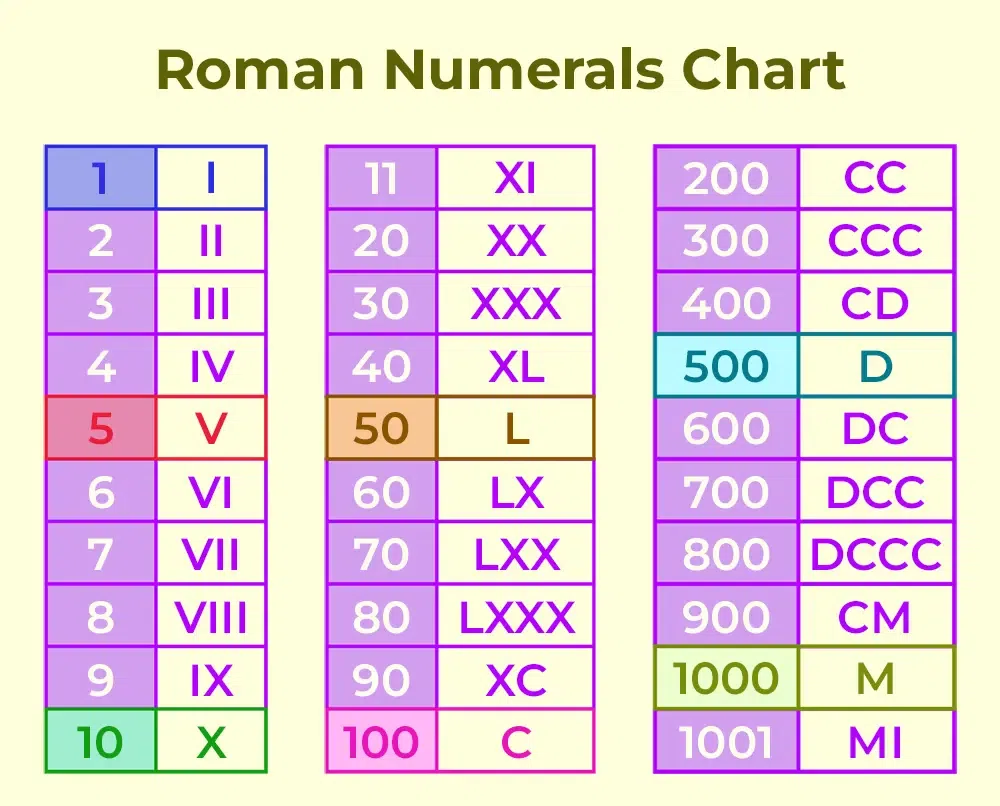
Roman Numerals Chart (1 to 1000)
Roman Numerals from 1 to 100 are shown in the image added below.
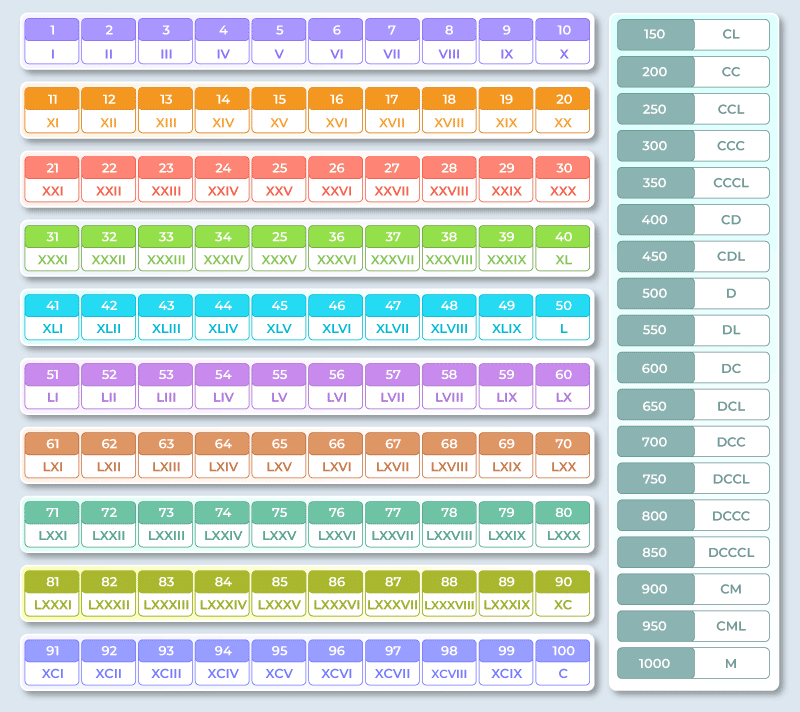
Roman Numerals 100 to 1000
The Roman Numbers for 100, 200, 300, 400, 500, 600, 700, 800, 900, and 1000 are discussed in the table below.
Roman Numerals Conversion | ||
|---|---|---|
Number | Roman Numerals | Evaluation |
100 | C | 100 |
200 | CC | 100 + 100 |
300 | CCC | 100 + 100 + 100 |
400 | CD | 500 – 100 |
500 | D | 500 |
600 | DC | 500 + 100 |
700 | DCC | 500 + 100 + 100 |
800 | DCCC | 500 + 100 + 100 + 100 |
900 | CM | 1000 – 100 |
1000 | M | 1000 |
Note- Roman Number System does not have any symbol for zero (0) unlike other number systems.
So the question arises: to increase the number by a multiple of 10 what symbol we must use initially different symbols are used for 10, 100, 1000, and other. But this seems very complex to use different symbols, hence Roman Number System is not further used today.
Roman Letters
English Letters are also called Roman Letters, but all English letters are not Roman letters. In English, we have 26 letters, namely,
A, B, C, D, E, F, G, H, I, J, K, L, M, N, O, P, Q, R, S, T, U, V, W, X, Y, and Z.
But in Roman Letters, we have 23 letters, namely,
A, B, C, D, E, F, G, H, I, K, L, M, N, O, P, Q, R, S, T, V, X, Y, and Z.
Observing the above-given letters, we can say that Roman Numerals have 23 letters of English Letters except J, U, and W.
Roman Numbers to Numbers
Roman numerals are typically written from largest to smallest, left to right, except in certain cases when a smaller numeral appears before a larger one to indicate subtraction.
For example:
- IV = 4 (5 - 1)
- IX = 9 (10 - 1)
- XL = 40 (50 - 10)
- XC = 90 (100 - 10)
- CD = 400 (500 - 100)
- CM = 900 (1000 - 100)
Roman Numerals 1 to 100 Examples
Example 1: Convert the Roman numeral "IV" to a number.
Solution:
- I: 1
- V: 5
- Since I come before V, we subtract its value from V. So, IV = 5 - 1 = 4.
- Therefore, IV in Roman numerals is equivalent to 4 in numbers.
Example 2: Convert the Roman numeral "XII" to a number.
Solution:
- X: 10
- I: 1
- I: 1
- Since I come before II, we add their values together:II = 1 + 1 = 2.
- Adding X (10) to II (2), we get10 + 2 = 12.
- Therefore, XII in Roman numerals is equivalent to12 in numbers.
Example 3: Convert the Roman numeral "XLV" to a number.
Solution:
- X: 10
- L: 50
- V: 5
- Since X comes before L, we subtract its value fromL: XL = 50 - 10 = 40.
- Adding V (5) to XL (40), we get 40 + 5 = 45.
- Therefore, XLV in Roman numerals is equivalent to45 in numbers.
Rules to Write Roman Numerals
While writing Roman Numerals, we have to follow these conversion rules :
Rule 1: If a bigger letter proceeds to a smaller then the letters are added.
For example XI, X > I, so XI = X + I = 10 + 1 = 11
Rule 2: If a smaller letter proceeds to a smaller one, then the letters are subtracted.
For example IX, I < X, so IX = IX = 10 - 1 = 9
Rule 3: If a letter repeats multiple times, they are added
For example XXX = X + X + X = 10 + 10 + 10 = 30
Rule 4: A letter can not be repeated more than three times, and V, L, and D cannot be repeated; they appear only once.
Steps of Conversion to Roman Numerals
Let us find the Roman Numerals for 1234.
Here are the steps of conversion into Roman numerals:
Step 1: Break the given number in such a form that the value of each part is known in Roman Numerals such as
1234 = 1000 + 100 + 100 + 10 + 10 + 10 + 5 - 1
Step 2: Substitute each Roman numeral for the given Hindu numerals,
- 1000 = D
- 100 = C
- 10 = X
- 5 = V
- 1 = I
Step 3: Substitute each value to find the given Roman Numerals.
1234 = DCCXXXIV
Subtractive Rule of Roman Numerals
The subtractive rule of Roman Numerals is made clear in the table below.
Write | Instead of | For the Value of |
|---|---|---|
IV | IIII | 4 |
IX | VIIII | 9 |
XL | XXXX | 40 |
XC | LXXXX | 90 |
CD | CCCC | 400 |
CM | DCCCC | 900 |
Roman Numbers Converter
Convert any number into its Roman numeral equivalent with this easy-to-use converter. Simply input the number, and get the Roman numeral instantly.
Try it yourself -
Articles related to Roman Numerals:
Solved Examples: Roman Numerals 1 to 100
Here are some solved examples of Roman Numbers.
Example 1: Convert 47 into Roman numerals.
Solution:
Given: 47 = 50 - 3
We know that,
- 50 = L
- 3 = III
Now, 47 = IIIL
Example 2: Convert 2023 intoRoman Numeral.
Solution:
2023 can be broken as,
2023 = 1000 + 1000 + 10 + 10 + 1 + 1 + 1
We know that,
- 1000 = M
- 10 = X
- 1 = I
Thus,
2023 = MMXXIII
Example 3: Simplify MXVII – LXV + II
Solution:
Given:
MXVII – LXV – II
We know that
- MXVII = 1017
- LXV = 65
- II = 2
Now, substituting these we get;
MXVII – LXV – II = 1017 - 65 + 2 = 954
Example 4: Simplify C + XLVII – XVII
Solution:
Given: C + XLVII – XVII
We know that
- C = 100
- XLVII = 47
- XVII = 17
Now, substituting these we get;
C + XLVII – XVII = 100 + 47 - 17 = 130
Roman Numerals Practice Questions
Here are some exercise problems on Roman Numbers for you to solve.
Question 1: What is the Square of X?
Question 2: What is the Square Root of LXXXI?
Question 3: Add the Roman numerals XXV and L.
Question 4: Subtract XL from C.
Question 5: What is the value of XXIV and XXV?
Modern Uses of Roman Numerals
Despite the prevalence of the Arabic numeral system, Roman numerals are still widely used today in several ways:
- Clocks and Watches : Many clock faces use Roman numerals.
- Movie and Book Titles : Roman numerals are used to number sequels, such as "Rocky II" or "Super Bowl LV."
- Monarchs and Popes : Kings, queens, and popes use Roman numerals in their names (e.g., Queen Elizabeth II, Pope John Paul II).
- Legal and Academic Documents : Legal documents and academic papers often use Roman numerals to structure sections.
Conclusion
Roman numerals are a system of numerical notation that was used in ancient Rome and is still occasionally used today. They consist of seven symbols, I, V, X, L, C, D, and M, representing the numbers 1, 5, 10, 50, 100, 500, and 1000, respectively.