

Scientific notation is a way of expressing very large or very small numbers in a compact form using powers of 10.
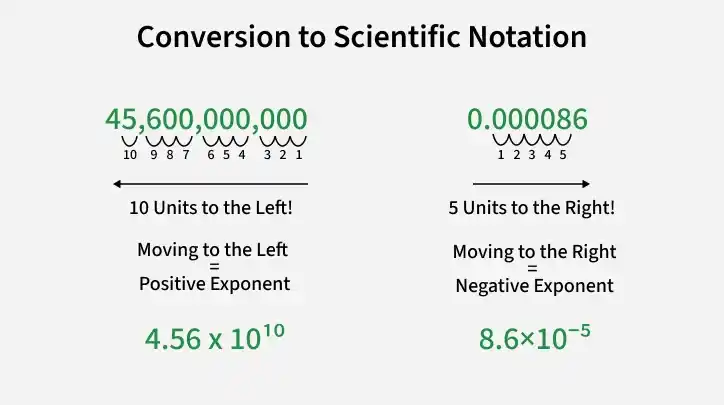
The general form of scientific notation is
n × 10m
where, n is a real number such that 1 ≤ n < 10 and is known as the significant.
Real-life example:
The distance from Earth to the Sun is approximately 150,000,000 kilometers.
Instead of writing the entire number, we can express it in scientific notation:
150,000,000 = 1.5 × 10⁸
Rules of Scientific Notation
- One Non-zero Digit: The number should be written so that there is only one non-zero digit to the left of the decimal point (e.g., 3.4, not 34).
- Power of Ten: The number is multiplied by 10n, where n is an integer. If you move the decimal point to the left, n is positive; if you move it to the right, n is negative.
- Magnitude: The coefficient (the number before 10n) should always be greater than or equal to 1 and less than 10.
Why Use Scientific Notation?
Scientific notation is useful for several reasons:
- It simplifies the writing of extremely large or small numbers, making them easier to understand.
- It makes calculations simpler, especially multiplication and division.
- It helps avoid mistakes when reading or writing very large or very small numbers, which can be cumbersome.
- It provides a consistent way to represent numbers across different scientific disciplines.
How to Write Numbers in Scientific Notation
To convert a number into scientific notation, follow these steps:
1. Identify the significant digits in the number.
2. Move the decimal point to the right or left until you have a number between 1 and 10.
3. Count how many places you moved the decimal point to determine the exponent of 10:
- If you moved left, the exponent is positive.
- If you moved right, the exponent is negative.
4. Write the number in the form n × 10m
Multiplication and Division in Scientific Notation
When multiplying or dividing numbers in scientific notation:
Multiplication: Multiply the coefficients and add the exponents.
- Example: (3 × 104) × (2 × 103) = (3 × 2) × 104+3 = 6 × 10⁷.
Division: Divide the coefficients and subtract the exponents.
- Example:
\frac{6 \times 10^5}{2 \times 10^2} = \frac{6}{2} \times 10^{5-2} = 3 \times 10^3
Addition and Subtraction in Scientific Notation
For addition and subtraction, the numbers must have the same exponent:
If the exponents are the same, add or subtract the coefficients.
- Example: (2 × 10⁴) + (3 × 10⁴) = (2 + 3)×104 =5×10⁴.
If the exponents are different, convert one number to have the same exponent as the other before performing the operation.
Similar Problems
Problem 1: Convert 450,000,000 to scientific notation.
Solution:
To convert 450,000,000, move the decimal point 8 places to the left:
450,000,000 = 4.5 × 10⁸
Problem 2: Convert 0.0000091 to scientific notation.
Solution:
To convert 0.0000091, move the decimal point 6 places to the right:
0.0000091 = 9.1 × 10⁻⁶
Problem 3: Convert 78,000,000,000 to scientific notation.
Solution:
To convert 78,000,000,000, move the decimal point 10 places to the left:
78,000,000,000 = 7.8 × 10¹⁰
Problem 4: Convert 0.0000065 to scientific notation.
Solution:
To convert 0.0000065, move the decimal point 6 places to the right:
0.0000065 = 6.5 × 10⁻⁶
Problem 5: Convert 1,500,000 to scientific notation.
Solution:
To convert 1,500,000, move the decimal point 6 places to the left:
1,500,000 = 1.5 × 10⁶
Practice Problems
1. Convert 450,000,000 to scientific notation.
2. Convert 0.0000091 to scientific notation.
3. Convert 78,000,000,000 to scientific notation.
4. Convert 0.0000065 to scientific notation.
5. Convert 1,500,000 to scientific notation.