
A square number is defined as a product of an integer multiplied by itself. It can also be defined as any number raised to the power 2.
For example: 169 (13 × 13), 169 is a square number. The square number sequence starts from 0 to infinity.
Mathematically, the nth square number can be expressed as:
Sn = n2
where n is a non-negative integer (0, 1, 2, 3, 4,...).
Square Numbers can be arranged in a square grid for each square number as follows:
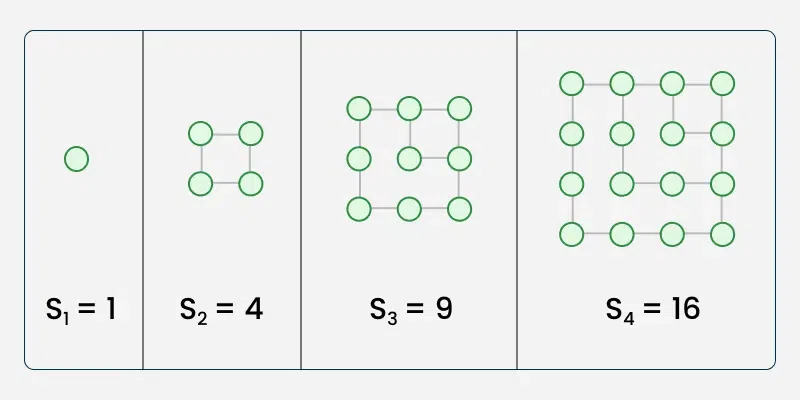
First few Square Numbers
There are a total of 45 square numbers between 0 to 2000. These numbers are:
0, 1, 4, 9, 16, 25, 36, 49, 64, 81, 100, 121, 144, 169, 196, 225, 256, 289, 324, 361, 400, 441, 484, 529, 576, 625, 676, 729, 784, 841, 900, 961, 1024, 1089, 1156, 1225, 1296, 1369, 1444, 1521, 1600, 1681, 1764, 1849, 1936
Note: Square numbers will always be positive: as ( - ) × ( - ) = ( + ) and ( + ) × ( + ) = ( + ).
Differences Between Consecutive Square Numbers
To find the difference between two consecutive square numbers you can use the formula:
(n + 1)2 - n2 = 2n + 1
Here’s how the differences between the first few square numbers look:
n | Square Number (n2) | Next Square Number ((n + 1)2) | Difference (2n + 1) |
|---|---|---|---|
0 | 0 | 1 | 1 |
1 | 1 | 4 | 3 |
2 | 4 | 9 | 5 |
3 | 9 | 16 | 7 |
4 | 16 | 25 | 9 |
5 | 25 | 36 | 11 |
6 | 36 | 49 | 13 |
7 | 49 | 64 | 15 |
8 | 64 | 81 | 17 |
9 | 81 | 100 | 19 |
A Few things we can determine from the above table:
The difference of square of the two consecutive numbers will always be equal to the sum of numbers.
For example:
Let's take 9 and 8
The difference of Square: (92 - 82) = 17
Sum of these two numbers: (9 + 8) = 17
The difference of the two consecutive square numbers will always be odd.
For example:
1, 3, 5, 7, 9, 11, ...
The square of an odd positive integer will always yield an odd number, while the square of an even positive integer will yield an even number.
For example:
112 = 121 (odd)
222 = 484 (even)
Related Reads,