
Long division method is a step-by-step process to find the square root of a number without using a calculator.
- It works well for large numbers and numbers that are not perfect squares.
- The method finds the root digit by digit, similar to how normal long division works.
Steps to calculate the square root by long division: 3249
Start from the right and group the digits into pairs, placing a bar over the pairs. For 3249, you have 32 and 49.
√ | (32 29)
Start from the right and group the digits into pairs, placing a bar over the pairs. For 3249, you have 32 and 49.
Step 1: Determine the largest single-digit number whose square is less than or equal to the first pair on the left. In this case, it's 5 because (52 = 25), which is less than 32.

Step 2: Subtract 25 (the square of 5) from 32, and bring down the next pair (49).

Step 3: Double the root (5) to get 10, and put an empty digit placeholder next to it.
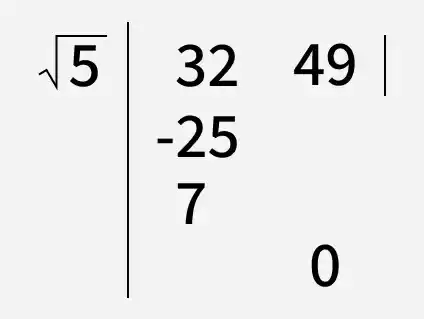
Step 4: Guess a digit to fill in the empty placeholder (in this case, 4). Place it next to the previous result to make a new number (70).

Step 5: Multiply the entire result (10) by the guessed digit (4), and subtract from the dividend (70). Bring down the next pair (49).
Repeat steps 4 and 5 until you find the desired level of precision or until there are no more decimal places in the original number.
The process continues with more decimal places as needed. The square root of 3249 is approximately 56.
Examples
1. Square Root of 729
-300.png)
2. Square Root of 44100
-(1)-300.png)
Square Root of Non-Perfect Square Number
A non-perfect square is a number that does not have a whole number as its Square Root. To find the square root of a non-perfect square by the long division method, we need to follow the same steps as for a perfect square.
Step 1: Split the number into the Perfect square closer to the given number, i.e.
√12 = √(9 + 3)
Step 2: Now we will write the perfect square value, whatever we have more or less divided by double of perfect square value
Now,
√(9 + 3) = 3 + 3/6 (3 is the perfect square value + perfect square value / double of perfect square)
= 3 + 0.5 = 3.5
Therefore, 3.5 is the answer
We can Solve this with other methods as,
√12
= √(16 - 4)
= 4 - 4/8
= 4 - 0.5 = 3.5 {4 (is the perfect square value) - (perfect square value/double of a perfect square)}
Long Division vs Factorisation
Long division and prime factorization are two different methods of finding the factors of a number.
- Long division is a process of dividing a number by another number, usually a smaller one, to get a quotient and a remainder.
- Prime factorization is a process of finding the prime numbers that multiply together to get the original number. They have only two factors, 1 and the number itself.
Both methods give us the same result, but they use different approaches. Long division is more general and can be used to find any factor of a number, not just prime factors. Prime factorization is more specific and can be used to find the unique combination of prime numbers that make up a number.
Related Articles
Solved Problems
Problem 1: Find the Square Root of 17424 by Long Division Method
Solution: Square root of 17424 is found using the long division method as,
Thus, the square root of 17424 is 132.
-(1)-300.png)
Problem 2: Find the Square Root of 7.29 by Long Division Method
Solution:
In the decimal numbers, after getting the remainder which is 329 just mark the point after the quotient which is 2 that's it. Now you can solve as it is with the same method.
Thus, the square root of 7.29 is 2.7.
-(1)-300.png)
Problem 3: Find the Square Root of 69169 by Long Division Method
Solution:
Square root of 69169 is found using the long division method as,
Thus, square root of 69169 is 263.
-(1)-300.png)
Problem 4: Find the Square Root of 27225 by Long Division Method
Solution:
Square root of 27225 is found using long division method as,
Thus, the square root of 27225 is 165.
-(1)-300.png)
Problem 5: Find the Square Root of 14161 by Long Division Method
Solution:
Square root of 14161 is found using the long division method as,
Thus, the square root of 14161 is 119.
-(1)-300.png)
Practice Problems on Square Roots by Long Division Method
P1. Evaluate the Square Root of 1444 by Long Division Method
P2. Find the Square Root of 54756 by Long Division Method
P3. Evaluate the Square Root of 3249 by Long Division Method
P4. Evaluate the Square Root of 2304 by Long Division Method