

A complex number is a number that has two components, or is equally divided into a real part and an imaginary part.
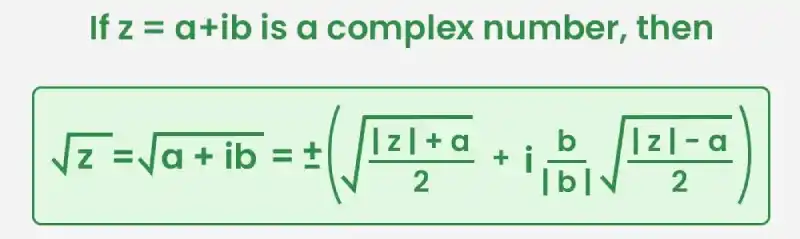
Square Root of a Complex Number (Algebraic Method)
To find the t of a complex number z = a + bi, we need to find another complex number w = x + yi such that:
w2 = z
This means: (x + yi)2 = a + bi
x2 + 2xyi - y2 = a + bi
Equating real and imaginary parts:
- x 2 - y 2 = a (Real part)
- 2xy = b (Imaginary part)
Now, solve for x and y:
First, let's solve for x2 and y2. To do this, substitute y = \frac{b}{2x} into the first equation (from 2xy = b):
⇒
⇒
⇒
Let z = x^2 to simplify this quadratic equation:
Solve this quadratic equation using the quadratic formula:
⇒
⇒
⇒
Since z = x^2, we have:
Thus,
Now use y = b/2x to find y:
⇒
⇒
⇒
⇒
Result: The square root of a + bi is given by:
As we know,
Thus,
This is the general form for the square root of a complex number a + bi.
Example: Find square root of 4 + 3i.
Solution:
Let
z = \sqrt{4 + 3i} = x + iy , which implies:
z^2 = (x + iy)^2 = x^2 + 2ixy - y^2 Equating the real and imaginary parts with 4 + 3i, we get:
- x2 - y2 = 4 (Real part)
- 2xy = 3 (Imaginary part)
From 2xy = 3, solve for y:
y = 3/2x
Substitute this into x2 - y2 = 4:
x^2 - \left( \frac{3}{2x} \right)^2 = 4
\Rightarrow x^2 - \frac{9}{4x^2} = 4 ⇒ 4x4 - 9 = 16x2
⇒ 4x4 - 16x2 - 9 = 0
Let u = x2, so the equation becomes:
⇒ 4u2 - 16u - 9 = 0
Solve this quadratic using the quadratic formula:
\Rightarrow u = \frac{-(-16) \pm \sqrt{(-16)^2 - 4(4)(-9)}}{2(4)}
\Rightarrow u = \frac{16 \pm \sqrt{256 + 144}}{8} = \frac{16 \pm \sqrt{400}}{8} = \frac{16 \pm 20}{8}
\Rightarrow u = \frac{16 + 20}{8} = \frac{36}{8} = 9/2 oru = \frac{16 - 20}{8} = \frac{-4}{8} = -1/2 Since u = x2 ≥ 0, we discard u = -1/2.
Thus, x2 = 9/2, so
x = \pm \sqrt{\frac{9}{2}} = \pm \frac{3}{\sqrt{2}} Now, substitute x into y = 3/2x:
\Rightarrow y =\pm \frac{3}{2 \times \frac{3}{\sqrt{2}}} = \pm \frac{1}{\sqrt{2}} Thus, z = x + iy =
\pm \frac{3}{\sqrt{2}} \pm i \frac{1}{\sqrt{2}} .
\Rightarrow \sqrt z = x + iy = \pm \left(\frac{3}{\sqrt{2}} + i \cdot \frac{1}{\sqrt{2}} \right) .
Note: Alternatively we can use the provided formula for easy calculations.
Square Root of a Complex Number (Polar Form)
The following procedure can also be followed to find the square root of a complex number a + bi, when given in polar form.
Step 1: Express the complex number in polar form. The polar form of a complex number z = a + bi is written as:
z = r(cos θ + isin θ)
Where r = |z| = √a2 + b2 is the modulus of the complex number, and θ is the argument, given by:
θ = arg(z)
Step 2: Using the square root formula from polar form. The square root of a complex number in polar form is:
\sqrt{z} = \pm \sqrt{r}\left(\cos \frac{\theta}{2} + i \sin \frac{\theta}{2}\right)
Step 3: Calculate the modulus r and argument θ, then by the help of below formula, find the square root of complex number.
Note: Prefer this method only if given complex number is z = r(cos θ + isin θ) = reiθ, and θ is well known value such as π/2, π/4, π/3, π/6, etc.
Let's consider an example for better understanding:
Example: Find the square root of z = eiπ/3.
Solution:
Given: z = eiπ/3 = z = cos π/3 + isin π/3
- r =1
- θ = π/3
Use the formula,
\sqrt z = \left( \cos \frac{\pi/3}{2} + i \sin \frac{\pi/3}{2} \right) \Rightarrow \sqrt z = \left( \cos \frac{\pi}{6} + i \sin \frac{\pi}{6} \right) \Rightarrow \sqrt z = \left( \frac{\sqrt 3}{2} + i \frac{1}{2} \right)
General Formula for nth Root of Complex Number
Given a complex number z = r(cosθ + isinθ), the nth roots of z are:
z_k = \sqrt[n]{r} \left( \cos \frac{\theta + 2k\pi}{n} + i \sin \frac{\theta + 2k\pi}{n} \right)
Where:
- r is the modulus of z i.e., r = ∣z∣
- θ is the argument (angle) of the complex number,
- n is the root you want to find,
- k is an integer and takes values from 0 to n−1.
Related Articles
Solved Problems on Square Root of Complex Numbers
Problem 1: Find square root of z = 3 + 4i
Solution:
|z| = \sqrt{3^2 + 4^2} = \sqrt{9 + 16} = \sqrt{25} = 5 Apply the formula:
\sqrt{z} = \pm \left( \sqrt{\frac{3 + 5}{2}} + i \cdot \frac{4}{|4|} \sqrt{\frac{5 - 3}{2}} \right) \Rightarrow \sqrt{z} = \pm \left( \sqrt{\frac{8}{2}} + i \cdot 1 \cdot \sqrt{\frac{2}{2}} \right) \Rightarrow \sqrt{z} = \pm \left( \sqrt{4} + i \sqrt{1} \right) = \pm (2 + i)
Problem 2: Find square root of z = 1 + i.
Solution:
|z| = \sqrt{1^2 + 1^2} = \sqrt{1 + 1} = \sqrt{2} Apply the formula:
\sqrt{z} = \pm \left( \sqrt{\frac{1 + \sqrt{2}}{2}} + i \cdot \frac{1}{|1|} \sqrt{\frac{\sqrt{2} - 1}{2}} \right) After calculating, we get:
\sqrt{z} = \pm \left( \sqrt{1.207} + i \sqrt{0.207} \right) \approx \pm (1.099 + 0.455i)
Problem 3: Find square root of z = − 1 + i.
Solution:
|z| = \sqrt{(-1)^2 + 1^2} = \sqrt{1 + 1} = \sqrt{2} Apply the formula:
\sqrt{z} = \pm \left( \sqrt{\frac{-1 + \sqrt{2}}{2}} + i \cdot \frac{1}{|1|} \sqrt{\frac{\sqrt{2} + 1}{2}} \right) After calculating, we get:
\sqrt{z} = \pm \left( \sqrt{0.207} + i \sqrt{1.207} \right) \approx \pm (0.455 + 1.099i)
Problem 4: Find square root of z = − 4 + 0i (Purely Real).
Solution:
|z| = \sqrt{(-4)^2} = \sqrt{16} = 4 Apply the formula:
\sqrt{z} = \pm \left( \sqrt{\frac{-4 + 4}{2}} + i \cdot \frac{0}{|0|} \sqrt{\frac{4 - (-4)}{2}} \right) \Rightarrow \sqrt{z} = \pm \left( \sqrt{0} + i \sqrt{4} \right) = \pm (0 + 2i) Hence, −4 = ±2i
Problem 5: Find square root of z = −3 + 4i.
Solution:
|z| = \sqrt{(-3)^2 + 4^2} = \sqrt{9 + 16} = \sqrt{25} = 5 Apply the formula:
\sqrt{z} = \pm \left( \sqrt{\frac{-3 + 5}{2}} + i \cdot \frac{4}{|4|} \sqrt{\frac{5 + 3}{2}} \right) \Rightarrow \sqrt{z} = \pm \left( \sqrt{1} + i \sqrt{4} \right) = \pm (1 + 2i) Hence, −3 + 4i = ±(1 + 2i)