

The square root of a number is essentially the value that, when multiplied by itself, yields the original number. For example square root of 9 is 3 because when we multiply 3 by 3, we get 9.
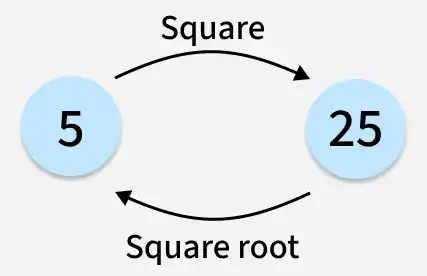
Let's take another number, 16. If you multiply 4 by itself, you get 16 (4 × 4 = 16). In this case, we say 4 is the square root of 16. The exponent for squares is 2, and for square roots, it's 1/2. So, the square root of a number n is written as √n or n1/2, where n is a positive number.
The symbol for the square root is commonly written as √, and it's known as a radical symbol.
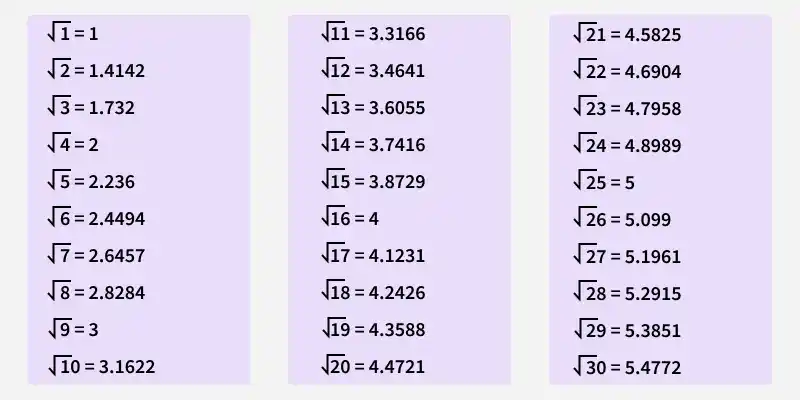
Square Roots of First 30 Numbers
Square Root by Prime Factorization Method
To determine the square root of a number using the prime factorization method, follow these steps:
- Step 1: Break down the given number into its prime factors.
- Step 2: Group the factors into pairs, ensuring that both factors in each pair are the same.
- Step 3: Select one factor from each pair.
- Step 4: Multiply the chosen factors together.
- Step 5: The result of this multiplication represents the square root of the given number.
Example: Find the square root of 324 by the Prime Factorization Method.
324 = 22 × 34
Since we are finding the square root, pair the prime factors in twos: 2 × 32
Multiply the prime factors: 2 × 32 = 2 × 9 = 18
The square root of 324 is √324 = 18
So, √324 = 18 using the prime factorization method.
Square Root of Negative Number
The square root of a negative number is not a real number, because squaring any real number always gives a positive result (or zero). To handle square roots of negative values, we use complex numbers.
The principal square root of −x is written as:
\sqrt{x} = i\sqrt{x}
where i is the imaginary unit defined as:
i = \sqrt{-1}
Let's consider an example with the perfect square number 9. Now, if we look at the square root of -9, there isn't a real number solution. Expressing it using the complex number approach, √(-9) becomes √9 × √(-1), resulting in 3i {given that √(-1) = i}. In this way, 3i serves as a square root of -9.
Also check - Square Roots of Decimals
Properties of Square Root
Various Properties of Square Root are,
- If a number is a perfect square, it has a perfect square root.
- If a number has an even number of zeros at the end, it can have a square root.
- You can multiply two square roots together. For example, if you multiply √3 by √7, the result is √21.
- Multiplying two identical square roots gives a non-square root number. For instance, √4 multiplied by √4 equals 4.
- The square root of negative numbers is not defined because perfect squares cannot be negative.
- If a number ends with 2, 3, 7, or 8 in the unit digit, it does not have a perfect square root.
- If a number ends with 1, 4, 5, 6, or 9 in the unit digit, it may have a perfect square root.
Related Concepts
- Perfect Squares
- Methods to find Square Root
- Long Division Method
- Square Root of Complex Numbers
- Square roots: 1 to 100
- Squre Root Calculator
- Square and Square Roots
- Practice Questions
- Real-Life Applications
- Perfect Squares Interesting Facts