

A square and a square root are opposite mathematical concepts. A square is obtained by multiplying a number by itself, while a square root is the number that, when multiplied by itself, gives the original number.
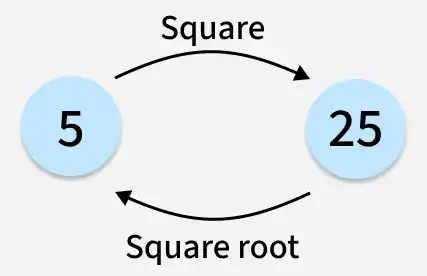
Square
The square of a number is the result obtained when the number is multiplied by itself. If a number is a, then its square is a × a = a².
Examples:
- 42 = 4 × 4 = 16
- 82 = 8 × 8 = 64
- 122 = 12 × 12 = 144
Squares of Negative Numbers
The squares of negative numbers also result in a positive value, as we know that the multiplication of two negative values always yields a positive value i.e.,
(-) × (-) = (+)
Thus, the square of the negative number is always positive i.e., (-n)2 = (-n) × (-n) = n2 (positive number)
Example: The square of (-5) is (-5)2 = (-5) × (-5) = 25.
Properties of Square Numbers
- The square of 0 is 0, and the square of 1 is 1 (0² = 0, 1² = 1)
- The square of an even number is always even, and the square of an odd number is always odd.
- The square of any real number is always non-negative (positive or zero).
- The square of an imaginary number can be negative.
(For example, i² = −1) - A perfect square never ends with 2, 3, 7, or 8 in the unit’s place.
- A number ending with an odd number of zeros can never be a perfect square.
- The square of the square root of a number is the number itself, i.e., (√a)² = a.
Numbers Between Squares
There is a simple way to find how many numbers lie between the squares of two consecutive numbers. If the two consecutive numbers are n and n + 1, then:
Numbers between their squares = 2n
Proof:
Take two numbers n and n+1,
Their squares are (n)2 and (n+1)2 respectively.
Numbers between these squares = (n+1)2 - (n)2 -1
= n2 + 1 + 2n - n2 -1
= 2n
Example: Find the numbers between (2)2 and (3)2
Solution:
Here, n = 2
Numbers between the squares:
2n = 2 × 2 = 4
So, there are 4 numbers between 4 and 9.
Square Roots
Square roots are nothing but the inverse operation of the square i.e. if a is the square of b then, the square root of b is a.
If a² = b, then √b = a.
The square root of any number is both positive and negative i.e. √(b) = ±a. This is because the square of (a)2 = b and (-a)2 = b, so its square is both positive and negative.
Examples:
- √4 = ±2
- √9 = ±3
- √16 = ±4
- √25 = ±5
Properties of Square Root
- If the unit digit of a number is 2, 3, 7, or 8, then it does not have a square root in N (natural numbers).
- If a number ends with an odd number of zeros, it does not have a perfect square root.
If a square number ends with an even number of zeros, then its square root will have half the number of zeros at the end. - The square root of an even perfect square is always even, and the square root of an odd perfect square is always odd.
Perfect Square
A perfect square is a number that can be written as the product of an integer with itself. In other words, it is a number obtained when a whole number is multiplied by the same number. It can also be written in the form n², where n is an integer.
Examples:
- 9 = 3 × 3
- 16 = 4 × 4
- 36 = 6 × 6
Numbers that cannot be written in this form are not perfect squares. For example, 18 is not a perfect square because it cannot be written as x × x for any integer x.
Tips and Tricks
1. Find the Square of Numbers Ending with 5
Steps:
- Write 25 at the end of the answer because 52=25.
- Take the remaining number (digits before 5).
- Multiply that number by its next consecutive number.
- Write the result before 25.
Example:
25²
- Last digit is 5, so the final result will end with 25.
- Remaining number = 2
- Next consecutive number = 3, so 2 × 3 = 6.
- Now, we write 6 before 25.
- Hence, the final result = 625.
45²
- Last digit is 5, so the final result will end with 25.
- Remaining number = 4
- Next consecutive number = 5, so 4 × 5 = 20.
- Now, we write 20 before 25.
- Hence, the final result = 2025.
2. Find Squares of Numbers Near 50
This trick is useful for two-digit numbers close to 50 such as 42, 46, 49, 53, etc.
It is based on the identity: (a+b)2=a2+2ab+b2 , where a = tens digit and b = units digit
Steps:
- Find a² (square of the tens digit).
- Find 2ab.
- Find b².
- Write a² at the beginning and b2 at the end (use two digits for b2 if needed).
- Add 2ab to the middle part to get the final result.
Example:
42²
- a=4 and b=2
- a2=16
- 2ab=2×4×2=16
- b2=04
Arrange: 16 | 04
Add middle value: 1604 + 0160 = 176446²
- a=4 and b=6
- a2=16
- 2ab=2×4×6=48
- b2=36
Arrange: 16 | 36
Add middle value: 1636 + 0480 = 2116
3. Find Squares of Numbers Slightly Greater than 100
Steps:
- Find how much the number exceeds 100.
- Add that difference to the number.
- Write the square of the difference at the end.
Example:
101²
- Difference from 100 = 1
- 101+1=102
- 12=01
- so, final result will become 10201
104²
- Difference from 100 = 4
- 104+4=108
- 42=16
- so, final result will become 10816
4. Trick to Find Square Roots of Numbers Ending with 25
Steps:
- Look at the first part of the number (excluding 25).
- Find the largest perfect square less than that number.
- The square root of that perfect square becomes the first digit.
- Add 5 at the end.
Example:
√2025
- Last digits = 25 → root ends with 5
- Remaining number = 20
- Largest square less than 20 = 16 (4²)
- Final square root will be 45
√4225
- Last digits = 25 → root ends with 5
- Remaining number = 42
- Largest square less than 42 = 36 (6²)
- Final square root will be 65
Solved Questions and Answers
Question 1: Find the square of 23.
Solution:
232 = (20 + 3)2
= 20(20 + 3) + 3(20 +3)
= 202 + 20 × 3 + 3 × 20 + 32
= 400 + 60 + 60 + 9
= 529
Question 2: Find the square root of 144.
Solution:
144 = (2 × 2) × (2 × 2) × (3 × 3)
⇒ 144 = 22 × 22 × 32
⇒ 144 = (2 × 2 × 3)2
⇒ 144 = 122
Therefore, √144 = 12
Sometimes a number is not a perfect square.
Question 3: Is 2352 a perfect square? If not, find the smallest multiple of 2352 which is a perfect square. Find the square root of the new number.
Solution:
2352 = 2 × 2 × 2 × 2 × 3 × 7 × 7
⇒ 2352 = 24 × 3 × 72
As the prime factor 3 has no pair, 2352 is not a perfect square.
To make it a perfect square, we multiply by 3.
Smallest multiple = 2352 × 3 = 7056
Now, 7056 = 24×32×72
All prime factors are in pairs, so 7056 is a perfect square.
Square root of 7056
√7056 = √(2⁴ × 3² × 7²) = 2² × 3 × 7 = 4 × 3 × 7 = 84
So, Smallest multiple 2352 which is a perfect square = 7056
Square root new number = 84
Question 4: Square root of 19.36.
Solution:
Step 1: Make pairs of an integral part and decimal part of the number. Add a zero to the extreme right of the decimal part if required.
\overline{19}.{\overline{36}} Step 2: Find the perfect square of an integral part, find the number closest to the integral part (Either small or equal). In this case, the square of 4 is 16 which is closest to 19:
Step 3: Put the decimal Part next to the Remainder obtained. Double the divisor of an Integral Part and place it in the next divisor, now we have to find the unit place value of this number.
Step 4: Now we have to find the unit place's number which should be multiplied in order to get 336, here we can see, if we multiply 84 with 4, we will get 336.
Hence, we obtained 4.4 as the square root of 19.36


