

Natural numbers are the set of numbers that we use for counting and ordering things. They start from 1 and end at infinity.
Natural Numbers = {1, 2, 3, 4, 5, 6, … ∞}
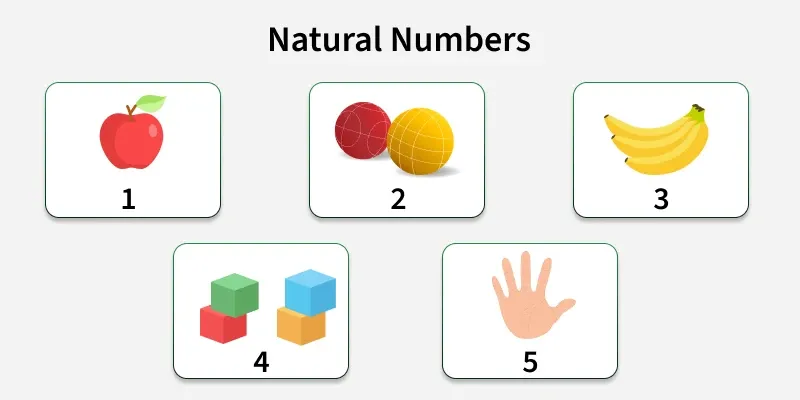
Characteristics of Natural Numbers:
- They include only positive integers.
- Denoted by N.
- They do not include fractions, decimals, or negatives.
- They are infinite — there’s no largest natural number.
Note: Some definitions (especially in computer science or set theory) include 0 as a natural number:Is Zero a Natural Number?
Types of Natural Numbers
- Odd natural numbers: 1, 3, 5, 7, .......
- Even natural numbers: 2, 4, 6, 8, .......
Natural Numbers vs Whole Numbers
Natural Numbers | Whole Numbers |
|---|---|
| The smallest natural number is 1. | The smallest whole number is 0. |
| All natural numbers are whole numbers. | All whole numbers are not natural numbers. |
| Representation of the set of natural numbers is N = {1, 2, 3, 4, ...} | Representation of the set of whole numbers is W = {0, 1, 2, 3, ...} |
Set of Natural Numbers
Set Form | Explanation |
|---|---|
| Statement Form | N = Set of numbers generated from 1. |
| Roaster Form | N = {1, 2, 3, 4, 5, 6, ...} |
| Set-builder Form | N = {x: x is a positive integer starting from 1} |
The set of whole numbers is identical to the set of natural numbers, with the exception that it includes 0 as an extra number.
W = {0, 1, 2, 3, 4, 5, ...} and N = {1, 2, 3, 4, 5, ...}

Natural Numbers on Number Line
Natural numbers are represented by all positive integers or integers on the right-hand side of 0, whereas whole numbers are represented by all positive integers plus zero.

Properties of Natural Numbers
All the natural numbers have these properties in common :
Let's learn about these properties in the table below.
| Property | Description | Example |
|---|---|---|
| Closure Property | ||
| Addition Closure | The sum of any two natural numbers is a natural number. | 3 + 2 = 5, 9 + 8 = 17 |
| Multiplication Closure | The product of any two natural numbers is a natural number. | 2 × 4 = 8, 7 × 8 = 56 |
| Associative Property | ||
| Associative Property of Addition | Grouping of numbers does not change the sum. | 1 + (3 + 5) = 9, (1 + 3) + 5 = 9 |
| Associative Property of Multiplication | Grouping of numbers does not change the product. | 2 × (2 × 1) = 4, (2 × 2) × 1 = 4 |
| Commutative Property | ||
| Commutative Property of Addition | The order of numbers does not change the sum. | 4 + 5 = 9, 5 + 4 = 9 |
| Commutative Property of Multiplication | The order of numbers does not change the product. | 3 × 2 = 6, 2 × 3 = 6 |
| Distributive Property | ||
| Multiplication over Addition | Distributing multiplication over addition. | a(b + c) = ab + ac |
| Multiplication over Subtraction | Distributing multiplication over subtraction. | a(b - c) = ab - ac |
Note:
- Subtraction and Division may not result in a natural number.
- Associative Property does not hold true for subtraction and division.
Operations With Natural Numbers
We can add, subtract, multiply, and divide the natural numbers together, but the result of the subtraction and division is not always a natural number.
Let's understand the operations on natural numbers:
| Operation | Description | Symbol | Examples |
|---|---|---|---|
| Addition | Combines two or more numbers to find their total. | + | 3 + 4 = 7, 11 + 17 = 28 |
| Subtraction | Finds the difference between two natural numbers; can result in natural or non-natural numbers. | - | 5 - 3 = 2, 17 - 21 = -4 |
| Multiplication | Finds the value of repeated addition. | × or * | 3 × 4 = 12, 7 × 11 = 77 |
| Division | Dividing the number into equal parts may result in a quotient and a remainder. | ÷ or / | 12 ÷ 3 = 4, 22 ÷ 11 = 2 |
| Exponentiation | Raises a number to a certain power. | ^ | 23 = 8 |
| Square Root | The value that, when multiplied by itself, gives the original number. | √ | √25 = 5 |
| Factorial | The product of all positive integers up to and including that number. | ! | 5! = 120 |
Mean of First n Natural Numbers
As mean is defined as the ratio of the sum of observations to the number of total observations.
Mean Formula for the first n terms of natural numbers:
Mean = S/n = (n+1)/2
where,
- S is the Sum of all Observations
- n is the Number of Terms Taken into Consideration
Sum of Squares of First n Natural Numbers
The sum of the squares of the first n natural numbers is given as follows:
S = n(n + 1)(2n + 1)/6
Where n is the number taken into consideration.
Related Articles
Solved Examples of Natural Numbers
Let's solve some example problems on Natural Numbers.
Question 1: Identify the natural numbers among the given numbers: 23, 98, 0, -98, 12.7, 11/7, 3.
Solution:
Since negative numbers, 0, decimals, and fractions are not a part of natural numbers.
Therefore, 0, -98, 12.7, and 11/7 are not natural numbers.
Thus, natural numbers are 23, 98, and 3.
Question 2: Prove the distributive law of multiplication over addition with an example.
Solution:
Distributive law of multiplication over addition states: a(b + c) = ab + ac
For example, 4(10 + 20), here 4, 10, and 20 are all natural numbers and hence must follow distributive law
4(10 + 20) = 4 × 10 + 4 × 20
4 × 30 = 40 + 80
120 = 120
Hence, proved.
Question 3: Prove the distributive law of multiplication over subtraction with an example.
Solution:
Distributive law of multiplication over addition states: a(b - c) = ab - ac.
For example, 7(3 - 6), here 7, 3, and 6 are all natural numbers and hence must follow the distributive law. Therefore,
7(3 - 6) = 7 × 3 - 7 × 6
7 × -3 = z1 - 42
-21 = -21
Hence, proved.
Question 4: List the first 10 natural numbers.
Solution:
1, 2, 3, 4, 5, 6, 7, 8, 9, and 10 are the first ten natural numbers.
Natural Numbers Question
Question 1: What is the Smallest Natural Number?
Question 2: What is the Biggest Natural Number?
Question 3: Simplify, 17(13 - 16)
Question 4: Simplify, 11(9 - 2)
Question 5: Find the sum of the first 20 natural numbers.
Question 6: Is 97 a prime natural number?
Question 7: What is the smallest natural number that is divisible by both 12 and 18?
Question 8: Find the product of the first 5 natural numbers.
Question 9: How many natural numbers are there between 50 and 100 (inclusive)?
Question 10: Discuss whether 0 is included in the set of natural numbers based on its definition.
Answer Key:
- 1
- Not defined
- -51
- 77
- 210
- Yes
- 36
- 120
- 51
- No