

Trigonometry can be defined as the branch of mathematics that determines and studies the relationships between the sides of a triangle and the angles subtended by them. Trigonometry is used in the case of right-angled triangles. Trigonometric functions define the relationships between the 3 sides and the angles of a triangle. There are 6 trigonometric functions mainly.
Before going into the study of the trigonometric functions we will learn about the 3 sides of a right-angled triangle.
The three sides of a right-angled triangle are as follows,
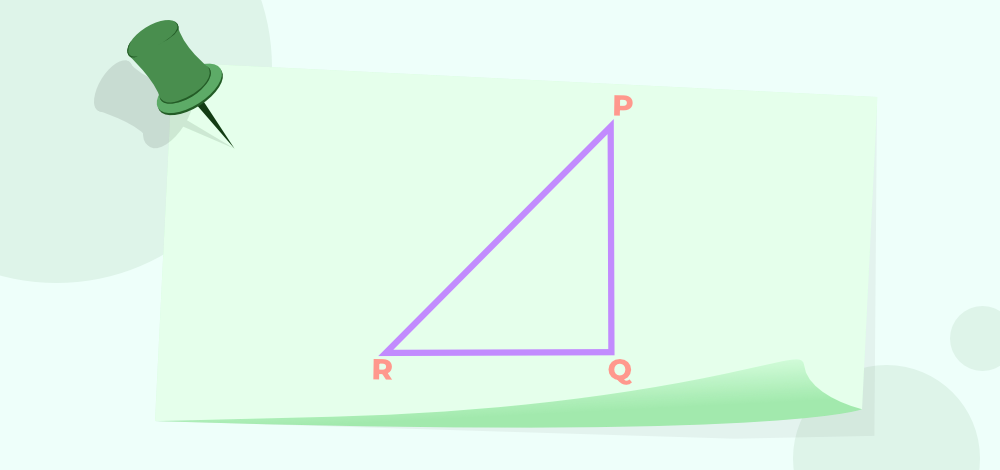
- Base: The side(RQ) on which the angle θ lies is known as the base.
- Perpendicular: It is the side(PQ) opposite to the angle θ in consideration.
- Hypotenuse: It is the longest side(PR) in a right-angled triangle and opposite to the 90° angle.
Trigonometric Functions
Trigonometry has 6 basic trigonometric functions, they are sine, cosine, tangent, cosecant, secant, and cotangent. Now let's look into the trigonometric functions. The six trigonometric functions are as follows,
- Sine Function: It is represented as sin θ and is defined as the ratio of perpendicular and hypotenuse.
- Cosine Function: It is represented as cos θ and is defined as the ratio of base and hypotenuse.
- Tangent Function: It is represented as tan θ and is defined as the ratio of sine and cosine of an angle. Thus the definition of tangent comes out to be the ratio of perpendicular and base.
- Cosecant Function: It is the reciprocal of sin θ and is represented as cosec θ.
- Secant Function: It is the reciprocal of cos θ and is represented as sec θ.
- Cotangent Function: It is the reciprocal of tan θ and is represented as cot θ.
What are Six Trigonometry Functions?
The six trigonometric functions have formulae for the right-angled triangles, the formulae help in identifying the lengths of the sides of a right-angled triangle, lets take a look at all those formulae,
| Trigonometric Functions | Formulae |
|---|---|
| sin θ | |
| cos θ | |
| tan θ | |
| cosec θ | |
| sec θ | |
| cot θ |
The below table shows the values of these functions at some standard angles,
| Function | 0° | 30° | 45° | 60° | 90° |
|---|---|---|---|---|---|
| ∞ | |||||
| ∞ | |||||
| ∞ | |||||
| ∞ |
Note: It is advised to remember the first 3 trigonometric functions and their values at these standard angles for ease of calculations.
Sample Problems on Six Trigonometric Functions
Problem 1: Evaluate sine, cosine, and tangent in the following figure.
.webp)
Solution:
Given,
- P = 3
- B = 4
- H = 5
Using the trigonometric formulas for sine, cosine and tangent,
sin\theta=\frac{P}{H}=\frac{3}{5}
cos\theta=\frac{B}{H}=\frac{4}{5}
tan\theta=\frac{P}{B}=\frac{3}{4}
Problem 2: In the same triangle evaluate secant, cosecant, and cotangent.
Solution:
As it is known the values of sine, cosine and tangent, we can easily calculate the required ratios.
cosec\theta=\frac{1}{sin\theta}=\frac{5}{3}
sec\theta=\frac{1}{cos\theta}=\frac{5}{4}
cot\theta=\frac{1}{tan\theta}=\frac{4}{3}
Problem 3: Given
Solution:
tan\theta=\frac{P}{B} Thus P = 6, B = 8
Using Pythagoras theorem,
H2 = P2 + B2
H2= 36 + 64 = 100
Therefore, H =10
Now,
sin\theta= \frac{6}{10}
cos\theta=\frac{8}{10}
Problem 4: If
Solution:
Given
cot\theta=\frac{12}{13} Thus
tan\theta=\frac{1}{cot\theta}=\frac{13}{12}
\therefore tan^2\theta=\frac{169}{144}
Problem 5: In the given triangle, verify sin2θ + cos2θ = 1
.webp)
Solution:
Given,
- P = 12
- B = 5
- H = 13
Thus
sin\theta=\frac{12}{13}
cos\theta=\frac{5}{13}
sin^2\theta=144/169
cos^2\theta=25/169
sin^2\theta+cos^2\theta=\frac{169}{169}=1 Hence verified.