

Real numbers are the numbers that can be represented on the number line and include both rational and irrational numbers.
- Rational numbers can be written in the form
\frac{p}{q} where q ≠ 0, and their decimal expansions either terminate or repeat. - Irrational numbers cannot be written as a fraction and have non-terminating, non-repeating decimals.
- Together, these two types form the complete set of real numbers.
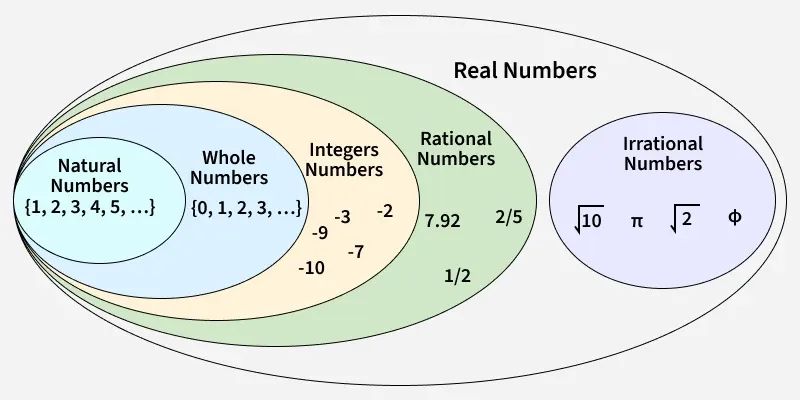
Rational Numbers are either finite or recurring in nature, but Irrational Numbers are non-terminating as well as non-repeating in nature.
Rational Numbers | Irrational Numbers |
|---|---|
| Those numbers that can be expressed as a ratio of two numbers p and q, where p and q are any integers and q is not equal to zero is called rational numbers, i.e., we can represent them in the (p/q) format. | Those numbers that cannot be expressed as a ratio of two numbers p and q, where p and q are any integers and q is not equal to zero is called rational numbers, i.e., we cannot represent them in the (p/q) format. |
| Rational Numbers are either finite or recurring in nature. | Irrational Numbers are non-terminating as well as non-repeating in nature. |
| Both the numerator and denominator are integers, where the denominator is not equal to zero. | These cannot be written in fractional form. So no concept of numerator and denominator here. |
| These include perfect squares such as 4, 9, 16, 25, 36, 49, and so on | These include surds such as √2, √3, √5, and so on. |
| Example: 3/2 = 1.5, 3.6767 , 6, 9.31, 64, 0.66666, 3.25 etc. | Example: √5, √11, π(Pi), etc. |
Also Check:
Sample Problems
Question 1: Is Pi (π) a rational or an irrational number, explain why?
Answer:
Pi (π) is an irrational number as it is non-terminating and non-repeating in nature. However, in mathematics, in order to make calculations easier, pi is rounded off as 3.14 and is also represented in fraction form as 22/7.
Question 2: Which of the given numbers are rational and which are irrational?
- 6
- 3/2
- √7
- √25
Answer:
- 6 ⇢ Rational number, terminating and non-repeating in nature.
- 3/2 ⇢ Rational number, in the form p/q, and q≠0.
- √7 ⇢ Irrational number, is the square root of a number that is not a perfect square.
- √25 ⇢ Rational number, it is the square root of a perfect square and the value is 5.
Question 3: The square root of a perfect square is an irrational number. Is this statement true or false?
Answer:
No, the statement "The square root of a perfect square is an irrational number" is not true. The correct fact is that the square root of perfect squares is a rational number, for instance, √36 = 6, √64 = 8. Irrational numbers are the square roots of those numbers that are not perfect squares, for instance, √2, √3, etc.