
Multidimensional OLAP (MOLAP) is a fast and efficient data analysis technology that stores data in pre-aggregated multidimensional cubes. These cubes allow quick access to summarized information across dimensions like time, product and location, enabling rapid responses to complex queries and reports.
Note: MOLAP takes a snapshot of data usually from a data warehouse and organizes it into a structured cube format for high speed analysis and compact storage. It remains popular for its performance and ability to handle large volumes of data efficiently.
MOLAP Architecture
The architecture of Multidimensional Online Analytical Processing (MOLAP) is designed to optimize the speed and efficiency of querying large sets of data. Here's how the MOLAP architecture is generally structured:
- Database Server: Stores data in multidimensional cubes optimized for fast, complex queries. It manages the raw data used to build the cubes.
- Query Engine: Processes user queries by retrieving pre-aggregated data from the cubes. Delivers fast responses for analysis and reporting.
- Frontend Tools: User interfaces that display data from the MOLAP server. They support reporting, analysis and data visualization.
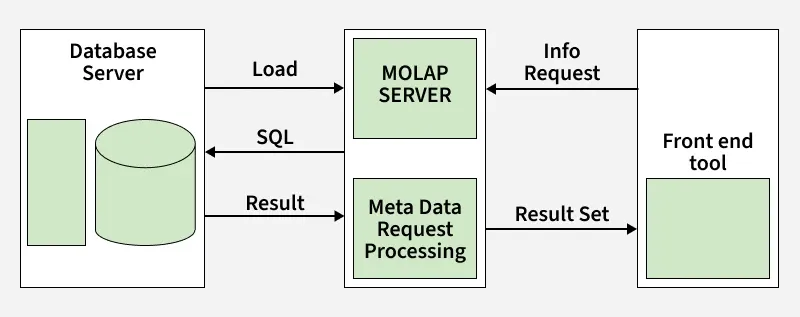
Working of MOLAP
Multidimensional Online Analytical Processing (MOLAP) works by storing and analyzing data in pre-aggregated, multidimensional cubes instead of traditional two-dimensional tables. This approach enhances query performance, making it ideal for business intelligence and analytical applications.
- Data Extraction & Cube Creation: MOLAP systems pull relevant data from data warehouses and store it in multidimensional cubes optimized for analysis. These cubes allow quick access to structured data.
- Pre-Aggregation & Optimization: The data cubes store pre-calculated summaries, which speeds up query processing and reduces computational overhead during analysis.
- Multidimensional Data Analysis: Users can explore data through four key functions
- Drill-Down: Access more detailed data, such as breaking down sales figures by region or individual stores.
- Roll-Up: Summarize data to get a broader view, like analyzing total sales by country instead of city.
- Slice-and-Dice: Segment data across multiple dimensions, such as comparing product sales by month and store location.
- Pivoting: Rotate data views to analyze it from different perspectives, like switching between yearly and regional sales comparisons.
- Fast Query Processing: Since MOLAP systems store data cubes separately from the main database, they can quickly respond to common business queries without reprocessing large datasets.
Key Features of MOLAP
- Multidimensional Data Storage: MOLAP stores data in multidimensional cubes instead of traditional relational tables, allowing quick and efficient access to pre-aggregated data.
- Fast Query Performance: Since data is pre-processed and stored in an optimized format, MOLAP provides rapid query responses, making it ideal for business intelligence and reporting.
- Data Aggregation & Pre-Calculation: MOLAP systems perform calculations in advance, reducing the need for real-time computation and speeding up analytical tasks.
- Advanced Data Analysis: Supports key OLAP operations like drill-down, roll-up, slice-and-dice and pivoting, enabling in-depth data exploration.
- Efficient Indexing & Caching: Uses optimized indexing and caching techniques to retrieve relevant data quickly, enhancing performance.
- Compact Storage: MOLAP uses specialized compression techniques to store data efficiently, reducing storage requirements while maintaining performance.
Advantages and Disadvantages
Advantages | Disadvantages |
|---|---|
Very fast query performance | Limited to summarized (pre-aggregated) data |
Efficient storage using compression | Not ideal for large, detailed datasets |
Pre-aggregated cubes enable quick analysis | Cube processing time can be long |
User-friendly multidimensional view | Requires additional storage for cube structures |
Ideal for repetitive and complex queries | Less flexible for real-time or ad-hoc analysis |
Applications of MOLAP
- Business Reporting: Analyzes sales, customer behavior and finances via dashboards.
- Financial Forecasting: Speeds up budgeting and profit analysis using large datasets.
- Sales & Marketing: Tracks product sales, trends and customer segments efficiently.
- Supply Chain: Monitors inventory and forecasts demand using historical data.
- Healthcare: Analyzes patient data and treatment outcomes across dimensions.
- Telecom: Tracks network performance and user patterns for service improvement.
- Retail & E-commerce: Studies buying behavior, pricing and customer experience.
- Fraud & Risk Management: Detects fraud and assesses credit risk in real time.
MOLAP Tools
- Oracle Essbase: A powerful MOLAP tool by Oracle that supports advanced data modeling, reporting and business intelligence applications.
- IBM Cognos TM1: A high-performance MOLAP tool used for financial planning, budgeting and analytics with in-memory processing for fast computations.
- Microsoft SQL Server Analysis Services (SSAS): Part of the Microsoft BI stack, SSAS offers MOLAP-based data analysis and reporting features.
- SAP BW (Business Warehouse): A data warehousing tool by SAP that includes MOLAP capabilities for multidimensional data analysis and enterprise reporting.
- MicroStrategy: A business intelligence platform that supports MOLAP for interactive dashboards, reporting and advanced data analytics.
- Jedox: A cloud-based MOLAP tool used for performance management, planning and real-time business analytics.