
A batch-processing operating system executes jobs in groups (batches) without direct user interaction. Users prepare their jobs offline (such as using punch cards) and submit them to an operator. The system groups jobs with similar requirements and processes them together to improve efficiency and reduce setup time.
- Jobs are grouped into batches based on similar requirements
- No direct interaction between user and computer
- Jobs are prepared offline and submitted to an operator
- Improves efficiency by reducing setup time and processing similar tasks together

Features of Batch Processing Operating System
- Designed for batch processing: Batch OS is specifically built to process jobs in groups (batches), where similar tasks are collected and executed together to improve efficiency.
- Handles large volumes of data: It is capable of processing huge amounts of data, making it suitable for organizations that deal with continuous and large-scale data operations.
- Execution without user interaction: Once jobs are submitted, they are executed automatically without any direct user involvement, which reduces manual effort.
- Improves speed and efficiency: By processing multiple jobs together, the system reduces setup time and increases overall processing speed.
- Ideal for organizations: It is widely used in industries like banking, payroll, and data processing where large datasets need to be handled regularly.
- Automatic job scheduling: The system schedules jobs automatically and executes them in a proper sequence, ensuring smooth workflow.
- Ordered task execution: Jobs are arranged in a logical or ranked order, which helps in better management and execution of tasks.
- Simplifies task handling: Batch OS makes it easier to manage, monitor, and control multiple jobs at once.
- Reduces CPU idle time: Continuous processing of batches ensures that the CPU remains busy, improving system utilization.
- Suitable for repetitive tasks: It is best for performing repetitive operations that do not require immediate user feedback.
Working of Batch Processing Operating System
- Job submission: Users prepare their jobs offline (e.g., using punch cards or files) and submit them to the system/operator without direct interaction.
- Batch formation: The system groups similar jobs together into batches based on their requirements (like same program or data type).
- Job queueing: These batches are placed in a queue (usually the ready queue) for execution.
- Scheduling of jobs: The operating system schedules jobs automatically and decides the order in which they will be executed.
- Sequential execution: Jobs are executed one after another without user intervention, ensuring continuous processing.
- Output generation: After execution, the output is generated and provided to the user later, not immediately.
- Efficiency improvement: By processing jobs in batches, the system reduces idle time and increases CPU utilization.
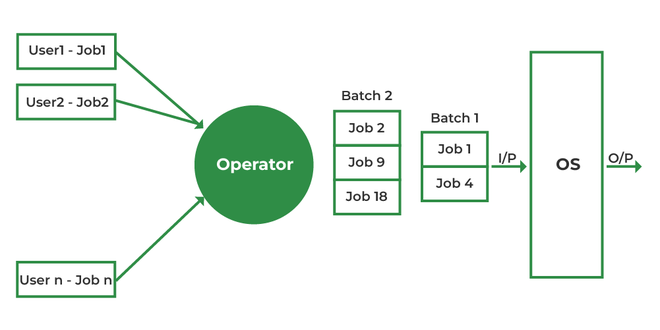
Example of Batch Operating System
Some examples of batch-processing operating systems include:
- IBM's z/OS
- Unisys MCP
- and Burroughs MCP/BCS
These systems are usually used in large organizations that require high-volume data processing, such as banks, airlines, and government agencies.
Advantages
The benefits of batch-processing operating systems include:
- Resource Efficiency: These systems improve the use of computation resources by processing jobs in groups and scheduling them during stages of resource accessibility.
- High Throughput: Batch processing systems can handle and complete a large number of tasks quickly, confirming quick turnaround times and high throughput.
- Error Reduction: Since these systems work without requiring user interference, they minimize the risk of faults that can occur with manual processing.
- Simplified Management: They restructure job management by automating the submission, scheduling, and implementation of tasks.
- Cost Efficiency: By producing well-organized use of resources and reducing processing time and errors, batch processing systems can be a cost-effective option.
- Scalability: These classifications can manage a huge number of tasks, making them scalable and appropriate for large organizations with significant data processing needs.
Disadvantages
There are many disadvantages to using batch operating systems, including:
- Limited functionality: A batch operating system can solve only simple tasks not solve more complex tasks. this can make them difficult to use for certain tasks, like managing files or software.
- Security issues: Batch operating systems are not more secure because they are not typically used for day-to-day tasks, so they are not as secure as more common operating systems. This can lead to security risks if the system is used by people who should not have access to it.
- Interruptions Batch systems can be interrupted frequently, which can lead to missed deadlines or mistakes.
- Inefficiency: Batch systems are often slow and difficult to use, which can lead to inefficiency in the workplace.