

Segmentation is a memory management technique in which a process is divided into variable-sized units called segments, where each segment represents a logical part of a program such as functions, arrays, or modules. It follows the user’s logical view of memory and allows flexible organization, protection, and sharing of data.
- Divides a process into variable-sized logical segments
- Each segment represents a program unit like function or array
- Uses a segment table for address translation (base and limit)
- Supports flexibility, protection, and sharing of memory
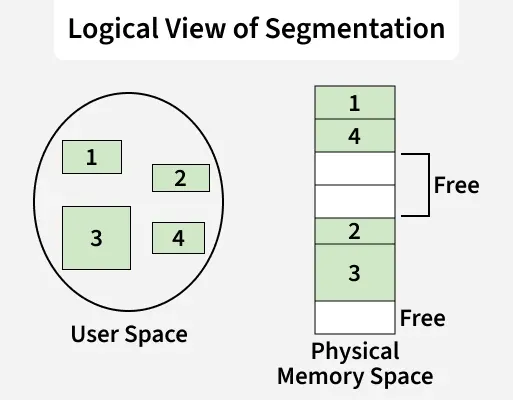
Features of Segmentation
1. Variable-sized divisions: Segments can have different lengths, depending on the program’s requirements.
2. Logical division of memory: Segments represent meaningful units like code, stack, data, or modules.
3. Two-part address: A logical address consists of:
- Segment number (s): Identifies which segment is being referred to.
- Offset (d): Specifies the exact location within that segment.
Logical Address = ⟨Segment number, Offset⟩
4. Protection and sharing: Different segments can have access rights (read, write, execute) and can be shared among processes.
5. No internal fragmentation: Memory is allocated according to segment size, so there is no unused space within a segment.
6. External fragmentation: Can occur when free memory is divided into small scattered blocks.
Types of Segmentation
- Simple Segmentation: A process is divided into multiple segments, and all segments are loaded into memory (not necessarily contiguously). Address translation is done using a segment table.
- Segmentation with Virtual Memory: A process is divided into segments, but only required segments are loaded into memory on demand. This reduces memory usage and supports execution of large programs.
Logical and physical addresses have a well-defined relationship, where the physical address is obtained using the segment table (base + offset).
Segment Table
Used to map a two-part logical address ⟨segment number, offset⟩ to a one-dimensional physical address. Each segment has an entry in the table. Each table entry contains:
- Base Address: Starting physical address of the segment in memory.
- Segment Limit: Size (length) of the segment; used to check whether the offset is within valid range.

Translation of Two-dimensional Logical Address to Dimensional Physical Address.
.webp)
The address generated by the CPU is divided into:
- Segment number (s): Number of bits required to represent the segment.
- Segment offset (d): Number of bits required to represent the position of data within a segment.
Advantages
- Reduced Internal Fragmentation: Segments are sized as per program needs, minimizing wasted space.
- Smaller Segment Table: Requires less space compared to page tables.
- Better CPU Utilization: Entire modules are loaded at once, improving performance.
- Closer to User’s View: Programs can be divided into logical modules, matching how users think.
- User-Controlled Size: Segment size is defined by the user, unlike fixed page size in paging.
- Security & Separation: Segments help isolate sensitive data and operations.
Disadvantages
- External Fragmentation: Free memory gets scattered, leading to wasted space.
- Overhead: Maintaining segment tables requires extra memory and management.
- Slower Access: Two memory lookups (segment table + main memory) increase access time.
- Complexity: Managing multiple variable-sized segments is harder than paging.
- Segmentation Faults: Errors may occur if a program tries to access memory outside its segment.