

IThe scalar (dot) product is a way of multiplying vectors, where the result is a single numerical value (scalar). It is commonly used to measure how much two vectors are aligned with each other.
- Vectors can be multiplied by a scalar or by another vector
- The scalar product (dot product) gives a scalar value
- It is widely used in physics to calculate quantities like work, energy, and power
- Example: Work done = dot product of force and displacement vectors

The scalar product of two vectors A and B is defined as:
\boxed{\overrightarrow{\rm A} \cdot \overrightarrow{\rm B}= |\overrightarrow{\rm A}|\, | \overrightarrow{\rm B} | \cos\theta}
where:
|\mathbf{A}| \, \, and \, \, |\mathbf{B}| are the magnitudes of the vectors.\theta is the angle between them.
Since the product is represented by a dot (·), it is called the dot product.
Scalar Product in terms of Unit Vector Representation
In the unit vector representation of vectors, i, j, and k are along the x-axis, y-axis, and z-axis, respectively. The scalar product can be calculated as
\overrightarrow{\rm A}.\overrightarrow{\rm B} = A_x B_x + A_yB_y + A_zB_z
where:
Matrix Representation of Scalar Products
It is useful to represent vectors as row or column matrices instead of as the above unit vectors. If we treat vectors as column matrices of their x, y, and z components, then the transposes of these vectors would be row matrices.
Now therefore, the Matrix A and Matrix B look like this:
The matrix product of these 2 matrices will give us the scalar product of the 2 matrices, which is the sum of corresponding components of the given 2 vectors; the resulting number will be the scalar product of vector A and vector B.
Physical Interpretation
Geometrically, the scalar product represents the product of the magnitude of one vector and the component of the other vector along its direction. It measures how much one vector acts in the direction of another.
Geometrical interpretation
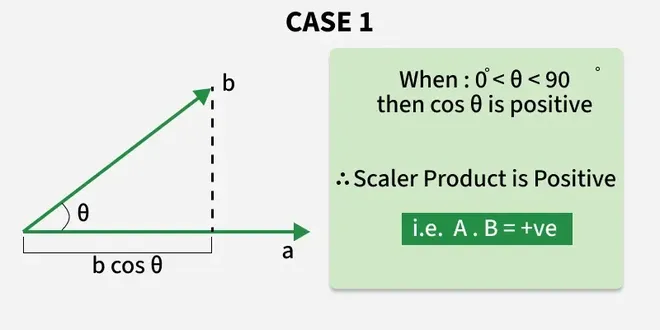
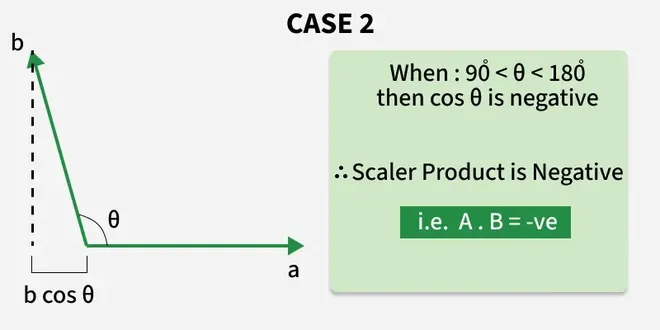
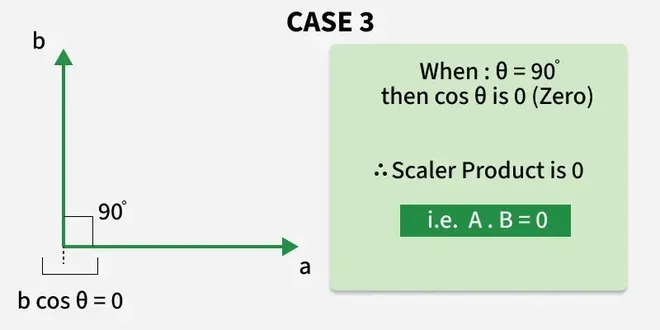
The product of two nonzero vectors can be visualized as multiplying the magnitude of any one of the vectors by the magnitude of the projection of the other vector upon it.
Case 1: When the angle between the two vectors is 0° < θ < 90°, then the scalar product is positive.
Case 2: When the angle between the two vectors is 90° < θ < 180°, then the scalar product is negative.
Case 3: When the angle between the two vectors is θ = 90°, then the scalar product is 0 (zero).
Special Cases of Scalar Product
(1) Scalar product of two parallel vectors: The scalar product of two parallel vectors is simply the product of the magnitudes of the two vectors. As the angle between vectors when they are parallel is 0 degrees and cos 0 = 1.
Therefore,
a.b = |a| × |b| cos 0
= |a| × |b|
(2) Scalar Product of Two Antiparallel Vectors: The scalar product of two antiparallel vectors is the negative of the product of the magnitudes of the two vectors.
a.b cos 180 = −|a| |b| (Since, cos 180 = -1)
(3) Scalar product of two orthogonal vectors: The scalar product of two orthogonal vectors is 0.
a.b cos 90 = 0 (Since cos 90 = 0)
Properties of Scalar Product (Dot Product)
1. Commutative Properties of Scalar Multiplication: If a and b are two vectors, then:
a.b = b.a
As, a.b = |a||b| cos θ and b.a = |b||a| cos θ Therefore a.b = b.a
2. Distributive Over Vector Addition: If a, b, and c are vectors, then
a.(b+c) = a.b + a.c
3. Scalar Multiplication: The scalar product is consistent with scalar multiplication. If u and v are constants and a and b are vectors, then,
(u a). (v b) = u v (a. b)
4. Orthogonality: Two vectors are orthogonal if their scalar product is zero.
i.e., vectors u and v are orthogonal if u . v = 0.
Applications
The scalar (dot) product has several important applications in vector operations and helps in understanding relationships between vectors.
- Used to find the projection of one vector onto another, such as projecting vector a onto b using
\frac{\mathbf{a} \cdot \mathbf{b}}{\lVert \mathbf{b} \rVert} - Helps calculate the scalar triple product of three vectors, written as
\mathbf{a} \cdot (\mathbf{b} \times \mathbf{c}) - Used to find the angle between two vectors using
\cos(\theta) = \frac{\mathbf{a} \cdot \mathbf{b}}{\lVert \mathbf{a} \rVert \, \lVert \mathbf{b} \rVert}