

- Courses
- Tutorials
- Interview Prep
GATE CS 2013
Question 1
A certain computation generates two arrays a and b such that a[i]=f(i) for 0 ≤ i < n and b[i]=g(a[i]) for 0 ≤ i < n. Suppose this computation is decomposed into two concurrent processes X and Y such that X computes the array a and Y computes the array b. The processes employ two binary semaphores R and S, both initialized to zero. The array a is shared by the two processes. The structures of the processes are shown below.
Process X:                         Process Y:
private i;                         private i;
for (i=0; i < n; i++) {            for (i=0; i < n; i++) {
   a[i] = f(i);                       EntryY(R, S);
   ExitX(R, S);                       b[i]=g(a[i]);
}                                 }
Which one of the following represents the CORRECT implementations of ExitX and EntryY?
(A)
ExitX(R, S) {
  P(R);
  V(S);
}

EntryY (R, S) {
  P(S);
  V(R);
}
(B)
ExitX(R, S) {
  V(R);
  V(S);
}

EntryY(R, S) {
  P(R);
  P(S);
}
(C)
ExitX(R, S) {
  P(S);
  V(R);
}
EntryY(R, S) {
  V(S);
  P(R);
}
(D)
ExitX(R, S) {
  V(R);
  P(S);
}
EntryY(R, S) {
  V(S);
  P(R);
}
- A
A
- B
B
- C
C
- D
D
Question 2
A shared variable x, initialized to zero, is operated on by four concurrent processes W, X, Y, Z as follows. Each of the processes W and X reads x from memory, increments by one, stores it to memory, and then terminates. Each of the processes Y and Z reads x from memory, decrements by two, stores it to memory, and then terminates. Each process before reading x invokes the P operation (i.e., wait) on a counting semaphore S and invokes the V operation (i.e., signal) on the semaphore S after storing x to memory. Semaphore S is initialized to two. What is the maximum possible value of x after all processes complete execution?
- A
-2
- B
-1
- C
1
- D
2
Question 3
Three concurrent processes X, Y, and Z execute three different code segments that access and update certain shared variables. Process X executes the P operation (i.e., wait) on semaphores a, b and c; process Y executes the P operation on semaphores b, c and d; process Z executes the P operation on semaphores c, d, and a before entering the respective code segments. After completing the execution of its code segment, each process invokes the V operation (i.e., signal) on its three semaphores. All semaphores are binary semaphores initialized to one. Which one of the following represents a deadlock-free order of invoking the P operations by the processes?
- A
X: P(a)P(b)P(c) Y: P(b)P(c)P(d) Z: P(c)P(d)P(a)
- B
X: P(b)P(a)P(c) Y: P(b)P(c)P(d) Z: P(a)P(c)P(d)
- C
X: P(b)P(a)P(c) Y: P(c)P(b)P(d) Z: P(a)P(c)P(d)
- D
X: P(a)P(b)P(c) Y: P(c)P(b)P(d) Z: P(c)P(d)P(a)
Question 4
Consider a hard disk with 16 recording surfaces (0-15) having 16384 cylinders (0-16383) and each cylinder contains 64 sectors (0-63). Data storage capacity in each sector is 512 bytes. Data are organized cylinder-wise and the addressing format is <cylinder no., surface no., sector no.> . A file of size 42797 KB is stored in the disk and the starting disk location of the file is <1200, 9, 40>. What is the cylinder number of the last sector of the file, if it is stored in a contiguous manner?
- A
1281
- B
1282
- C
1283
- D
1284
Question 5
Which of the following statements are TRUE?
1. The problem of determining whether there exists
   a cycle in an undirected graph is in P.
2. The problem of determining whether there exists
   a cycle in an undirected graph is in NP.
3. If a problem A is NP-Complete, there exists a
   non-deterministic polynomial time algorithm to solve A.
- A
1, 2 and 3
- B
1 and 2 only
- C
2 and 3 only
- D
1 and 3 only
Question 6
A computer uses 46-bit virtual address, 32-bit physical address, and a three-level paged page table organization. The page table base register stores the base address of the first-level table (T1), which occupies exactly one page. Each entry of T1 stores the base address of a page of the second-level table (T2). Each entry of T2 stores the base address of a page of the third-level table (T3). Each entry of T3 stores a page table entry (PTE). The PTE is 32 bits in size. The processor used in the computer has a 1 MB 16-way set associative virtually indexed physically tagged cache. The cache block size is 64 bytes. What is the size of a page in KB in this computer?
- A
2
- B
4
- C
8
- D
16
Question 7
Consider the following two sets of LR(1) items of an LR(1) grammar.
X -> c.X, c/d
   X -> .cX, c/d
   X -> .d, c/d
   X -> c.X, $
   X -> .cX, $
   X -> .d, $
Which of the following statements related to merging of the two sets in the corresponding LALR parser is/are FALSE?
- Cannot be merged since look aheads are different.
- Can be merged but will result in S-R conflict.
- Can be merged but will result in R-R conflict.
- Cannot be merged since goto on c will lead to two different sets.
- A
1 only
- B
2 only
- C
1 and 4 only
- D
1, 2, 3, and 4
Question 8
Which of the following is/are undecidable?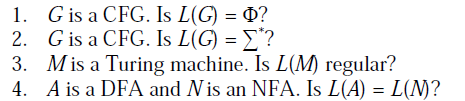
- A
3 only
- B
3 and 4 only
- C
1, 2 and 3 only
- D
2 and 3 only
Question 9
What is the return value of f(p,p), if the value of p is initialized to 5 before the call? Note that the first parameter is passed by reference, whereas the second parameter is passed by value.
int f(int &x, int c) {
   c = c - 1;
   if (c==0) return 1;
   x = x + 1;
   return f(x,c) * x;
}
- A
3024
- B
6561
- C
55440
- D
161051
Question 10
The preorder traversal sequence of a binary search tree is 30, 20, 10, 15, 25, 23, 39, 35, 42. Which one of the following is the postorder traversal sequence of the same tree?
- A
10, 20, 15, 23, 25, 35, 42, 39, 30
- B
15, 10, 25, 23, 20, 42, 35, 39, 30
- C
15, 20, 10, 23, 25, 42, 35, 39, 30
- D
15, 10, 23, 25, 20, 35, 42, 39, 30
There are 65 questions to complete.