
- Courses
- Tutorials
- Interview Prep
GATE EC ||COMMUNICATION SYSTEM||INFORMATION THEORY, PROBABILTY OF ERROR & DECISION THEORY & CODING TECHNIQUE|| PYQs (2000-2025)
Question 1
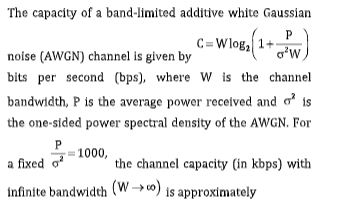
PYQ || 2014 MCQ ||1 MARK
1.44
1.08
0.72
0.36
Question 2
A random variable X takes values –0.5 and 0.5 with probabilities 1/4 and 3/4 , respectively. The noisy observation of X is Y = X + Z, where Z has uniform probability density over the interval (–1, 1). X and Z are independent. If the MAP rule baaed detector outputs ˆX as then the value of α(accurate to two decimal places) is_______.
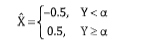
then the value of α(accurate to two decimal places) is_______.
–0.5
Question 3
A random variable X takes values –1 and +1 with probabilities 0.2 and 0.8 respectively. It is transmitted across a channel which adds noise N, so that the random variable at the channel output is Y = X + N. The noise N is independent of X, and is uniformly distributed over the interval [–2, 2]. The receiver makes a decision
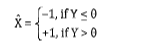
Where the threshold θ ∈ [1,1]is chosen so as to minimize the probability of error Pr[ˆX≠X] ,the minimum probability of error (rounded off to one decimal place) is ________. (COMMUNICATION SYSTEM ||PROBABILTY OF ERROR & DECISON THEORY|| PYQ || 2019 NAT ||2 MARK)
0.1
Question 4
3
1
2
0
Question 5
A digital communication system transmits a block of N bits. The probability of error in decoding a bit is a α. The error event of each bit is independent of error events of
other bits. The received block is declared erroneous if at least one of the bits is decoded wrongly. The probability that the received block is erroneous is
PYQ || 2020 MCQ ||2 MARK)
N(1 – α)
1 – α^ N
α^ N
1 – (1 – α) ^N
Question 6
In a digital communication system, a symbol S randomly chosen from the set {s 1 ,s 2 ,s 3 ,s 4 } is transmitted. It is given that s 1 = -3, s 2 = -1, s 3 = +1 and s 4 = +2, The received symbol is Y = S + W. W is a zero-mean unit-variance Gaussian random variable and is independent of S. Pi is the conditional probability of symbol error for the maximum likelihood (ML) decoding when the transmitted symbol S = S i . The index i for which the conditional symbol error probability P i is the highest is ……. (In integer)
(PYQ || 2020 NAT ||2 MARK)
3
Question 7
A speech signal band limited to 4 kHz, is sampled at 1.25 times the Nyquist rate. The speech samples, assumed to be statistically independent and uniformly distributed
in the range -5 V to +5 V, are subsequently quantized in an 8-bit uniform quantizer and then transmitted over a voice-grade AWGN telephone channel. If the ratio of
transmitted signal power to channel noise power is 26 dB, the minimum channel bandwidth required to ensure reliable transmission of the signal with arbitrarily small
probability of transmission error (rounded off to two decimal places) is _____ kHz.
(PYQ || 2021 NAT ||2 MARK)
9.25
Question 8
Consider a polar non-return to zero (NRZ) waveform using +2 V and -2 V for representing binary ‘1’ and ‘0’ respectively, is transmitted in the presence of additive
zero-mean white Gaussian noise with variance 0.4 V 2 . If the a priori probability of transmission of a binary ‘1’ is 0.4, the optimum threshold voltage for a maximum a
posteriori (MAP) receiver (rounded off to two decimal places) is ____ V.
( PYQ || 2021 NAT ||2 MARK)
0.04
Question 9
A source generates three symbols with probabilities 0.25, 0.25, 0.50 at a rate of 3000 symbols per second. Assuming independent generation of symbols, the most
efficient source encoder would have average bit rate is
( PYQ || 2021 NAT ||2 MARK)
6000 bits/sec
4500 bits/sec
3000 bits/sec
1500 bits/sec
Question 10
A memoryless source emits n symbols each with a probability p. The entropy of the source as a function of n
(PYQ || 2008 MCQ ||2 MARK)
increases as log n
decreases as log(1/n)
increases as n
increases as n log
There are 55 questions to complete.