
- Courses
- Tutorials
- Interview Prep
GATE EC|| CONTROL SYSTEM || FREQUENCY DOMAIN ANALYSIS|| PYQS(2000-2025)
Question 1
An amplifier with resistive negative feedback has two left-half plane poles in its open-loop transfer function. The amplifier
(GATE 2001 || EC || MCQ||1 MARK)
will always be unstable at high frequency
will be stable for all frequency
may be unstable, depending on the feedback factor
will oscillate at low frequency
Question 2
[2000 : 1 Mark]
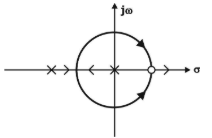
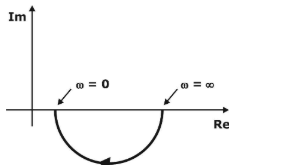
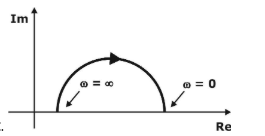
Which one of the following polar diagrams corresponds to a lag network?
(GATE 2001 || EC || MCQ||1 MARK)

Question 3
In the system shown below, x(t) = (sin t)u(t). In a steady state, the response y(t) will be

(GATE 2006 || EC || MCQ||1 MARK)
[Tex]\frac{1}{\sqrt{2}} \sin \left( t - \frac{\pi}{4} \right)[/Tex]
[Tex]\frac{1}{\sqrt{2}} \sin \left( t + \frac{\pi}{4} \right)[/Tex]
[Tex]\frac{1}{\sqrt{2}} e^{-t} \sin t[/Tex]
[Tex]\sin t - \cos t[/Tex]
Question 4
The frequency response of a linear, time-invariant system is given by
[Tex]H(f) = \frac{5}{1 + j 10 \pi f}[/Tex]
The step response of the system is
(GATE 2007 || EC || MCQ||1 MARK)
[Tex]H(f) = \frac{5}{1 + j 10 \pi f}[/Tex]
[Tex]5(1 - e^{-t/5}) u(t)[/Tex]
[Tex]\frac{1}{5} (1 - e^{-5t}) u(t)[/Tex]
[Tex]\frac{1}{5} (1 - e^{-t/5}) u(t)[/Tex]
Question 5
Consider two transfer functions and
[Tex]G_1(s) = \frac{1}{s^2 + as + b}[/Tex]
[Tex]G_2(s) = \frac{s}{s^2 + as + b}[/Tex]
The 3-dB bandwidths of their frequency responses are respectively,
(GATE 2006 || EC || MCQ||1 MARK)
[Tex]\sqrt{a^2 - 4b}, \sqrt{a^2 + 4b}[/Tex]
[Tex]\sqrt{a^2 + 4b}, \sqrt{a^2 - 4b}[/Tex]
[Tex]\sqrt{a^2 - 4b}, \sqrt{a^2 - 4b}[/Tex]
[Tex]\sqrt{a^2 + 4b}, \sqrt{a^2 + 4b}[/Tex]
Question 6
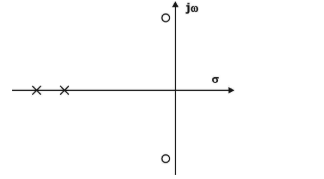
Consider the pole-zero plot shown in the figure. Identify the type of filter represented by this pole-zero configuration.
Low pass filter
High pass filter
Band pass filter
Notch filter
Question 7
A system with a transfer function [Tex]G(s) = \frac{(s^2 + 9)(s + 2)}{(s + 1)(s + 3)(s + 4)}[/Tex]
is excited by sin(ωt). The steady-state output of the system is zero at
(GATE 2001 || EC || MCQ||1 MARK)
[Tex]\omega = 1[/Tex] rad/s
[Tex]\omega = 2[/Tex] rad/s
[Tex]\omega = 3[/Tex] rad/s
[Tex]\omega = 4[/Tex] rad/s
Question 8
The transfer function of a mass-spring-damper system is given by
[Tex]G(s) = \frac{1}{Ms^2 + Bs + K}[/Tex]
The frequency response data for the system are given in the following table.
| Frequency | Magnitude (dB) | Phase (°) |
|---|---|---|
| 0.01 | -18.5 | -0.2 |
| 0.1 | -18.5 | -1.3 |
| 0.2 | -18.4 | -2.6 |
| 1 | -16.0 | -16.9 |
| 2 | -11.4 | -89.4 |
| 3 | -21.5 | -151.0 |
| 5 | -32.8 | -167.0 |
| 10 | -45.3 | -174.5 |
The unit step response of the system approaches a steady-state value of ______.
(GATE 2015 || EC || MCQ||2 MARK)
0.12
Question 9
For a unity feedback control system with the forward path transfer function, the peak resonant magnitude M of the closed-loop frequency response is 2. The corresponding value of the gain K (correct to two decimal places) is.(GATE 2018 || EC || MCQ||2 MARK)
14.92
Question 10
A system with a transfer function

is subjected to an input 5 cos 3t. The steady-state output of the system is

The value of a is ……
(GATE 2005 || EC || MCQ||2 MARK)
4
There are 14 questions to complete.