
- Courses
- Tutorials
- Interview Prep
GATE EC || MATHEMATICS ||DIFFERENTIAL EQUATIONS || PYQs
Question 1
Match the application to appropriate numerical method.
Application
P1: Numerical integration
P2: Solution to a transcendental equation
P3: Solution to a system of linear equations
P4: Solution to a differential equation
Numerical Methods
M1: Newton-Raphson Method
M2: Runge-Kutta Method
M3: Simpson’s 1/3 rule
M4: Gauss Elimination Method
P1–M3, P2–M2, P3–M4, P4–M1
P1–M3, P2–M1, P3–M4, P4–M2
P1–M4, P2–M1, P3–M3, P4–M2
P1–M2; P2–M1, P3–M3, P4–M4
Question 2
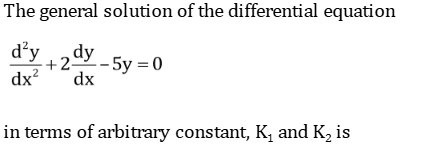
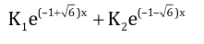
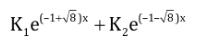
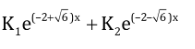
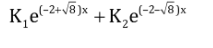
Question 3
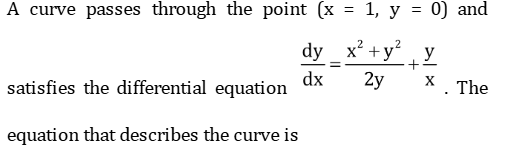
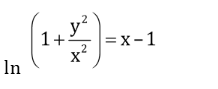
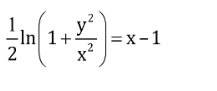
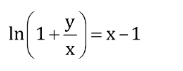
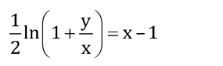
Question 4
Consider the hom
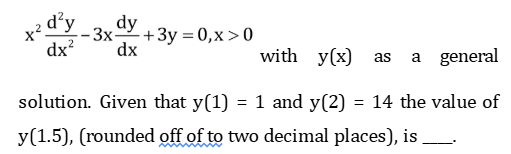
ogeneous ordinary differential equation
5.24 to 5.26
Question 5

Hyperbolas and Parabolas
Hyperbolas and Circles
Parabolas and Circles
Circles and Hyperbolas
Question 6
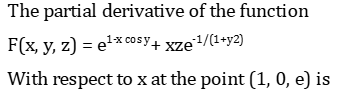
1
1/e
0
-1
Question 7

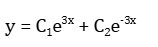

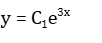

Question 8
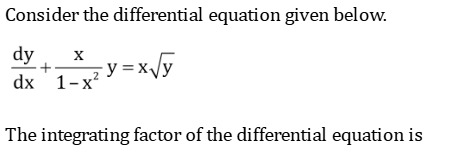

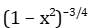


Question 9
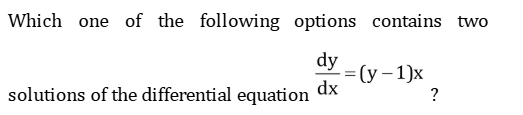
ln|y – 1| = 0.5x2 + C and y = -1
ln|y – 1| = 2x2 + C and y = 1
ln|y – 1| = 2x2 + C and y = -1
ln|y – 1| = 0.5x2 + C and y = 1
Question 10
Which one of the following is the general solution of the first order differential equation

Where x, y are real?
y = 1 + x + tan–1 (x +c), where c is constant.
y = 1 + x + tan (x + c), where c is a constant
y = 1 –x + tan–1 (x + c), where c is a constant.
y = 1 – x + tan (x + c), where c is a constant.
There are 34 questions to complete.