

Monolithic architecture is a software design methodology that combines all of an application's components into a single, inseparable unit.
- A traditional approach in system design, which contains all application components like user interface, business logic, and data access layers into a single codebase.
- It was preferred for its simplicity and ease of initial setup.
- In contrast, alternative architectural approaches, like microservices, divide the application into smaller, separately deployable services.
- Because of its rigidity, it is difficult to scale and maintain, which makes it difficult to adjust to changing needs.
Example: An e-commerce application where features like product catalog, user accounts, cart, orders, and payments are all built and deployed as a single application.
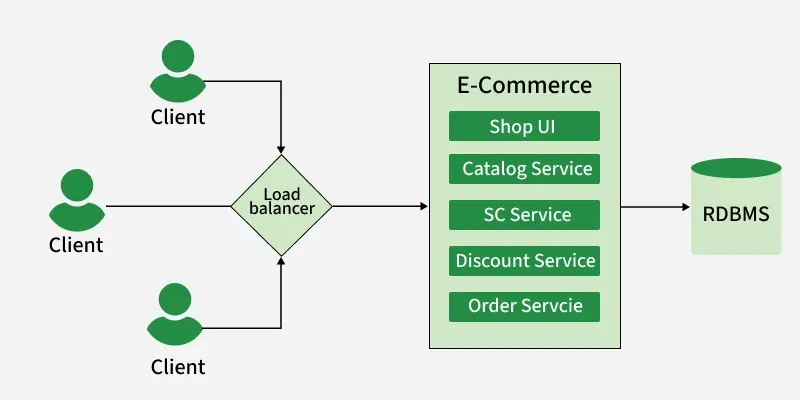
Characteristics
Monolithic architecture exhibits several defining characteristics:
- Single Codebase: All major components of the application are typically developed and maintained within a single codebase, simplifying initial development and management.
- Tight Coupling: Application components are closely integrated and may depend on one another, so changes in one part can affect other parts of the application.
- Shared Runtime: Components typically run within the same application process or runtime, allowing them to communicate through direct function or method calls without inter-service network communication.
- Layered Structure: A monolithic application may be organized into layers such as the presentation, application/business logic, and data layers, which are packaged and deployed together.
- Limited Independent Scalability: Individual components cannot generally be scaled independently; the application is typically scaled as a whole.
- Single-Unit Deployment: The entire application is packaged, tested, and deployed as a single unit, making deployment simpler initially but requiring the whole application to be redeployed for changes.
Importance
Monolithic systems, despite facing increasing competition from more modern architectural styles like microservices, still hold significant importance in various contexts:
- Simplicity: Monolithic architectures are easier to develop, deploy, and understand since all components are together.
- Cost-Effectiveness: They can be more economical for small to medium-sized projects with lower infrastructure requirements.
- Performance: Running components within the same process can reduce inter-service communication overhead and may improve performance for certain workloads.
- Security: A monolithic architecture has fewer inter-service communication points, which can simplify security management. However, the overall security of the system depends on its design, implementation, configuration, and security practices.
- Legacy Support: Many existing systems use monolithic architectures, so understanding them is important for maintaining, modernizing, and migrating legacy applications.
Components
The key components of a monolithic architecture are:
- User Interface (UI): Handles user interaction through buttons, forms, and other elements.
- Application Logic: Contains the main functionality, processes UI requests, and performs computations.
- Data Access Layer: Manages database interactions, enabling data querying, insertion, updating, and deletion.
- Database: Stores application data in relational, NoSQL, or other formats as needed.
- External Dependencies: Connects with third-party APIs, authentication providers, or messaging queues for added functionality.
- Middleware: Handles cross-cutting concerns like logging, security, performance, and inter-component communication.
Design Principles
Monolithic system design focuses on preserving manageability, consistency, and simplicity within a single codebase. Some of the key design principles are:
- Modularity: Structure the code in separate modules even within a single codebase.
- Separation of Concerns: Keep different responsibilities (UI, business logic, data access) separate for clarity and easier debugging.
- Scalability: Design for horizontal scaling using caching, asynchronous processing, and optimized components.
- Encapsulation: Expose only necessary interfaces while hiding internal implementation to reduce dependencies.
- Consistency: Maintain consistent coding styles, design patterns, and principles across the codebase.
Challenges in deploying Monolithic Architecture
Monolithic architecture deployment presents a number of difficulties, such as:
Long Deployment Cycles
When a monolithic application is deployed, the complete codebase is usually deployed as a single unit.
- All components must be packaged, tested, and deployed together.
- This coupling can result in longer deployment times.
Risk of Downtime
Monolithic deployments can have a higher risk of deployment-related disruption, particularly when the entire application must be updated as a single unit.
- Deployments may affect the entire application, making updates potentially more disruptive.
- Downtime can occur if the deployment requires temporarily stopping the application, although deployment strategies such as blue-green or rolling deployments can help minimize or avoid downtime.
- Deployment issues can impact a large portion or the entire application, potentially affecting users and business operations.
Limited Scalability
Monolithic applications can be scaled horizontally by running multiple instances of the entire application, but individual components generally cannot be scaled independently.
- Scaling the entire application can lead to inefficient resource usage when only specific components require additional capacity.
- Running multiple full application instances can increase infrastructure and operational costs during periods of high demand.
Resource Consumption
Monolithic architectures may lead to higher resource usage in some scenarios, particularly when the entire application must be scaled even if only certain components require additional capacity.
- Scaling the entire application can result in unused resources when only specific components experience increased demand.
- Resource efficiency and operational costs depend on factors such as workload, application design, and scaling strategy.
Limited Flexibility
Making changes in a monolithic application can be more complex due to tightly coupled components.
- Modifications often impact multiple parts of the codebase
- Higher risk of introducing bugs or inconsistencies.
Advantages
- Simple to develop, test, and deploy since everything is in a single codebase.
- Easier debugging because all components run within the same application.
- Better performance in small applications due to no inter-service communication overhead.
- Lower initial cost and faster development for MVPs and small teams.
Scaling Monolithic Systems
Scaling monolithic systems can be challenging due to their inherent design, but several strategies can help alleviate these challenges:
- Vertical scaling: Vertical scaling is also known as scale-up, this involves increasing existing server or virtual machine resources (such as CPU, memory, or storage) when running a monolithic application.
- Performance Optimization: Identifying and optimizing operational bottlenecks in single-function operations. This might involve profiling the application to find areas of inefficiency, optimizing database queries, improving algorithmic complexity, or reducing unnecessary resource usage
- Caching: Strengthen caching options to reduce the load on external services. By saving frequently accessed data or statistical results, you can reduce the strain on the application and improve response time.
- Load Balancing: Use load balancing to distribute incoming traffic across multiple instances of a monolithic application. This can help divide the work more evenly and improve scalability.
- Database sharding: If the database is a bottleneck, consider sharding the database to share data across multiple database instances. Each shard stores a small portion of the data, allowing for horizontal scaling of the database.
Strategies for Migrating from Monolithic Architecture to Microservices
The process of migration from a monolithic to a microservices architecture is complex and calls for careful planning and implementation. The following are some typical migration tactics:
- Strangler Fig Pattern: Gradually replace parts of the monolithic app with microservices. Old functionality is refactored while new features are implemented as microservices, enabling smooth migration without downtime.
- Decomposition by Business Capability: Break the monolith into microservices based on business domains or features. Each service handles a specific function, allowing teams to focus on distinct areas.
- Database Decoupling: Separate the database for each microservice to reduce dependencies. Each service can have its own schema, enabling independent development and deployment.
- Event-Driven Architecture: Use events for asynchronous communication between microservices. This reduces tight coupling and improves scalability and resilience.