
Draw deterministic finite automata (DFA) of the language containing the set of all strings over {a, b} in which 2nd symbol from RHS is 'a'. The strings in which 2nd last symbol is "a" are:
aa, ab, aab, aaa, aabbaa, bbbab etc
Input/Output
INPUT : baba
OUTPUT: NOT ACCEPTED
INPUT: aaab
OUTPUT: ACCEPTED
Constructing the DFA of the given problem directly is very complicated. So, here we are going to design the non-deterministic finite automata (NFA) and then convert it to the deterministic finite automata (DFA). The NFA of the language containing all the strings in which 2nd symbol from the RHS is "a" is:

Here, A is the initial state and C is the final state. Now, we are going to construct the state transition table of the above NFA.
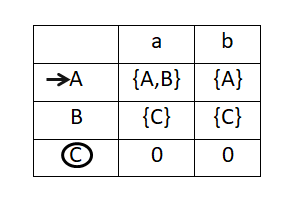
After that we will draw the state transition table of DFA using subset configuration on the state transition table of NFA. We will mention all the possible transition for a and b.
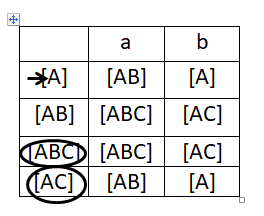
Now it's become very easy to draw the DFA with the help of its transition table. In this DFA, we have four different states A, AB, ABC and AC, where ABC and AC are the final states and A is the initial state of the DFA.
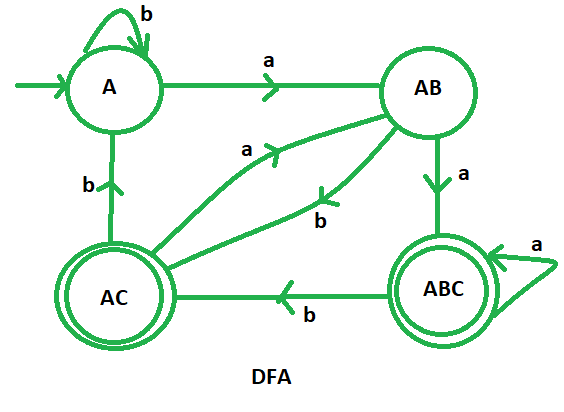
This is our required DFA of the language containing the set of all strings over {a, b} in which 2nd symbol from RHS is 'a'.
Transition Table
| STATES | INPUT (a) | INPUT (b) |
|---|---|---|
| ---> A (initial state) | AB | A |
| AB | ABC* (final state) | AC* (final state) |
| AC* (final state) | AB | A |
| ABC* (final state) | ABC* (final state) | AC* (final state) |
C++ & Python Implementation
#include <iostream>
using namespace std;

// Forward declarations of state functions
void stateA(string n);
void stateAB(string n);
void stateABC(string n);
void stateAC(string n);

// State function for state A
void stateA(string n) {
    // Check if the input string is empty
    if (n.length() == 0) {
        cout << "string not accepted" << endl;
    } else {
        // Check the first character of the input
        if (n[0] == 'a') {
            stateAB(n.substr(1)); // Call stateAB for remaining substring
        } else if (n[0] == 'b') {
            stateA(n.substr(1)); // Call stateA for remaining substring
        }
    }
}

// State function for state AB
void stateAB(string n) {
    // Check if the input string is empty
    if (n.length() == 0) {
        cout << "string not accepted" << endl;
    } else {
        // Check the first character of the input
        if (n[0] == 'a') {
            stateABC(n.substr(1)); // Call stateABC for remaining substring
        } else if (n[0] == 'b') {
            stateAC(n.substr(1)); // Call stateAC for remaining substring
        }
    }
}

// State function for state ABC
void stateABC(string n) {
    // Check if the input string is empty
    if (n.length() == 0) {
        cout << "string accepted" << endl;
    } else {
        // Check the first character of the input
        if (n[0] == 'a') {
            stateABC(n.substr(1)); // Call stateABC for remaining substring
        } else if (n[0] == 'b') {
            stateAC(n.substr(1)); // Call stateAC for remaining substring
        }
    }
}

// State function for state AC
void stateAC(string n) {
    // Check if the input string is empty
    if (n.length() == 0) {
        cout << "string accepted" << endl;
    } else {
        // Check the first character of the input
        if (n[0] == 'a') {
            stateAB(n.substr(1)); // Call stateAB for remaining substring
        } else if (n[0] == 'b') {
            stateA(n.substr(1)); // Call stateA for remaining substring
        }
    }
}

int main() {
    string n;
    cin >> n; // Take input string from user
    stateA(n); // Call stateA to check the input
    return 0;
}

// This Code is Contributed by Shivam Tiwari
import java.util.Scanner;

public class StateMachine {

    // Forward declarations of state functions
    static void stateA(String n) {
        // Check if the input string is empty
        if (n.length() == 0) {
            System.out.println("string not accepted");
        } else {
            // Check the first character of the input
            if (n.charAt(0) == 'a') {
                stateAB(n.substring(1)); // Call stateAB for the remaining substring
            } else if (n.charAt(0) == 'b') {
                stateA(n.substring(1)); // Call stateA for the remaining substring
            }
        }
    }

    static void stateAB(String n) {
        // Check if the input string is empty
        if (n.length() == 0) {
            System.out.println("string not accepted");
        } else {
            // Check the first character of the input
            if (n.charAt(0) == 'a') {
                stateABC(n.substring(1)); // Call stateABC for the remaining substring
            } else if (n.charAt(0) == 'b') {
                stateAC(n.substring(1)); // Call stateAC for the remaining substring
            }
        }
    }

    static void stateABC(String n) {
        // Check if the input string is empty
        if (n.length() == 0) {
            System.out.println("string accepted");
        } else {
            // Check the first character of the input
            if (n.charAt(0) == 'a') {
                stateABC(n.substring(1)); // Call stateABC for the remaining substring
            } else if (n.charAt(0) == 'b') {
                stateAC(n.substring(1)); // Call stateAC for the remaining substring
            }
        }
    }

    static void stateAC(String n) {
        // Check if the input string is empty
        if (n.length() == 0) {
            System.out.println("string accepted");
        } else {
            // Check the first character of the input
            if (n.charAt(0) == 'a') {
                stateAB(n.substring(1)); // Call stateAB for the remaining substring
            } else if (n.charAt(0) == 'b') {
                stateA(n.substring(1)); // Call stateA for the remaining substring
            }
        }
    }

    public static void main(String[] args) {
        Scanner scanner = new Scanner(System.in);
        System.out.print("Enter the string: ");
        if (scanner.hasNext()) {
            String n = scanner.next(); // Take input string from the user
            stateA(n); // Call stateA to check the input
        } else {
            System.out.println("No input provided.");
        }
        scanner.close();
    }
}

// This Code is Contributed by Shivam Tiwari
def stateA(n):
    #if length found 0
    #print not accepted
    if (len(n)==0):
        print("string not accepted")
    else:

        #if at index 0
        #'a' found call
        #function stateAB
        if(n[0]=='a'):
            stateAB(n[1:])

        #else if 'b' found
        #call function A.
        elif (n[0]=='b'):
            stateA(n[1:])

def stateAB(n):
    #if length found 0
    #print not accepted
    if (len(n)==0):
        print("string not accepted")
    else:

        #if at index 0
        #'a' found call
        #function stateABC
        if(n[0]=='a'):
            stateABC(n[1:])

        #else if 'b' found
        #call function AC.
        elif (n[0]=='b'):
            stateAC(n[1:])

def stateABC(n):
    #if length found 0
    #print accepted
    if (len(n)==0):
        print("string accepted")
    else:

        #if at index 0
        #'a' found call
        #function stateABC
        if(n[0]=='a'):
            stateABC(n[1:])

        #else if 'b' found
        #call function AC.
        elif (n[0]=='b'):
            stateAC(n[1:])

def stateAC(n):
    #if length found 0
    #print accepted
    if (len(n)==0):
        print("string accepted")
    else:
        #if at index 0
        #'a' found call
        #function stateAB
        if(n[0]=='a'):
            stateAB(n[1:])

        #else if 'b' found
        #call function A.
        elif (n[0]=='b'):
            stateA(n[1:])


#take string input
n=input()

#call stateA
#to check the input
stateA(n)
using System;

class StateMachine
{
    // Forward declarations of state functions
    static void StateA(string n);
    static void StateAB(string n);
    static void StateABC(string n);
    static void StateAC(string n);

    // State function for state A
    static void StateA(string n)
    {
        // Check if the input string is null or empty
        if (string.IsNullOrEmpty(n))
        {
            Console.WriteLine("Invalid input: string not accepted");
            return;
        }

        // Check the first character of the input
        if (n[0] == 'a')
        {
            StateAB(n.Substring(1)); // Call StateAB for the remaining substring
        }
        else if (n[0] == 'b')
        {
            StateA(n.Substring(1)); // Call StateA for the remaining substring
        }
    }

    // State function for state AB
    static void StateAB(string n)
    {
        // Check if the input string is null or empty
        if (string.IsNullOrEmpty(n))
        {
            Console.WriteLine("Invalid input: string not accepted");
            return;
        }

        // Check the first character of the input
        if (n[0] == 'a')
        {
            StateABC(n.Substring(1)); // Call StateABC for the remaining substring
        }
        else if (n[0] == 'b')
        {
            StateAC(n.Substring(1)); // Call StateAC for the remaining substring
        }
    }

    // State function for state ABC
    static void StateABC(string n)
    {
        // Check if the input string is null or empty
        if (string.IsNullOrEmpty(n))
        {
            Console.WriteLine("string accepted");
            return;
        }

        // Check the first character of the input
        if (n[0] == 'a')
        {
            StateABC(n.Substring(1)); // Call StateABC for the remaining substring
        }
        else if (n[0] == 'b')
        {
            StateAC(n.Substring(1)); // Call StateAC for the remaining substring
        }
    }

    // State function for state AC
    static void StateAC(string n)
    {
        // Check if the input string is null or empty
        if (string.IsNullOrEmpty(n))
        {
            Console.WriteLine("string accepted");
            return;
        }

        // Check the first character of the input
        if (n[0] == 'a')
        {
            StateAB(n.Substring(1)); // Call StateAB for the remaining substring
        }
        else if (n[0] == 'b')
        {
            StateA(n.Substring(1)); // Call StateA for the remaining substring
        }
    }

    static void Main()
    {
        Console.Write("Enter a string: ");
        string n = Console.ReadLine(); // Take input string from the user
        StateA(n); // Call StateA to check the input
    }
}

// This Code is Contributed by Shivam Tiwari
// Forward declarations of state functions
function stateA(n) {
    // Check if the input string is empty
    if (n.length === 0) {
        console.log("String not accepted");
    } else {
        // Check the first character of the input
        if (n[0] === 'a') {
            stateAB(n.substr(1)); // Call stateAB for remaining substring
        } else if (n[0] === 'b') {
            stateA(n.substr(1)); // Call stateA for remaining substring
        }
    }
}

function stateAB(n) {
    // Check if the input string is empty
    if (n.length === 0) {
        console.log("String not accepted");
    } else {
        // Check the first character of the input
        if (n[0] === 'a') {
            stateABC(n.substr(1)); // Call stateABC for remaining substring
        } else if (n[0] === 'b') {
            stateAC(n.substr(1)); // Call stateAC for remaining substring
        }
    }
}

function stateABC(n) {
    // Check if the input string is empty
    if (n.length === 0) {
        console.log("String accepted");
    } else {
        // Check the first character of the input
        if (n[0] === 'a') {
            stateABC(n.substr(1)); // Call stateABC for remaining substring
        } else if (n[0] === 'b') {
            stateAC(n.substr(1)); // Call stateAC for remaining substring
        }
    }
}

function stateAC(n) {
    // Check if the input string is empty
    if (n.length === 0) {
        console.log("String accepted");
    } else {
        // Check the first character of the input
        if (n[0] === 'a') {
            stateAB(n.substr(1)); // Call stateAB for remaining substring
        } else if (n[0] === 'b') {
            stateA(n.substr(1)); // Call stateA for remaining substring
        }
    }
}

// Driver code
let inputString = prompt("Enter a string: "); // Take input string from the user
stateA(inputString); // Call stateA to check the input
//This code is contributed by Monu.
Output
Input: aaab
Output: string accepted
Input: baba
Output: string not accepted
Conclusion
Non-deterministic finite automata (NFA) simplifies building deterministic finite automata (DFA) for languages with specified patterns, such as strings with the 2nd symbol from the right being 'a'. This method simplifies and organizes DFA construction. Automata theory benefits from this method for representing and processing complex linguistic patterns.