
Problem
Design a non deterministic PDA for accepting the language L = {am ,b2m | m>=1}
L = {abb, aabbbb, aaabbbbbb, aaaabbbbbbbb, ......}
In each of the string, the number of a's are followed by double number of b's.
Explanation - Here, we need to maintain the order of a’s and b’s. That is, all the a's are coming first and then all the b's are coming. Thus, we need a stack along with the state diagram. The count of a’s and b’s is maintained by the stack. Here, the number of b's are exactly double of the number of a's. We will take 2 stack alphabets:
𝚪 = { a, z }
Where,𝚪 = set of all the stack alphabet , z = stack start symbol
Approach used in the construction of PDA
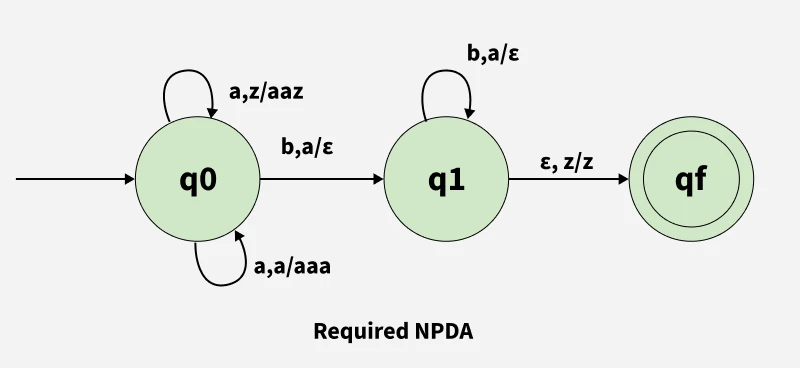
As we want to design a NPDA, thus every time 'a' comes before 'b'. When ‘a’ comes then push 'aa' in stack and if again ‘a’ comes then also push 'aa'.
After that, when ‘b’ comes then pop one 'a' from the stack.
So, at the end if the stack becomes empty then we can say that the string is accepted by the PDA.
Stack Transition Functions -
𝛅(q0, a, z)
\vdash (q0, aaz) [ Push ‘aa’ into stack when stack is empty for input 'a']
𝛅(q0, a, a)\vdash (q0, aaa) [ Push ‘aa’ for each input ‘a’]
𝛅(q0, b, a)\vdash (q1, 𝜀) [ Pop one ‘a’ for first input ‘b’ and move to q1]
𝛅(q1, b, a)\vdash (q1, 𝜀) [ Pop one ‘a’ for each additional ‘b’]
𝛅(q1, 𝜀, z)\vdash (qf, z) [ No stack change, move to final state]
Where, q0 = Initial state , qf = Final state , ϵ = indicates pop operation So, this is our required non deterministic PDA for accepting the language L = {am , b2m | m>=1}