
Overview of Reverse Engineering Processes
Uploaded by
codehomiesOverview of Reverse Engineering Processes
Uploaded by
codehomies- Introduction & Geometric Form
- Prototyping
- Material Characteristics and Process Identification
- Composition Determination
- Data Processing
- 3D Scanning and Modelling
- 3D Inspection
- Case Studies
- Industrial Applications
2
UNIT I
INTRODUCTION & GEOMETRIC FORM
Definition – Uses – The Generic Process – Phases – Computer Aided Reverse Engineering -
Surface and Solid Model Reconstruction – Dimensional Measurement – Prototyping.
[Link] :
Reverse Engineering (RE) involves analyzing, measuring, and testing to recreate an object or
retrieve details of a past event. It focuses on reconstructing existing designs for preservation,
replication, or reinvention. This process is critical in industries like aerospace, automotive,
consumer electronics, medical devices, and forensic science.
Key Highlights:
● Purpose: RE can be used for creating high-value commercial parts, restoring historical
artifacts, or developing competitive alternatives.
● Advancements: Modern tools like 3D laser scanning and high-resolution microscopy
simplify RE processes.
● Definitions:
○ The Society of Manufacturing Engineers emphasizes understanding underlying
technologies of products.
○ The Military Handbook MIL-HDBK-115A highlights the economic value of RE
in competitive procurement.
● Applications: RE is used to duplicate OEM parts, repair or replace worn components,
and create models or prototypes for analysis.
RE requires a multidisciplinary approach combining mathematics, engineering, and data analysis
while adhering to legal and ethical standards.
© 2024 CodeHomies. All Rights Reserved. 2
Powered by CodeHomies | Crafted with passion by Praveen
Kumaresan
3
2. Uses :
Reverse engineering is a versatile discipline applied across multiple industries, serving to
recreate, analyze, or redesign components and systems. Its applications are underpinned by the
principles of analyzing an object to understand its design and functionality, often in the absence
of original documentation.
1. General Applications
● Reproduction of Parts: Used to create replicas or replacements for existing parts,
especially when original designs are unavailable.
● Forensic Analysis: Helps decode mechanisms, retrace events, or reconstruct accidents in
aviation, automotive, and other sectors.
● Prototype Development: Facilitates the creation of new designs or repair solutions for
aftermarket demands.
● Art and Heritage Preservation: Reconstructs and preserves historical artifacts and
artworks.
2. Industrial Applications
● Aerospace and Automotive: Focuses on performance evaluation, regulatory compliance,
and aftermarket part production.
● Architecture and Shipbuilding: Recreates intricate designs and improves upon existing
systems.
3. Software Reverse Engineering
● Code Recovery: Analyzes systems to recreate source code or enhance legacy systems.
● Security: Identifies and neutralizes vulnerabilities, playing a critical role in cybersecurity.
© 2024 CodeHomies. All Rights Reserved. 3
Powered by CodeHomies | Crafted with passion by Praveen
Kumaresan
4
● Software Lifecycle Maintenance: Assists in refining and updating software through
reengineering processes.
4. Life Sciences and Medical Devices
● Medical Implants: Develops custom-fit implants, such as orthopedic or dental devices,
using high-resolution scanning and 3D modeling.
● Diagnostics and Monitoring: Enhances devices like hearing aids or glucose monitors,
ensuring compatibility with modern software.
● Prototyping for Treatment: Advances orthodontic treatments with digital scanning and
manufacturing.
5. Enabling Technologies
● Digital Revolution: Integration of CAD tools, 3D scanners, and advanced software
enables precise measurements, modeling, and prototyping.
● Finite Element Analysis (FEA): Simulates stresses and loads on components, ensuring
reliability and performance.
6. Regulatory and Ethical Considerations
● Industries like life sciences face stringent regulatory requirements to ensure safety and
efficacy.
● Intellectual property concerns, especially in software, require adherence to legal
standards to avoid infringement.
Reverse engineering's adaptability makes it an invaluable tool for innovation, restoration, and
optimization across diverse fields. By leveraging digital advancements, it continues to drive
significant progress in product development and system enhancement.
© 2024 CodeHomies. All Rights Reserved. 4
Powered by CodeHomies | Crafted with passion by Praveen
Kumaresan
5
3. The Generic Process :
Accurate Measurement and Replication:
Advanced metrology technologies enable precise measurement and replication of part
geometries using high-precision hardware and sophisticated software.
Visualization and Analysis:
Engineers can visualize, meter, and analyze geometric details, transforming raw data into
intelligent computer models.
Reverse Engineering Advancements:
Revolutionary software algorithms and hardware developments support rapid prototyping and
reverse engineering.
Data Capture and Retention:
Miniature geometric details are accurately captured and retained for analysis and reproduction.
Interoperable Systems:
The use of interchangeable operating systems and seamless data transformability enhances
efficiency and accelerates the reverse engineering process.
© 2024 CodeHomies. All Rights Reserved. 5
Powered by CodeHomies | Crafted with passion by Praveen
Kumaresan
6
Widespread Applications:
These technologies have significantly influenced modern reverse engineering, becoming a
standard in the field for geometric form analysis and reproduction.
4. Phases :
1. Data Acquisition:
○ Use of precision hardware (e.g., scanners, sensors) to capture the geometric
details of the part.
○ Collection of raw data points representing the part’s surface and features.
2. Data Processing:
○ Transformation of raw data into structured formats suitable for analysis.
○ Filtering, noise reduction, and refinement to ensure accuracy.
3. Model Reconstruction:
○ Reconstruction of captured data into digital 3D models using advanced
algorithms.
○ Retention of intricate geometric details during the process.
4. Analysis and Validation:
○ Evaluation of the reconstructed model against the original geometry for accuracy.
○ Use of analytical tools to ensure compliance with design specifications.
5. Integration and Prototyping:
○ Leveraging software and hardware tools for rapid prototyping or reverse
engineering.
○ Interoperability of systems for seamless integration and data exchange.
6. Deployment:
○ Application of the reconstructed model in various engineering, manufacturing, or
reverse engineering tasks.
○ Final validation and deployment in the desired operational environment.
© 2024 CodeHomies. All Rights Reserved. 6
Powered by CodeHomies | Crafted with passion by Praveen
Kumaresan
7
5. Computer Aided Reverse Engineering :
1. Object Selection:
○ The process begins with identifying the physical object to be analyzed.
○ This object serves as the basis for reverse engineering.
2. Data Acquisition:
○ Two primary methods are used to acquire the geometry of the object:
■ CMM (Coordinate Measuring Machine): Captures precise
measurements of the object's surface and dimensions.
■ Scanning: Uses laser or optical devices to collect a dense "cloud of
points" representing the object's geometry.
3. Cloud of Points:
○ The collected data points from scanning or CMM are combined to create a
detailed point cloud.
○ This point cloud represents the 3D surface of the object.
4. Format Importing:
○ The point cloud data is imported into CAD software for processing.
○ This step may involve converting the point cloud into a suitable file format for
further manipulation (e.g., STL, IGES, or STEP files).
© 2024 CodeHomies. All Rights Reserved. 7
Powered by CodeHomies | Crafted with passion by Praveen
Kumaresan
8
5. Model Reconstruction:
○ CAD tools are used to transform the point cloud into a 3D parametric model.
○ This reconstructed model retains the object's original geometric details.
6. Manufacturing Program Generation:
○ Based on the reconstructed model, a manufacturing program is created to replicate
the part.
○ This program includes tool paths, machining strategies, and CNC instructions.
7. Sending to CNC:
○ The manufacturing program is sent to the CNC (Computer Numerical Control)
machine.
○ The CNC machine fabricates the part based on the digital model.
8. Verification in CMM:
○ The fabricated part is verified using CMM to ensure accuracy and compliance
with the original geometry.
○ If discrepancies are found, adjustments are made in the manufacturing process.
Applications of CARE
● Rapid Prototyping: Creating prototypes directly from physical objects.
● Quality Assurance: Ensuring parts match design specifications.
● Legacy Part Recreation: Reproducing parts without existing CAD models.
● Customization: Designing custom-fit components based on physical data.
This process highlights how computer-aided tools streamline and enhance reverse engineering
capabilities, enabling precise reproduction and innovation in product design.
© 2024 CodeHomies. All Rights Reserved. 8
Powered by CodeHomies | Crafted with passion by Praveen
Kumaresan
9
6. Surface and Solid Model Reconstruction :
1. Overview of Model Reconstruction
● Reverse engineering begins with reconstructing a subject from data acquired using
scanners or probes.
● The process includes four phases:
○ Data Acquisition: Using 3D scanners or probes to collect geometric details.
○ Polygonization: Converting raw point cloud data into a polygon mesh.
○ Refinement: Segmenting, realigning, and smoothing data points.
○ Model Generation: Producing CAD or NURBS models for engineering
applications.
2. Data Acquisition and Processing
● Point Cloud Data: A cluster of 3D points representing an object’s geometry.
○ Converted to formats like STL (triangular polyhedral mesh) or NURBS for CAD.
○ Triangulation balances between surface precision and file size.
● Processing Methods:
○ Removing redundant data, reorientation, and smoothing surfaces.
○ Segmentation: Divides point cloud data into surface patches modeled
mathematically.
© 2024 CodeHomies. All Rights Reserved. 9
Powered by CodeHomies | Crafted with passion by Praveen
Kumaresan
10
3. Scanning Instruments and Technology
● Contact Probes:
○ Directly touch the object using an arm with a tiny ball.
○ Economical, accurate for small and simple parts.
● Noncontact Probes:
○ Use lasers for imaging without physical contact.
○ Ideal for delicate or complex parts.
● 3D Scanners:
○ Capture detailed 3D features for accurate geometric reconstruction.
4. Applications
● Transforms physical parts into 3D digital models.
● Useful for prototyping, design, and manufacturing.
5. Sub Topic
5.1.1 Scanning Instruments and Technology
● Overview of digitizing devices: probes (contact/noncontact) and scanners.
● Process of capturing geometric and dimensional details of physical parts.
● Technologies used: laser triangulation, autofocus, and white-light digitizing.
● Examples of devices: Konica Minolta Range7, Faro Laser ScanArm V3, Leica T-Scanner.
● Advancements in accuracy, resolution, and environmental friendliness.
5.1.2 Principles of Imaging
● Fundamentals of capturing 3D features using digital cameras and laser systems.
● Importance of resolution, triangulation, and focus for precise imaging.
● Role of light sources (e.g., laser, white light) in 3D imaging processes.
● Continuous vs. discrete signal processing in digital imaging.
5.1.3 Cross-Sectional Scanning
● Techniques for capturing intricate internal or layered details of objects.
● Importance of scanning sharp edges and contours for better-defined results.
● Applications in complex or multi-layered designs requiring detailed geometry.
5.1.4 Digital Data
● Conversion of physical object features into digital point clouds and polygonal meshes.
© 2024 CodeHomies. All Rights Reserved. 10
Powered by CodeHomies | Crafted with passion by Praveen
Kumaresan
11
● File formats (ASCII, binary) and their compatibility with CAD systems.
● Benefits of digital data in modeling, design modification, and scaling.
● Use of real-time scanning for immediate data verification and adjustments.
5.1.5 Computational Graphics and Modeling
● Transformation of scanned data into 3D models for analysis and manufacturing.
● Role of software (e.g., Rapidform XOR, PolyWorks) in enhancing design.
● Integration of design intent detection (e.g., features like extrusions, fillets).
● Application of computational tools in reverse engineering and product development.
5.1.6 Data Refinement and Exchangeability
● Refining raw point cloud data for improved accuracy and usability.
● Techniques for handling geometric ambiguities and creating high-quality models.
● Exchange of data between various software and CAD platforms.
● Importance of interoperability and compatibility for seamless workflows.
[Link] Measurement :
High-Tech Measuring Instruments:
● Modern instruments like VERTEX 200 (by Micro-Vu Corporation) can measure part
dimensions with high accuracy (in micrometers).
● Precision depends on both the instrument and the skill of the technician or engineer.
Challenges in Dimensional Measurement:
● Used Parts:
○ A used part may show wear, deformation, or damage, leading to inaccurate
measurements.
○ Example: A new vs. used Schick shaver—used one shows subtle deformations.
● Repairs and Surface Treatments:
○ Repairs (e.g., welding) and treatments (e.g., coatings) can alter dimensions,
making base measurements difficult.
Measurement Variability:
© 2024 CodeHomies. All Rights Reserved. 11
Powered by CodeHomies | Crafted with passion by Praveen
Kumaresan
12
● Example: A bolt hole measured as 0.510 in. during reverse engineering vs. OEM data
showing 0.500 in..
● Decision depends on:
○ Regulatory policies
○ Part criticality
○ Tolerance requirements
Measuring Devices in Reverse Engineering:
● Devices include optical, laser, and video precision tools.
● These must be calibrated and traceable to standards like NIST for accuracy.
Measurement Process:
● Reliability depends on:
○ Number of samples (varies from 1 to 10 based on part complexity).
● OEM dimensions (from drawings, manuals, or bulletins) are ideal for comparison when
available.
8. Prototyping :
Prototyping is a key technology in modern product design and manufacturing, often referred to
as rapid prototyping due to the speed at which tangible models are created. This process
significantly accelerates the transition from conceptual designs to physical parts, offering
advantages in areas like machine design and reverse engineering. By quickly producing model
parts, prototyping allows engineers to better visualize design concepts and computer models,
providing a clearer understanding of how a product will function.
Key Points:
● Speed: Rapid prototyping enables faster production compared to traditional methods like
machining.
● Cost-Effective: The technology offers savings in time and cost for producing parts with
complex geometries that would otherwise be difficult or impossible to manufacture.
● Automation: Modern digital technologies automate the prototyping process, improving
efficiency and precision.
● Benefits: Allows quick form, fit, and functional testing of designs, especially in reverse
engineering applications.
© 2024 CodeHomies. All Rights Reserved. 12
Powered by CodeHomies | Crafted with passion by Praveen
Kumaresan
13
● Limitations: Despite the many benefits, rapid prototyping has limitations such as part
accuracy, material restrictions, and surface finishing quality.
Additive vs. Subtractive Prototyping:
● Additive Prototyping: Involves building parts layer by layer using materials like plastic,
wax, or ceramic. The process adds material to create the desired shape.
● Subtractive Prototyping: Removes material from a larger block to shape the part, such
as in milling or drilling.
The core advantage of additive prototyping is the ability to produce highly intricate internal
features that are difficult to achieve with traditional manufacturing. However, the material
properties, part size, and surface finishing often restrict the overall effectiveness for functional
testing.
Additive Prototyping Technologies:
1. Stereolithography (SLA):
○ SLA is one of the earliest and most popular rapid prototyping techniques, which
uses ultraviolet light to cure resin layers into solid parts.
○ SLA produces parts with fine surface finishes and high geometric accuracy, but
the parts can be weaker than those made from engineering-grade materials.
2. Selective Laser Sintering (SLS):
○ This method uses a laser to sinter powdered materials such as nylon, sintering
them layer by layer to form solid parts.
○ While SLS parts are more durable and accurate than SLA parts, they often have
poor surface finishes and high porosity, making them unsuitable for functional
testing.
3. Direct Metal Laser Sintering (DMLS):
○ DMLS uses metal powders, such as steel or bronze, to create metal parts with
complex geometries. This process is particularly useful for producing small parts
with intricate designs and internal passages.
4. Fused Deposition Modeling (FDM):
○ In FDM, a print head deposits layers of molten plastic filament onto a platform.
The process uses materials like ABS, polycarbonate, and other polymers.
○ FDM parts are relatively strong, making them suitable for certain functional tests,
although they may have rough surface finishes and poorer tolerance control
compared to other methods.
5. Three-Dimensional Printing (3DP):
© 2024 CodeHomies. All Rights Reserved. 13
Powered by CodeHomies | Crafted with passion by Praveen
Kumaresan
14
○ This technique involves laying down a thin layer of powder material, followed by
spraying an adhesive where solidification is needed. The resulting part is built up
layer by layer.
○ While 3DP is quick and inexpensive, parts produced by this method often suffer
from rough finishes, weak mechanical strength, and limited material options.
Applications:
Prototyping is crucial for industries that rely on rapid design validation, such as automotive,
aerospace, and healthcare. For instance, in reverse engineering, a part (like an airfoil) can be
quickly prototyped and tested (e.g., in a wind tunnel) before full-scale production.
© 2024 CodeHomies. All Rights Reserved. 14
Powered by CodeHomies | Crafted with passion by Praveen
Kumaresan
15
UNIT II
MATERIAL CHARACTERISTICS AND PROCESS IDENTIFICATION
Alloy Structure Equivalency – Phase Formation and Identification – Mechanical Strength –
Hardness –Part Failure Analysis – Fatigue – Creep and Stress Rupture – Environmentally
Induced Failure Material Specification - Composition Determination - Microstructure Analysis -
Manufacturing Process Verification.
1. Alloy Structure Equivalency :
Structure of Engineering Alloys
● Definition: Alloys are metallic substances used in engineering, combining two or more
elements with unique properties.
● Structures:
○ Crystalline Alloys: Have repetitive atomic patterns; e.g., Aluminum–4% Copper
alloy.
○ Amorphous Alloys: Solidify without crystallization; exhibit a random atomic
arrangement (e.g., metallic glass).
● Single Crystals:
○ No grain boundaries, exceptional strength, and better creep and thermal fatigue
resistance (e.g., Ni-based superalloys in turbine blades).
● Grain Morphology:
○ Fine-Grain Alloys: Higher tensile strength at room temperature.
○ Coarse-Grain Alloys: Better for high-temperature applications (improved creep
resistance).
Effects of Process and Product Form on Material Equivalency
● Impact of Manufacturing Processes:
○ Traditional Methods: Casting, forging, and rolling create distinct
microstructures.
○ Advanced Techniques:
■ Osprey Spray Forming: Atomizes molten alloy for near-net shapes with
fine grains (e.g., turbine cases).
■ Powder Metallurgy and Rapid Solidification: Produce nano-structured
materials with enhanced properties.
© 2024 CodeHomies. All Rights Reserved. 15
Powered by CodeHomies | Crafted with passion by Praveen
Kumaresan
16
● Microstructure Evolution:
○ Varies by manufacturing process; e.g., aluminum casting (equiaxed grains) vs.
aluminum extrusion (elongated grains) have different properties despite identical
compositions.
● Reverse Engineering:
○ Microstructure analysis helps identify manufacturing processes and determine
material equivalency.
Key Points for Exams
1. Alloy Structure: Crystalline (ordered) vs. amorphous (random) affects alloy properties.
2. Single Crystals: Superior performance in high-stress, high-temperature applications.
3. Manufacturing Influence: Determines microstructure and final properties (e.g., fine vs.
coarse grains).
4. Advanced Methods: Osprey spray forming and nano-structuring improve cost-efficiency
and performance.
5. Reverse Engineering: Microstructure is crucial for identifying material origins and
processes.
2. Phase Formation and Identification :
Phase Diagram
© 2024 CodeHomies. All Rights Reserved. 16
Powered by CodeHomies | Crafted with passion by Praveen
Kumaresan
17
● Definition: A phase diagram represents the relationship between composition, phase, and
temperature for alloys, providing critical information for manufacturing and heat
treatment processes.
● Key Features:
○ Axes: Temperature (y-axis) vs. composition (x-axis).
○ Fe-C Phase Diagram: Shows phases like ferrite (α), austenite (γ), and cementite
(Fe₃C). Carbon content ranges from 0–6.7%.
○ Liquidus and Solidus: Liquidus marks the start of solidification; solidus
indicates the completion. Between these temperatures, a liquid-solid mixture
exists.
○ Eutectic Composition: Fe-4.3% C melts at 1147°C, the lowest melting point for
Fe-C alloys.
○ Thermodynamics and Kinetics: Guide phase transformations and explain
equilibrium and nonequilibrium phases. Controlled cooling can create specific
nonequilibrium phases used in engineering.
Grain Morphology
● Types:
○ Equiaxed: Grains have similar dimensions in all directions.
○ Columnar: Formed during solidification near mold surfaces, often mixed with
dendritic structures.
○ Single Crystal: No grain boundaries; aligned crystallographic structure.
● Importance in Reverse Engineering:
© 2024 CodeHomies. All Rights Reserved. 17
Powered by CodeHomies | Crafted with passion by Praveen
Kumaresan
18
○ Grain morphology affects material properties and functionality.
○ Reveals manufacturing and heat treatment history, aiding process replication.
Recrystallization and Recovery
● Recrystallization: Cold-deformed metals form new grains above a critical temperature,
refining microstructure and relieving stress.
○ Requires a minimum deformation for activation.
○ Affected by temperature, deformation type, and impurities.
● Secondary Recrystallization: Occurs at higher temperatures, leading to abnormal grain
growth.
● Kinetics: Governed by activation energy (Q), recrystallization rate increases
exponentially with temperature (Equation 3.2).
Key Concepts:
● Gibbs Phase Rule: Defines degrees of freedom in equilibrium systems: F=C−P+2F = C -
P + 2F=C−P+2.
● Recrystallization Temperature: Temperature for complete recrystallization; sensitive to
impurities and deformation level.
3. Mechanical Strength :
Mechanical strength refers to a material's ability to withstand mechanical failure under stress. It
includes properties like tensile strength, yield strength, elongation, and toughness. These
properties are critical for comparative analysis in reverse engineering and should align with
specific project requirements.
Classic Mechanics
● Elasticity: Below the elastic limit, materials obey Hooke's Law, and any deformation is
reversible once the stress is removed.
● Plasticity: Beyond the elastic limit, permanent deformation occurs.
Critical Resolved Shear Stress (CRSS)
● CRSS is vital for understanding the mechanical behavior of single crystals, especially in
materials like jet engine blades.
© 2024 CodeHomies. All Rights Reserved. 18
Powered by CodeHomies | Crafted with passion by Praveen
Kumaresan
19
● In single crystals, deformation occurs along specific crystallographic slip systems:
○ FCC metals (e.g., aluminum): 12 slip systems.
○ BCC metals (e.g., chromium): 48 slip systems.
○ HCP metals (e.g., magnesium): 3 slip systems.
● The alignment of crystal orientation with stress direction enhances strength.
Fracture Strength
● Components must never operate beyond their fracture strength to avoid catastrophic
failure.
● Fracture strength is affected by material defects, stress concentrations, and notches.
Material Toughness
● Definition: Toughness is the material's ability to absorb energy before fracture,
influenced by strain rate, temperature, and crack size.
● Tests: Charpy and Izod impact tests measure toughness under dynamic loading.
● Factors:
○ Ductile–brittle transition temperatures vary with loading conditions.
○ Material structures like BCC steels exhibit sudden transitions in toughness at
specific temperatures.
Notch Effects
● Notches introduce a triaxial stress state, causing localized stress concentrations and
impacting mechanical properties.
● Effects:
○ Brittle materials: Weakened by notches.
○ Ductile materials: Strengthened by strain hardening.
● Notches can increase ductile–brittle transition temperatures, complicating test
comparisons between notched and smooth specimens.
Bending, Torsion, and Hoop Stress
● Bending Stress (σb): Combines tension and compression in beams. Calculated using
bending moment, cross-sectional inertia, and distance from the neutral axis.
● Torsion Stress (τt): Twisting stress in shafts due to torque. Maximum torsion stress is
calculated using the shaft radius and polar moment of inertia.
● Hoop Stress: Circumferential tensile stress in cylindrical or spherical structures, such as
pressure vessel walls or turbine disks.
© 2024 CodeHomies. All Rights Reserved. 19
Powered by CodeHomies | Crafted with passion by Praveen
Kumaresan
20
4. Hardness :
Hardness measures a material's resistance to plastic deformation, including indentation,
scratching, wear, or machining. It is a widely used, often nondestructive technique for assessing
mechanical properties, heat treatment conditions, and material strength.
Common Hardness Scales:
● Bulk Hardness: Brinell (BHN), Rockwell (RB, RC), and Vickers (VPH).
● Microhardness: Knoop and Vickers microhardness.
● Surface Hardness: Rockwell superficial, Shore scleroscope, and nanoscale tests.
© 2024 CodeHomies. All Rights Reserved. 20
Powered by CodeHomies | Crafted with passion by Praveen
Kumaresan
21
4.1 Hardness Measurement
Brinell Hardness (BHN):
● Formula:
Where:
○ F: Indenting force.
○ D: Indenter diameter.
○ Di: Indentation diameter.
● Applications: Suitable for soft-to-medium hardness materials but not for very thin or
extremely hard specimens.
Rockwell Hardness (RH):
● Method:
○ Apply a minor load (F1F_1F1) to establish a zero reference position.
○ Apply a major load (F2F_2F2), then release it to measure indentation depth (hhh).
● Scales:
○ B Scale (RB): Soft materials like aluminum alloys.
○ C Scale (RC): Hard materials like stainless steel.
○ Numbers above RB 100 or RC 70 indicate a switch to a harder scale.
© 2024 CodeHomies. All Rights Reserved. 21
Powered by CodeHomies | Crafted with passion by Praveen
Kumaresan
22
● Modern Integration: Digital and image technologies enhance measurement precision,
data processing, and statistical analysis.
Vickers Hardness (VPH):
● Uses diamond pyramid indenters.
● Retains accuracy up to high hardness levels (VPH≈BHN for values <500).
● Preferred for microhardness testing and thin coatings.
Shore Scleroscope Hardness:
● A dynamic test measuring rebound height/energy, heavily influenced by material
elasticity.
● Used for comparing materials with similar elastic properties.
Challenges in Hardness Measurement:
● Measurement accuracy depends on consistent testing conditions and scales.
● Conversion between hardness scales (e.g., Rockwell, Brinell, Vickers) is approximate and
should be avoided unless necessary.
4.2 Hardness and Tensile Strength Relationship
Empirical Relationships for Mild Steels and Cast Irons:
1. Mild Steels:
○ UTS (MPa)≈3.4 BHN
○ UTS (ksi)≈0.5 BHN
2. Cast Irons:
○ UTS (MPa)≈1.58 BHN−86
○ UTS (ksi)≈0.23 BHN−12.5
Vickers Hardness and Flow Stress:
● Relationship: VPH≈0.3 Flow Stress (MPa)
● Flow stress relates to yield strength and varies with alloy composition, microstructure,
and strain.
Applications and Limitations:
● Hardness testing is cost-effective and widely used for noncritical parts in reverse
engineering.
© 2024 CodeHomies. All Rights Reserved. 22
Powered by CodeHomies | Crafted with passion by Praveen
Kumaresan
23
● Relationships between hardness and tensile strength are alloy-specific and not universally
applicable, especially for critical parts.
5. Part Failure Analysis :
Advancements in technology have reduced part failures, but ensuring the safety and reliability of
reverse-engineered parts requires matching the quality of original components. Failures can be
broadly categorized into instantaneous failures (e.g., overload) and progressive failures (e.g.,
fatigue, creep, or corrosion). Key points include:
Types of Part Failures
1. Excessive Elastic Deformation
○ Elastic deformation (e.g., shaft deflection or column buckling) occurs when
stress exceeds the material's elastic limit.
○ Controlled by elastic moduli (e.g., Young’s modulus) determined by material
composition.
○ Stiffness can be improved by changing the component's shape or dimensions.
2. Excessive Plastic Deformation
○ Yielding: Permanent deformation starts when stress exceeds the yield strength
(predicted by Von Mises or Tresca criteria).
○ Creep: Time-dependent deformation occurs under stress at high temperatures,
common in engines or power plants.
3. Fracture
○ Brittle fracture: Sudden and without warning in brittle materials.
○ Fatigue: Progressive fracture due to repeated cyclical loads, common in machine
design.
○ Stress rupture: Failure under static load at high temperatures.
4. Environmental Effects
○ Includes corrosion and hydrogen embrittlement, causing slow, long-term
damage.
○ Protective measures like coatings or plating minimize environmental impact.
© 2024 CodeHomies. All Rights Reserved. 23
Powered by CodeHomies | Crafted with passion by Praveen
Kumaresan
24
Analysis and Prevention
● Metallurgical Failure Analysis involves studying the microstructure and material
properties to understand failure causes.
● Tools: TEM, SEM, X-ray spectroscopy, and light microscopy.
● Failures result from applied loads and the operating environment (e.g., stress
corrosion).
Key Challenges in Reverse Engineering
● Matching or exceeding the life expectancy of OEM parts is difficult due to the
theoretical nature of predictions.
● Understanding design functionality, material behavior, and service conditions is critical
to producing reliable reverse-engineered components.
Prevention of Failures
● Ensure proper material selection, design for load conditions, and regular maintenance.
● Address combined effects of stress and environmental factors.
6. Fatigue :
1. What is Fatigue?
● Fatigue is a time-dependent failure phenomenon caused by repeated alternating
stresses.
● Failure occurs at stress levels lower than the material’s yield strength.
● Two types:
○ High-Cycle Fatigue (HCF): Many cycles (above 10⁴–10⁵) with low stress.
○ Low-Cycle Fatigue (LCF): Fewer cycles (below 10⁴–10⁵) with high stress.
© 2024 CodeHomies. All Rights Reserved. 24
Powered by CodeHomies | Crafted with passion by Praveen
Kumaresan
25
2. Fatigue Conditions:
● Repeated alternating stress or strain.
● Sufficient number of cycles.
● Stress amplitude must exceed a threshold for most materials.
3. High-Cycle Fatigue (HCF):
● High cycles, low stress. Controlled by elastic deformation.
● Example: Thermal cycling or vibration in jet engines.
● S-N Curve:
○ Plots stress (S) vs. cycles to failure (N).
○ Cycles (N) are on a logarithmic scale due to large values.
○ Factors affecting HCF: alloy microstructure, surface condition, temperature, and
stress frequency.
4. Low-Cycle Fatigue (LCF):
© 2024 CodeHomies. All Rights Reserved. 25
Powered by CodeHomies | Crafted with passion by Praveen
Kumaresan
26
● Low cycles, high stress. Dominated by plastic deformation.
● Example: A single flight cycle (takeoff to landing) in jet engines.
● Used for life prediction of critical components like shafts and turbine disks.
5. Effect of Mean Stress:
● Components face both dynamic alternating stress and static steady-state stress.
● Fatigue failure risk increases with higher tensile mean stress.
● Goodman Diagrams: Show relationship between mean stress and allowable alternating
stress.
6. Fatigue Crack Propagation:
● Fatigue starts with a small crack (caused by irregularities like scratches or corrosion).
● Crack growth stages:
1. Initiation at stress concentration sites.
2. Propagation (reduces load-carrying area).
3. Overload failure when remaining material can't sustain the load.
● Striations (marks in the material) form with each fatigue cycle, which helps estimate
crack growth rate.
7. Thermal Mechanical Fatigue (TMF):
● A type of LCF caused by combined thermal and mechanical stresses.
● Example: Jet engine turbine blades, exposed to hot and cold cycles, face expansion,
bending, and centrifugal stresses.
8. Fatigue vs. Tensile Strength:
● Fatigue strength is not directly related to tensile strength due to different failure
mechanisms:
○ Fatigue initiates at surface irregularities, showing transgranular fracture.
○ Tensile failure occurs due to overload, resulting in different fracture patterns.
Key Points to Remember:
© 2024 CodeHomies. All Rights Reserved. 26
Powered by CodeHomies | Crafted with passion by Praveen
Kumaresan
27
● Fatigue failures often occur unexpectedly and progress over time.
● Predicting fatigue life is critical for safety, especially in aerospace and engineering
applications.
7. Creep and Stress Rupture :
High-Temperature Failure:
1. Creep: Time-dependent, gradual deformation under stress at elevated temperatures.
○ Occurs: Above the metal's recrystallization temperature, where atoms become
mobile.
○ Application: A key failure mode in components like turbine blades operating
above 1000°C.
2. Stages of Creep:
○ Primary Stage: Deformation rate decreases with time.
○ Secondary Stage: Steady creep rate (minimum rate).
○ Tertiary Stage: Rapid increase in creep rate leading to fracture.
3. Fracture Modes:
○ Low Temperature: Transgranular fracture (within grains).
○ High Temperature: Intergranular fracture (along grain boundaries).
4. Stress Rupture Test:
○ Similar to a creep test but performed at higher loads to measure fracture time
(short-term test).
○ Focuses on stress-rupture life (stress vs. time to fracture).
○ Used to predict long-term performance via extrapolation.
© 2024 CodeHomies. All Rights Reserved. 27
Powered by CodeHomies | Crafted with passion by Praveen
Kumaresan
28
Larson–Miller Parameter (Predicting Creep Life)
● Purpose: Predict long-term creep or stress-rupture life using short-term tests.
● Formula:
P T= + (log10 t C)
● Where:
○ T = the test temperature in Rankin
○ °R = °F + 460
○ t = the time to rupture (or reach a certain strain)
○ C = the Larson–Miller constant, approximately 20
○ P = Larson–Miller parameter
● Example: At 1500°F for 100,000 hours, P=49,000P = 49,000P=49,000. Using the master
curve, the maximum allowable stress is ~165 MPa (24 ksi).
● Caution: Predictions may vary due to metallurgical changes during prolonged exposure.
Creep Mechanisms
1. Dislocation Glide: Dominates at high stress.
2. Diffusional Creep:
○ At lower stress and higher temperature, atoms move along grain boundaries or
through grains.
○ Creep rate increases with smaller grain size due to easier atomic diffusion.
Key Takeaways for Reverse Engineering
● Matching grain size between the original and reverse-engineered parts is crucial.
○ Fine grains: Good for tensile strength (room temp), bad for creep resistance (high
temp).
● Stress rupture and creep data help design engineers determine allowable stress for
specific temperatures and lifetimes.
8. Environmentally Induced Failure Material Specification :
1. Importance of Corrosion Management
● Corrosion costs industries billions annually (e.g., $300 billion in the U.S.).
© 2024 CodeHomies. All Rights Reserved. 28
Powered by CodeHomies | Crafted with passion by Praveen
Kumaresan
29
● It is caused by electrochemical reactions between components and their environments,
often occurring unexpectedly during service.
● Corrosion management is essential in industries like automotive (warranty and design)
and aviation (fleet management programs like the Italian Air Force's Corrosion Control
Register).
● Reverse engineering faces challenges in assessing corrosion resistance due to
time-consuming and expensive testing.
Key Types of Environmental Failures
1. Corrosion
● Definition: A chemical/electrochemical reaction between materials and the environment,
causing material degradation.
● Examples: Fretting corrosion, erosion corrosion, and oxidation.
● Mechanism: Simultaneous anodic (oxidation) and cathodic (reduction) reactions.
○ Anodic: Metal loses electrons (e.g., Fe → Fe²⁺ + 2e⁻).
○ Cathodic: Oxygen dissolved in water reacts to form compounds like hydroxides
(e.g., Fe(OH)₂).
○ Corrosion is faster near oxygen-rich areas (e.g., waterlines).
2. Stress Corrosion
● Occurs when mechanical stress combines with a corrosive environment.
● Results in brittle failures with rough, discolored fracture surfaces.
● Cracking may be intergranular (along grain boundaries) or transgranular (across
grains).
○ Example: Chloride stress corrosion in stainless steel.
3. Oxidation
● Metals react with oxygen to form oxides, altering surface properties (e.g., Al → Al₂O₃).
● Protective oxide layers can prevent further oxidation.
● Engineering alloys (e.g., nickel- and cobalt-based) often include elements like chromium
or aluminum to enhance oxidation resistance.
4. Hot Corrosion
● Caused by the reaction of metals with sulfur (e.g., in turbine engines exposed to seawater
and sulfur-containing fuels).
© 2024 CodeHomies. All Rights Reserved. 29
Powered by CodeHomies | Crafted with passion by Praveen
Kumaresan
30
● Sodium sulfate (Na₂SO₄) reacts with protective oxides, leading to material degradation.
● Observed in turbine blades, diesel engines, and auto mufflers.
● Effects: Wall thinning, fatigue cracking, and irregular surface voids.
5. Metal Embrittlement
● Hydrogen Embrittlement:
○ Hydrogen atoms absorbed into metal lattices reduce bonding strength.
○ Occurs in humid environments or oil wells and leads to brittle failure without
yielding.
○ Reversible if hydrogen is released.
● Cryogenic Embrittlement:
○ Low temperatures cause materials (e.g., carbon steel) to lose ductility and fail
abruptly.
Protection Measures and Testing
● Design and Materials: Use corrosion-resistant materials or apply protective coatings.
● Accelerated Testing: Predict long-term environmental effects using quick simulation
methods.
● Inspection and Maintenance: Regular checks, especially in aging structures like aircraft
or turbines.
Material Specification
Material specifications are essential documents detailing the requirements for engineering
materials and the processes used to fabricate them. Various professional institutions publish
material specifications to standardize materials and processes across industries. For example,
Society of Automotive Engineers International (SAE) publishes Aerospace Material
Specifications (AMS), which are among the most widely referenced in the aviation sector.
Origin of SAE
The SAE was founded in 1905 as the Society of Automobile Engineers. In 1916, it merged with
other engineering societies, including the American Society of Aeronautic Engineers, forming
the Society of Automotive Engineers (SAE). The term "automotive" derives from the Greek
word autos (self) and the Latin motivus (of motion), reflecting the society’s focus on machinery
powered by its own motion. SAE has played a vital role in the development of both the
automotive and aerospace industries.
Contents of Material Specifications
© 2024 CodeHomies. All Rights Reserved. 30
Powered by CodeHomies | Crafted with passion by Praveen
Kumaresan
31
The structure and content of a material specification depend on its intended purpose and
application. A typical Aerospace Material Specification (AMS) includes the following
sections:
1. Title Section:
○ Found on the first page.
○ Provides revision history.
○ Highlights key material characteristics.
○ Lists nominal composition and heat treatment conditions.
2. Scope: Defines the application and limitations of the specification.
3. Applicable Documents: Lists related standards and references.
4. Technical Requirements: Details material properties, performance standards, and
processing techniques.
5. Quality Assurance Provisions: Specifies tests and inspection requirements to ensure
compliance.
6. Preparation for Delivery: Provides guidelines for packaging and delivery.
7. Acknowledgment: Notes the formal acceptance or confirmation procedures.
8. Rejections: Lists conditions under which materials or processes fail to meet the
specification.
9. Notes: Includes additional remarks, instructions, or clarifications.
Alloy Designation Systems
Several organizations have developed alloy designation systems to standardize material
classifications. Notable systems include:
1. SAE International and ASTM International:
○ Widely recognized in the U.S. and globally for setting industry standards.
2. Regional Standards:
○ British Standards (BS): Material codes used in the United Kingdom.
○ DIN (German Standards): Published by Deutsches Institut für Normung
(German Institute for Standardization). DIN EN numbers indicate the German
version of European standards.
○ Swedish Standards (SS): Identified by the prefix “SS.”
○ Chinese GB Standards: GB stands for Guobiao (National Standards) and is
published by the Standardization Administration of China.
○ Japanese JIS Standards: Published by the Japanese Standards Association,
primarily used for industrial materials.
These designation systems and standards ensure that materials meet consistent quality and
performance criteria across industries and regions.
© 2024 CodeHomies. All Rights Reserved. 31
Powered by CodeHomies | Crafted with passion by Praveen
Kumaresan
32
9. Composition Determination:
Alloying Elements
● Alloying Elements: These are added to improve material properties (e.g., strength, heat
resistance). Examples: Rene N6 and CSMX-10M (nickel-based superalloys) contain
12-13 elements for high-temperature applications like gas turbines.
● Impurities: Unintended elements in the alloy.
● Important questions in reverse engineering include:
○ Does a small difference in composition (e.g., 0.1% aluminum) matter?
○ Is a trace element (e.g., 0.05% tungsten) intentional or accidental?
Understanding the role of each element is crucial but complex.
Mass Spectroscopy
● What is Mass Spectroscopy? A technique to analyze chemical composition by plotting
ion intensity vs. mass-to-charge ratio (m/z).
● How it works:
○ Ions are extracted and separated by mass-to-charge ratio.
○ A detector measures ion signals to create a mass spectrum.
● ICP-MS (Inductively Coupled Plasma-Mass Spectrometry):
○ Uses ionized argon plasma to ionize sample atoms.
○ Measures elements with atomic masses from lithium (7) to uranium (250).
○ Highly sensitive (detects parts per trillion).
○ Advantage: Measures multiple elements simultaneously, unlike atomic
absorption spectroscopy.
Electron Specimen Interaction and Emission
● Electron-Specimen Interaction: Energetic electrons striking a sample cause emissions
used in:
○ SEM (Scanning Electron Microscopy): Analyzes surface details of bulk
samples.
○ TEM (Transmission Electron Microscopy): Analyzes thin samples by
transmitted electrons.
X-Ray Analysis
© 2024 CodeHomies. All Rights Reserved. 32
Powered by CodeHomies | Crafted with passion by Praveen
Kumaresan
33
● How X-rays are Emitted:
○ Inner-shell electrons are ejected.
○ Outer-shell electrons fall into the vacancy, releasing energy as X-rays.
● Types of X-rays:
○ K-line X-rays: Electron falls to the K shell.
■ Kα: From L shell to K shell.
■ Kβ: From M shell to K shell.
○ L-line X-rays: Electron falls to the L shell.
■ Lα: From M shell to L shell.
■ Lβ: From N shell to L shell.
Key Takeaway: X-ray analysis helps identify materials by observing energy released when
electrons shift between shells.
10. Microstructure Analysis :
Microstructure Analysis (Simplified Summary)
● Microstructure Overview:
The microstructure of an alloy provides clues about its manufacturing process, heat
treatment, and fabrication history. It is shaped by thermodynamics (determining phase
existence) and kinetics (controlling phase changes and growth rates). Understanding
these can reveal how an alloy was made.
Reverse Engineering Case Study on Ductile Iron
● Ductile Iron:
○ Used in crankshafts, gears, and other industrial parts due to its strong and versatile
microstructure.
○ Microstructure: Nodular graphite (spherical shape) surrounded by ferrite (soft
phase) in a pearlite matrix (hard phase).
○ Reverse engineering of ductile iron involves analyzing its microstructure to
determine its properties and production methods.
Light Microscopy
● Light Microscopes:
Used to examine small details of materials.
© 2024 CodeHomies. All Rights Reserved. 33
Powered by CodeHomies | Crafted with passion by Praveen
Kumaresan
34
○ Resolution: Ability to distinguish two close points (limit ~0.2 µm for optical
microscopes).
○ Magnification: Enlargement of an image. Higher magnification reduces the field
of view.
○ Modern microscopes (e.g., confocal microscopes) include laser scanners and
cameras, improving resolution and producing 3D images.
Scanning Electron Microscopy (SEM)
● SEM Basics:
○ Uses high-energy electrons to scan a sample and obtain detailed surface
information.
○ Electron Gun: Emits electrons (from tungsten filament or lanthanum hexaboride)
using high voltage (~120 keV).
○ Detection: Focused electrons hit the sample, revealing surface texture and
composition.
○ SEM is crucial in reverse engineering for identifying material composition.
Transmission Electron Microscopy (TEM)
● TEM Overview:
○ Provides very high magnification and resolution (down to atomic level, ~10⁻¹⁰ m).
○ Key Data Collected: Grain structure, crystal arrangement, and chemical
composition.
○ How It Works:
■ Illumination System: Uses an electron gun and lenses to focus an
electron beam.
■ Imaging System: Forms images of the microstructure or diffraction
patterns.
■ Signal Collection: Captures images using detectors and cameras.
○ Non-conductive samples are coated with carbon or gold to avoid electron buildup.
Key Takeaways for Exam
● Microstructure provides insight into an alloy’s heat treatment and fabrication process.
● Light Microscopy is limited in resolution (~0.2 µm) but good for basic analysis.
● SEM focuses on surface details and uses high-energy electrons.
● TEM provides atomic-level detail, making it a powerful tool for material characterization
in reverse engineering.
© 2024 CodeHomies. All Rights Reserved. 34
Powered by CodeHomies | Crafted with passion by Praveen
Kumaresan
35
[Link] Process Verification :
Overview:
○ Manufacturing starts with material selection, moves to process choice, and ends
with a functional test.
○ Key factors: temperature, time, force, and atmosphere.
○ Reverse engineering often starts with examining macrostructure (surface finish)
and microstructure (grain features).
Key Manufacturing Processes
11.1 Casting:
● Involves melting and solidification to produce ingots or parts.
● Example: Direct Chill Casting shows 3 grain layers (fine, columnar, and coarse
equiaxed grains).
● Reverse engineering uses macro/microstructure to verify casting methods.
11.2 Product Forming:
● Shaping raw materials (ingots) into products (e.g., turbine disks) by forging, rolling, or
extrusion.
● Grain texture reveals direction of applied force.
● Properties depend on force and operating temperature.
11.3 Machining and Surface Finishing:
● Material removal to shape parts:
○ Traditional: Cutting (e.g., milling, drilling) or abrading (e.g., grinding).
○ Advanced: Laser cutting and EDM (preferred for delicate parts, e.g., medical
devices).
● Reverse engineering focuses on:
○ Surface roughness.
○ Grain morphology.
○ Residual stress.
11.4 Joining Process:
● Combines parts using soldering, brazing, or welding.
● Helps reduce cost by using different materials for different sections.
● Critical for repairs:
© 2024 CodeHomies. All Rights Reserved. 35
Powered by CodeHomies | Crafted with passion by Praveen
Kumaresan
36
○ Requires understanding of filler material, temperature effects, and environment.
11.5 Heat Treatment:
● Enhances material properties like hardness or strength.
● Challenges in reverse engineering:
○ Similar properties can result from different heat treatments.
○ Many parameters cannot be verified after the process.
11.6 Heat Treatment Specifications:
● Includes processes like annealing, stress relief, normalization, etc.
● Several heat treatments can yield similar hardness but different fatigue strengths.
● Often proprietary methods are used.
11.7 Surface Treatment:
● Essential for performance but hard to reverse-engineer due to proprietary methods.
● Common techniques:
○ Surface heat treatment.
○ Protective coating.
○ Shot peening.
Tips for Exams:
Focus on:
● Parameters of manufacturing: temperature, time, force, atmosphere.
● Processes like casting, forging, and machining.
● Key challenges in reverse engineering (e.g., proprietary methods, similarity of
outcomes)
© 2024 CodeHomies. All Rights Reserved. 36
Powered by CodeHomies | Crafted with passion by Praveen
Kumaresan
37
UNIT III
DATA PROCESSING
Statistical Analysis – Data Analysis – Reliability and the Theory of Interference – Weibull
Analysis – Data Conformity and Acceptance – Data Report – Performance Criteria –
Methodology of Performance Evaluation – System Compatibility.
[Link] Analysis :
Reverse engineering is heavily dependent on accurate data acquisition and its statistical
interpretation. Statistical analysis integrates raw data with mathematical theories to extract
meaningful engineering insights. However, there are challenges in the assumptions and
accuracy of statistical analyses, which must be evaluated for suitability and relevance to specific
engineering goals.
1.1 Statistical Distribution
© 2024 CodeHomies. All Rights Reserved. 37
Powered by CodeHomies | Crafted with passion by Praveen
Kumaresan
38
Statistical analysis begins with data distribution, described quantitatively using mathematical
statistical functions. Distributions are divided into two categories:
1. Discrete Distribution:
○ Example: Binomial Distribution (e.g., coin toss experiments).
○ The data is countable and finite, often represented in tables and cumulative
frequency charts.
2. Continuous Distribution:
○ Examples: Normal Distribution (Gaussian) and Weibull Distribution.
○ Continuous variables like dimensions, tensile strength, or material properties are
analyzed in this category.
Illustration: A coin toss experiment is conducted 75 times, each with 40 tosses, recording the
number of heads. The frequencies for outcomes (e.g., 10 to 30 heads) and their cumulative
frequencies are tabulated and visualized using a distribution curve (Figure 6.1).
1.2 Statistical Parameters and Functions
Statistical functions are mathematical models expressed through statistical parameters, which
define and analyze data sets. Commonly used parameters include:
● Population: Entire set of data points being studied.
● Sample: A subset of the population used for analysis.
● Variate: The specific values within the data set.
● Variance: Measures the dispersion or spread of data points.
● Standard Deviation: The square root of variance, showing data dispersion relative to the
mean.
● Mean (Average): The central value of the data set.
● Median: The middle value of the data when ordered.
● Skewness: Indicates the asymmetry in the distribution.
Significance in Reverse Engineering
● Numerical Insights vs. Scientific Principles:
○ Statistical analysis provides numerical insights (e.g., mean tensile strength) but
lacks scientific explanation about processes or methods leading to observed
results.
○ To gain a deeper understanding, it is crucial to combine statistics with engineering
principles.
● Composition Analysis and Statistical Confidence:
○ Material specifications often include ranges of acceptable compositions,
accounting for manufacturing variations and measurement inaccuracies.
© 2024 CodeHomies. All Rights Reserved. 38
Powered by CodeHomies | Crafted with passion by Praveen
Kumaresan
39
○ Multiple tests improve statistical confidence but might not drastically affect
material identification outcomes.
Conclusion: Statistical analysis forms a critical foundation for decision-making in reverse
engineering, but its true value lies in its integration with scientific and engineering principles.
Understanding and correctly interpreting statistical randomness, parameters, and distributions are
essential for deriving reliable conclusions.
2. Data Analysis :
2.1 Statistical Confidence Level and Interval
● Confidence Level: Indicates how sure we are about our data (e.g., 95%
confidence means we're 95% sure our results are accurate).
● Confidence Interval: Provides a range of values that the true result is likely
to fall within.
● The required sample size for data analysis depends on:
○ Population size (how big the dataset is).
○ Desired confidence level and interval.
● There are no fixed rules for sample size in reverse engineering because it
varies based on the problem.
2.2 Sampling
● Sampling: A technique to collect data from a smaller group (sample) to
make conclusions about the entire population.
○ Example: Testing the tensile strength of 2024 aluminum alloy
produced by many vendors—testing every piece is impractical, so we
take a sample instead.
● Sampling Distribution: Represents the probability of specific values (e.g.,
tensile strength) within the population. This helps predict population
characteristics based on the sample.
2.3 Statistical Bias
© 2024 CodeHomies. All Rights Reserved. 39
Powered by CodeHomies | Crafted with passion by Praveen
Kumaresan
40
● Statistical Bias occurs when errors are introduced due to:
○ Biased Sample: Samples are not representative of the entire
population (e.g., all samples come from one vendor).
○ Biased Estimator: Incorrect methods are used to estimate population
parameters.
○ Biased Measurement Instrument: Instruments used for testing are
not properly calibrated or maintained.
● To avoid bias:
○ Use calibrated equipment (as per standards like ANSI).
○ Ensure trained personnel handle testing.
○ Scrutinize sample sources (e.g., ensure samples come from
independent suppliers, not from the same foundry).
3. Reliability and the Theory of Interference :
3.1 Reliability
1. Statistical Reliability:
○ Definition: Consistency or repeatability of measurements.
○ Key Points:
■ Reliability depends on the repeatability of the measurement instrument,
similar instruments, and the operator.
■ High reliability does NOT always mean the data is valid.
■ Example: A misaligned Rockwell hardness tester may produce
consistent (reliable) but incorrect (invalid) results.
2. Part Reliability:
○ Definition: The probability that a part performs its function without failure under
specific conditions for a certain period.
○ Key Points:
■ Focuses on predicting failure rates or hazard rates (how often failure
occurs) for parts.
■ Essential for ensuring machine safety and financial efficiency.
■ Helps in reverse engineering to predict a part’s performance over time.
© 2024 CodeHomies. All Rights Reserved. 40
Powered by CodeHomies | Crafted with passion by Praveen
Kumaresan
41
3.2 Prediction of Reliability Using Statistical Inference
1. Traditional Mechanics:
○ Part strength and applied stress are treated as single values.
○ If strength > stress → part is safe.
○ If strength ≤ stress → part fails.
2. Statistical Interference:
○ Strength and stress are treated as statistical distributions instead of single values.
○ Even if the mean strength > mean stress, overlap between distributions can
occur.
■ Overlap Zone: Weak parts may fail under heavy loads (statistically
possible).
○ Purpose: Analyze reliability considering this overlap to predict part safety more
accurately.
© 2024 CodeHomies. All Rights Reserved. 41
Powered by CodeHomies | Crafted with passion by Praveen
Kumaresan
42
4. Weibull Analysis :
The Weibull distribution, introduced by Walloddi Weibull in 1951, is particularly effective in
predicting life data, such as fatigue endurance, and is widely used in machine design and reverse
engineering for part life prediction. It is more accurate for life-related data compared to the
normal distribution.
Key Characteristics of Weibull Distribution:
1. Parameters:
○ Location parameter (t₀): Starting point or origin where failure begins; also
known as "guaranteed life."
○ Scale parameter (η): Determines the distribution's spread; referred to as
"characteristic life," where 63.2% of failures occur.
○ Shape parameter (β): Dictates the distribution's profile:
■ β < 1: Failure rate decreases over time.
■ β = 1: Constant failure rate.
■ β > 1: Failure rate increases over time.
2. Differences from Normal Distribution:
○ Asymmetry: Weibull distributions are skewed (long tail), unlike the symmetric
normal distribution.
○ Requires additional shape parameter (β) for flexibility in modeling diverse failure
patterns.
Weibull Probability Paper:
● Used to plot cumulative failure data against time (or cycles, distance, etc.).
● Both axes are logarithmic.
● Linearization of Weibull’s equation simplifies plotting and parameter estimation.
Applications:
● Reliability and Unreliability Predictions: Weibull analysis helps estimate part reliability or
failure rates based on limited data.
● Statistical Inference: By analyzing β, engineers can infer the population's failure
characteristics:
○ Decreasing, constant, or increasing failure rates.
© 2024 CodeHomies. All Rights Reserved. 42
Powered by CodeHomies | Crafted with passion by Praveen
Kumaresan
43
Visual Insights:
● Weibull probability plots allow engineers to verify if data fits a Weibull distribution and
determine reliability metrics.
● Confidence intervals (e.g., 90%) can be added to account for statistical uncertainty in
predictions.
Impact of Parameters:
1. Scale parameter (η):
○ Larger η shifts the curve to the right, representing longer life, but doesn’t change
the shape.
2. Shape parameter (β):
○ Influences the failure rate and reliability.
○ Populations with varying β values display markedly different reliability
characteristics.
© 2024 CodeHomies. All Rights Reserved. 43
Powered by CodeHomies | Crafted with passion by Praveen
Kumaresan
44
5. Data Conformity and Acceptance :
5.1 Dimension and Tolerance
● Fluctuation and Tolerances:
○ Advanced manufacturing, like CNC machining, produces uniform parts with
tighter tolerances than initial designs may require.
○ Tolerance relaxation may be necessary but must be justified through industrial
standards (e.g., ABMA's ABEC grades for precision ball bearings) or
documentation.
● Impacts of Tolerance Adjustments:
○ Adjustments can affect the next-level assemblies (e.g., bolt hole diameter
influencing bolt lifespan or turbine blade tolerances affecting jet engine
performance).
● OEM Data vs. Measured Data:
○ Reverse engineering often faces discrepancies between actual measurements and
OEM design data.
○ Two approaches to resolve discrepancies:
1. Increase sample size for better statistical averages.
2. Make engineering judgments based on experience.
5.2 Data Acceptance
● Deterministic vs. Statistical Perspectives:
○ Deterministic: A part is acceptable or unacceptable based on singular values.
○ Statistical: Acceptance is defined by confidence intervals (e.g., a part must meet a
minimum life cycle at 95% confidence within a specific range).
● Sample Size and Confidence Intervals:
○ Larger sample sizes reduce confidence intervals, potentially changing
unacceptable results to acceptable outcomes.
5.3 Source of Data
● Availability Challenges:
○ OEM data is often proprietary, requiring measurements or tests of actual parts.
○ New OEM parts might be restricted or unavailable, necessitating use of
alternative markets, the internet, or industrial standards.
● Public and Government Data:
○ Publicly funded parts often have accessible data (e.g., civilian aircraft engines
derived from military counterparts).
○ Cross-referencing civilian and military parts requires establishing clear linkages.
© 2024 CodeHomies. All Rights Reserved. 44
Powered by CodeHomies | Crafted with passion by Praveen
Kumaresan
45
● Alternative Resources:
○ Standards (e.g., SAE AMS, ASTM), catalogs, and manuals provide useful reverse
engineering references.
5.4 Statistical Regression and Relationships Between Properties
● Regression Analysis:
○ Used to estimate material properties (e.g., low-cycle fatigue life) or relationships
(e.g., tensile strength vs. hardness).
● Hardness vs. Tensile Strength:
○ Hardness generally correlates with higher tensile strength and fatigue endurance.
○ Quantitative relationships are approximate due to differences in measurement
methods and units.
● Tensile Strength vs. Fatigue Resistance:
○ Fatigue resistance relates to cyclic loads, while tensile strength relates to static
loads.
○ Fatigue resistance is more sensitive to changes in material properties, making
equivalence claims between materials with the same tensile strength challenging.
Key Takeaways:
1. Tolerance adjustments must be justified and consider impacts on assembly and
performance.
2. Statistical methods like regression help bridge gaps in available data but come with
approximations and uncertainties.
3. Accessing OEM data can be difficult, necessitating creative solutions such as relying on
public or derivative sources.
4. Engineers must balance deterministic criteria with statistical variability to make
informed acceptance decisions.
6. Data Report :
Purpose of a Reverse Engineering Report
● Objective: To provide a detailed design blueprint that enables the duplication of the
original part.
● Key Data Included:
© 2024 CodeHomies. All Rights Reserved. 45
Powered by CodeHomies | Crafted with passion by Praveen
Kumaresan
46
○ Material composition.
○ Part dimensions.
○ Test results.
○ Manufacturing procedures.
○ Specifications and standards.
○ Comparison with the baseline OEM (Original Equipment Manufacturer) part.
Test Data Requirements
1. Comprehensive and Accurate Reporting:
○ Include details of the sample source (e.g., new, used, or purchased part), part
number, and testing methodology.
○ Cite appropriate specifications and standards (e.g., ASTM standards).
2. Micrographs:
○ Include micrographs at sufficient magnification to substantiate conclusions (e.g.,
showing recrystallized microstructure).
○ Low-quality or missing micrographs undermine conclusions.
3. Test Conditions:
○ Record test environments and conditions (e.g., temperature, atmosphere).
○ Ensure test instrument calibration and traceability.
4. Data Integrity:
○ Accuracy must be ensured.
○ Falsified data is punishable under federal laws, including Title 18, Chapter 17.
Statistical Presentation of Data
● Dimensional Measurements:
○ Report in statistical terms with means and standard deviations (where sufficient
data is available).
● Test Results:
○ Use simple averages for limited data (e.g., three tensile tests).
○ Statistical analysis is more meaningful when a large sample size is available.
● Chemical Composition:
○ Usually presented as singular numerical percentages unless more samples justify
statistical reporting.
Use of Statistical Data
● Average vs. Mean:
○ Average values are typically preferred for simplifying calculations unless
statistical data is warranted.
© 2024 CodeHomies. All Rights Reserved. 46
Powered by CodeHomies | Crafted with passion by Praveen
Kumaresan
47
○ For critical parts, more rigorous statistical analysis might be required.
● Field Management Application:
○ Statistical analysis is essential for part failure management and inspection
scheduling.
Practical Insights
● Statistical rigor is often limited in reverse engineering due to high part reliability.
● Semiquantitative conclusions based on averages are typically sufficient for most
applications.
● However, statistical reliability is crucial when developing failure management protocols.
7. Performance Criteria :
7.1 Performance Criteria
Engineering vs. Regulatory Requirements
1. Engineering Criteria:
○ Derived from scientific analyses and engineering tests.
○ Includes parameters like tensile strength, cyclic load resistance, and
environmental tolerance.
2. Regulatory Requirements:
○ Focus on safety and legal compliance.
○ Governed by federal agencies with established guidelines.
3. Interrelation:
○ Both criteria are closely tied, often impacting each other during reverse
engineering.
Case Example: Life-Limited Aviation Parts
● B.1 Life Definition:
○ Indicates the lifespan (e.g., 15,000 hours) within which only 1 in 1,000 parts is
expected to fail.
○ Failure is defined by specific criteria (e.g., a crack of 1/32 inch in length).
● Challenges in Reverse Engineering:
○ Different methodologies for calculating life cycles and safety margins.
© 2024 CodeHomies. All Rights Reserved. 47
Powered by CodeHomies | Crafted with passion by Praveen
Kumaresan
48
○ The new parts often require distinct field management plans (e.g., different
inspection intervals).
PMA Parts in Aviation
● Definition:
○ Parts Manufacturer Approval (PMA) certifies that a part meets FAA safety and
regulatory requirements.
● Regulatory Oversight:
○ FAA publishes numerous orders, advisories, and policies.
○ PMA parts are widely discussed in forums like Gorham International
Conferences.
● Advocacy:
○ MARPA (Modification and Replacement Parts Association): Established in
2001, it represents PMA interests and collaborates with the FAA.
Comparison to Other Industries
● Medical Devices:
○ Highly regulated, similar to aviation.
● Automotive Aftermarket:
○ Mature and less government-regulated, relying on industry standards.
7.1.1 Test and Analysis
1. Mechanical Strength as a Safety Criterion:
○ Durability during normal operation is critical.
○ Premature failure risks safety and incurs costs.
2. Testing Methods:
○ Direct Comparative Tests:
■ Ideal but often impractical due to high costs (e.g., testing crankshafts or
turbine shafts).
○ Alternative Analytical Approaches:
■ Used when direct testing is prohibitively expensive.
7.1.2 Environmental Resistance Analysis
1. Challenges:
○ Environmental degradation is slow and difficult to detect.
○ Accelerated testing must simulate long-term conditions within a shorter time
frame.
2. Accelerated Testing Considerations:
© 2024 CodeHomies. All Rights Reserved. 48
Powered by CodeHomies | Crafted with passion by Praveen
Kumaresan
49
○ Design Challenges:
■ Simulating worst-case scenarios often leads to aggressive corrosion, which
might not represent real-life conditions.
○ Caution in Test Setup:
■ Tests may inadvertently introduce new corrosion mechanisms (e.g.,
galvanic corrosion caused by metallic bolts used in the setup).
Key Takeaways
● Evaluating part performance in reverse engineering requires careful consideration of both
engineering and regulatory benchmarks.
● Direct testing is often infeasible for complex or expensive parts, necessitating alternative
analytical approaches.
● Environmental resistance analysis presents unique challenges, especially in simulating
realistic long-term damage.
● For aviation, PMA certification underscores the critical importance of compliance and
safety in reverse-engineered parts.
8. Methodology of Performance Evaluation :
Engineering vs. Regulatory Requirements
1. Engineering Criteria:
○ Derived from scientific analyses and engineering tests.
○ Includes parameters like tensile strength, cyclic load resistance, and
environmental tolerance.
2. Regulatory Requirements:
○ Focus on safety and legal compliance.
○ Governed by federal agencies with established guidelines.
3. Interrelation:
○ Both criteria are closely tied, often impacting each other during reverse
engineering.
Case Example: Life-Limited Aviation Parts
● B.1 Life Definition:
○ Indicates the lifespan (e.g., 15,000 hours) within which only 1 in 1,000 parts is
expected to fail.
© 2024 CodeHomies. All Rights Reserved. 49
Powered by CodeHomies | Crafted with passion by Praveen
Kumaresan
50
○ Failure is defined by specific criteria (e.g., a crack of 1/32 inch in length).
● Challenges in Reverse Engineering:
○ Different methodologies for calculating life cycles and safety margins.
○ The new parts often require distinct field management plans (e.g., different
inspection intervals).
PMA Parts in Aviation
● Definition:
○ Parts Manufacturer Approval (PMA) certifies that a part meets FAA safety and
regulatory requirements.
● Regulatory Oversight:
○ FAA publishes numerous orders, advisories, and policies.
○ PMA parts are widely discussed in forums like Gorham International
Conferences.
● Advocacy:
○ MARPA (Modification and Replacement Parts Association): Established in
2001, it represents PMA interests and collaborates with the FAA.
Comparison to Other Industries
● Medical Devices:
○ Highly regulated, similar to aviation.
● Automotive Aftermarket:
○ Mature and less government-regulated, relying on industry standards.
8.1 Test and Analysis
1. Mechanical Strength as a Safety Criterion:
○ Durability during normal operation is critical.
○ Premature failure risks safety and incurs costs.
2. Testing Methods:
○ Direct Comparative Tests:
■ Ideal but often impractical due to high costs (e.g., testing crankshafts or
turbine shafts).
○ Alternative Analytical Approaches:
■ Used when direct testing is prohibitively expensive.
8.2 Environmental Resistance Analysis
1. Challenges:
○ Environmental degradation is slow and difficult to detect.
© 2024 CodeHomies. All Rights Reserved. 50
Powered by CodeHomies | Crafted with passion by Praveen
Kumaresan
51
○ Accelerated testing must simulate long-term conditions within a shorter time
frame.
2. Accelerated Testing Considerations:
○ Design Challenges:
■ Simulating worst-case scenarios often leads to aggressive corrosion, which
might not represent real-life conditions.
○ Caution in Test Setup:
■ Tests may inadvertently introduce new corrosion mechanisms (e.g.,
galvanic corrosion caused by metallic bolts used in the setup).
Key Takeaways
● Evaluating part performance in reverse engineering requires careful consideration of both
engineering and regulatory benchmarks.
● Direct testing is often infeasible for complex or expensive parts, necessitating alternative
analytical approaches.
● Environmental resistance analysis presents unique challenges, especially in simulating
realistic long-term damage.
● For aviation, PMA certification underscores the critical importance of compliance and
safety in reverse-engineered parts.
9. System Compatibility:
System compatibility plays a crucial role in the functionality and safety of mechanical systems,
ensuring that all components work seamlessly together. The importance of compatibility extends
from everyday systems, such as automotive fuel requirements, to highly specialized applications,
such as aviation and industrial machinery.
9.1 Functionality
System compatibility begins with ensuring that parts physically fit and function within the
system. While dimensions and geometric form are critical, the primary focus is on how well the
new part integrates into the existing assembly to perform its intended design function. Even
minor alterations in design can affect performance and reliability.
9.2 Interchangeability
© 2024 CodeHomies. All Rights Reserved. 51
Powered by CodeHomies | Crafted with passion by Praveen
Kumaresan
52
Interchangeability is a cornerstone of system compatibility. Industries like automotive have
embraced aftermarket parts extensively, adhering to standards that ensure compatibility and
functionality. For example, standardized fasteners such as bolts and screws must meet specific
dimensions, thread types, and lengths, as defined by industrial standards (e.g., metric and unified
screw thread tables). However, industries like aviation and medical devices impose stricter
controls, limiting the use of non-OEM parts to maintain safety and reliability.
9.3 Cumulative Effect
A significant challenge in system compatibility arises from the cumulative effect of minor
alterations. A single change, such as a heavier seat in an aircraft, may fall within design
tolerance. However, repeated application of the same change (e.g., replacing all seats with
heavier versions) can collectively exceed critical thresholds, such as shifting the aircraft's center
of gravity, leading to unsafe conditions. While the aviation industry regulates individual parts
through PMA (Parts Manufacturer Approval), it often overlooks the cumulative impacts of
widespread adoption of these parts in OEM systems.
© 2024 CodeHomies. All Rights Reserved. 52
Powered by CodeHomies | Crafted with passion by Praveen
Kumaresan
53
UNIT IV
3D SCANNING AND MODELLING
Introduction, working principle and operations of 3D scanners: Laser, White Light, Blue Light -
Applications- Software for scanning and modelling: Types- Applications- Preparation techniques
for Scanning objects- Scanning and Measuring strategies - Calibration of 3D Scanner- Step by
step procedure: 3D scanning - Geometric modelling – 3D inspection- Case studies.
[Link], working principle and operations of 3D scanners: Laser, White Light, Blue
Light :
Definition of 3D Scanning and Modelling
● 3D scanning refers to the process of capturing the physical shape and dimensions of an
object using specialized equipment, converting it into a digital 3D model.
● 3D modelling involves creating a digital representation of an object, which can be
manipulated for various purposes such as design, analysis, and production.
Importance in Modern Industries
● Plays a critical role in industries such as manufacturing, automotive, healthcare,
aerospace, and entertainment, allowing for enhanced precision, faster prototyping, and
effective design processes.
Technological Advancements
● Advances in scanning technology have made 3D scanning more accessible, accurate, and
affordable, opening new possibilities for rapid prototyping, reverse engineering, and
virtual simulation.
Applications Across Various Fields
● Applications include reverse engineering, quality control, inspection, preservation of
cultural artifacts, 3D printing, medical applications, and virtual reality in entertainment.
Integration with Other Technologies
© 2024 CodeHomies. All Rights Reserved. 53
Powered by CodeHomies | Crafted with passion by Praveen
Kumaresan
54
● 3D scanning often integrates with other advanced technologies like computer-aided
design (CAD), 3D printing, and augmented reality (AR) for improved product
development and functionality.
Benefits of 3D Scanning
● High precision, fast data acquisition, and minimal human error. It eliminates the need for
physical molds and prototypes, saving time and costs.
● Facilitates customization and personalization, especially in healthcare and manufacturing
sectors.
Evolution and Future Trends
● The field continues to evolve with advancements in software, sensors, and scanning
techniques. Future trends point towards further integration with AI, IoT, and automation,
enhancing the speed and accuracy of 3D scanning and modelling processes.
Basic Principle of 3D Scanning
3D scanners capture the physical dimensions of an object by collecting data points on its surface.
This data is then used to create a detailed digital 3D model. The scanners work based on the
principle of capturing spatial information (coordinates) from the object and converting it into
digital form.
Types of 3D Scanners and Their Working Principles:
● Laser Scanners:
○ Principle: Laser scanners emit laser beams onto the surface of the object. The
time it takes for the laser to reflect back to the scanner (time-of-flight) or the
angle of reflection (triangulation) is measured to determine the distance between
the scanner and the surface.
○ Operations: The laser beam is moved around the object (either by rotating the
scanner or moving the object itself), collecting millions of data points. These
points are then processed into a 3D mesh.
○ Applications: Highly accurate scanning of objects, especially in reverse
engineering, quality control, and historical preservation.
● White Light Scanners:
○ Principle: White light scanners project a pattern of structured light (usually
stripes) onto the surface of the object. The deformation of the pattern is captured
by a camera, and the 3D shape is reconstructed based on the distortion.
○ Operations: The scanner uses the projected light pattern to capture detailed
surface geometry. A camera captures the changes in the pattern as it interacts with
the object, allowing for the calculation of depth and surface features.
© 2024 CodeHomies. All Rights Reserved. 54
Powered by CodeHomies | Crafted with passion by Praveen
Kumaresan
55
○ Applications: Ideal for capturing intricate details with high precision, commonly
used in automotive and product design.
● Blue Light Scanners:
○ Principle: Blue light scanners work similarly to white light scanners but use blue
LED lights, which offer better precision due to their shorter wavelength. This
allows for higher accuracy in capturing fine details and textures.
○ Operations: The structured blue light is projected onto the object, and a camera
records the deformed pattern. The captured data is used to calculate the 3D model
of the object.
○ Applications: Often used for scanning small to medium-sized objects requiring
high resolution, such as dental and jewelry applications.
Scanning Process:
● Data Acquisition:
The scanner collects a large number of points from the surface of the object. Each point
has specific coordinates (X, Y, Z) that represent a point on the object’s surface.
● Point Cloud Generation:
The captured data points are compiled into a “point cloud” — a collection of data points
in 3D space. This point cloud can be processed into a more refined model.
● Mesh Generation:
The point cloud is converted into a polygon mesh (typically triangles) to represent the
object in 3D space. The mesh can then be textured to add color and detail to the 3D
model.
● Model Processing and Optimization:
After creating the mesh, the data may require cleaning (removal of noise or irrelevant
data) and optimization (decimation of excessive points to improve performance). The
final model can then be used for analysis, design, or manufacturing purposes.
Scanner Calibration:
● Calibration is a key step to ensure the accuracy of 3D scanning. Calibration involves
aligning the scanner's sensors and correcting for distortions or errors. This may involve
setting known reference points, adjusting the sensor’s alignment, and ensuring consistent
data collection accuracy throughout the scan.
Post-Processing of 3D Scans:
● Once the scanning is complete, the raw data often requires post-processing using
software tools to refine the model. This might include noise reduction, alignment of
multiple scans, stitching data together, and preparing the model for further use such as 3D
printing or digital simulation.
© 2024 CodeHomies. All Rights Reserved. 55
Powered by CodeHomies | Crafted with passion by Praveen
Kumaresan
56
2. Applications :
Applications of 3D Scanning
3D scanning has diverse applications across various industries due to its ability to create accurate
digital representations of physical objects. Below are some key applications:
1. Product Design and Development
● Reverse Engineering:
3D scanning allows designers to capture the geometry of existing products and create
digital models for redesign or improvement. It’s particularly useful when original design
files are unavailable or when optimizing product features.
● Prototyping and Simulation:
By converting physical prototypes into digital 3D models, designers can test and simulate
how products will perform in real-world conditions without the need for additional
physical prototypes.
2. Manufacturing and Quality Control
● Inspection and Measurement:
3D scanners are extensively used in quality control to measure the dimensions of parts
and ensure they meet manufacturing specifications. This helps detect defects or
deviations early in the production process.
● Additive Manufacturing (3D Printing):
Scanned data can be directly used to create 3D printable models. It helps in custom or
low-volume manufacturing, especially for products requiring intricate designs or
personalized components.
3. Architecture and Construction
● Building Information Modeling (BIM):
3D scanning is used in architecture to capture detailed 3D representations of existing
structures. This helps in renovation projects, where accurate measurements are needed to
model or analyze the building before making modifications.
● Site Surveying:
Scanners help capture complex terrain or construction site conditions, providing accurate
data for creating detailed topographic maps and planning construction projects.
© 2024 CodeHomies. All Rights Reserved. 56
Powered by CodeHomies | Crafted with passion by Praveen
Kumaresan
57
4. Heritage Preservation and Archaeology
● Cultural Heritage Preservation:
3D scanning is used to preserve historical landmarks, artifacts, and sites. It helps in
documenting ancient objects, sculptures, and buildings in their current form for future
restoration or study without causing any damage.
● Virtual Museums and Exhibitions:
Museums and institutions use 3D scans to digitize artifacts, creating virtual exhibits that
can be accessed online, allowing people to interact with cultural heritage from anywhere
in the world.
5. Automotive and Aerospace Industries
● Vehicle Design and Customization:
In automotive engineering, 3D scanners help design vehicle parts by capturing detailed
measurements of existing components. This allows for design optimizations, testing, and
the creation of custom parts.
● Aerospace Engineering:
The aerospace industry uses 3D scanning for both design and maintenance. Scanning is
employed for inspecting complex aerospace components, ensuring they meet tight
tolerances and performance standards. Reverse engineering of aerospace parts is also
common, especially for obsolete or hard-to-source components.
6. Healthcare and Medical Applications
● Prosthetics and Orthotics:
3D scanning is used to create custom-fit prosthetics or orthotic devices based on a
patient’s body measurements. The technology ensures that these devices fit perfectly and
improve comfort and functionality.
● Dental Scanning:
Dentists use 3D scanners to create digital impressions of patients’ teeth, improving
accuracy in treatments like crowns, bridges, and aligners. It also speeds up the process
compared to traditional molding techniques.
7. Entertainment and Gaming
● 3D Character Modeling for Animation:
In the entertainment industry, 3D scanning is used to create realistic 3D models of people
or objects for use in movies, video games, and virtual reality (VR). This allows animators
to capture intricate details for more lifelike characters and environments.
© 2024 CodeHomies. All Rights Reserved. 57
Powered by CodeHomies | Crafted with passion by Praveen
Kumaresan
58
● Virtual Reality (VR) and Augmented Reality (AR):
3D scanning supports VR and AR by digitizing real-world objects and environments,
making them interactive and usable within virtual or augmented applications, such as for
gaming or simulations.
8. Forensics and Accident Reconstruction
● Crime Scene Analysis:
3D scanning technology is used in forensics to capture crime scenes or accident locations
with high accuracy. These scans help in recreating events, providing investigators with
accurate data for analysis and courtroom presentations.
● Accident Reconstruction:
Forensic engineers use 3D scanning to recreate vehicle collisions or accidents, helping to
analyze the sequence of events and determine fault or causality.
9. Art and Jewelry Design
● Jewelry Design and Manufacturing:
3D scanners are widely used in the jewelry industry to digitize designs and create custom
pieces. Scanning allows jewelers to accurately replicate intricate patterns or ornaments
and produce high-quality models for casting or 3D printing.
● Artistic Design:
Artists use 3D scanning for replicating sculptures or creating digital works. It allows for
accurate reproduction of complex shapes or reinterpreting physical art in digital form for
further manipulation or exhibition.
10. Consumer Goods and Retail
● Customization of Products:
Retailers use 3D scanning for customizing products, especially footwear, eyewear, and
fashion items. By scanning a customer's body or specific body parts, products like shoes
or glasses can be tailored for a perfect fit.
● Virtual Fitting Rooms:
Many e-commerce businesses use 3D scanning to enable virtual try-on experiences.
Customers can upload their body measurements, and the system will render 3D models of
products to show how they would look when worn.
11. Robotics and Automation
● Robot Vision:
3D scanning helps robots in industrial environments by providing detailed and accurate
© 2024 CodeHomies. All Rights Reserved. 58
Powered by CodeHomies | Crafted with passion by Praveen
Kumaresan
59
spatial data of their surroundings. This data assists in tasks like navigation, manipulation,
and object recognition.
● Automation of Manufacturing Processes:
3D scanning is used in automated production systems for quality assurance, ensuring the
dimensions and tolerances of products are within specification as they move through the
production line.
12. Education and Research
● Scientific Research:
Researchers use 3D scanning to gather precise data for studies, particularly in fields like
biology, geology, and engineering. It allows for detailed analysis without the need for
physical contact with the sample or subject.
● Educational Tools:
In educational settings, 3D scanning is used as a teaching tool to bring theoretical
concepts to life by allowing students to interact with digital 3D models of complex
objects or phenomena.
Conclusion:
3D scanning offers a wide range of applications across industries due to its precision, speed, and
ability to create digital models of real-world objects. Its use spans from product design and
manufacturing to heritage preservation, healthcare, and entertainment, offering immense value in
terms of improving accuracy, saving time, and enabling innovative solutions.
3. Software for scanning and modelling: Types- Applications :
Software for Scanning and Modeling: Types & Applications
3D scanning and modeling involve various software tools designed to process scanned data and
create digital 3D models. These tools help in transforming real-world objects into precise 3D
representations for various applications such as product design, reverse engineering, 3D printing,
and more.
© 2024 CodeHomies. All Rights Reserved. 59
Powered by CodeHomies | Crafted with passion by Praveen
Kumaresan
60
Types of Software for Scanning and Modeling
1. Scanning Software
Scanning software directly interfaces with 3D scanners to capture and process data from the
physical world into a digital 3D model. These tools are used to control the scanning process,
align multiple scans, and manage the resulting point clouds or mesh data.
● Examples:
○ Artec Studio: A powerful software for processing data from Artec 3D scanners.
It allows users to process, clean, and align point clouds into mesh models.
○ Geomagic Control X: A software tool designed for 3D inspection and reverse
engineering. It integrates with a wide range of 3D scanners to process scan data
and generate 3D models.
○ FARO SCENE: Used with FARO laser scanners, SCENE processes 3D laser
scan data to create accurate point clouds and detailed 3D models.
○ 3D Systems Geomagic Capture: This is a comprehensive 3D scanning software
suite for processing scan data, focusing on reverse engineering and design.
2. Modeling Software
Modeling software allows users to create and manipulate 3D models, often using scanned data as
the starting point. These tools are ideal for transforming raw scan data into usable design files for
prototyping, 3D printing, or manufacturing.
● Examples:
○ Autodesk Meshmixer: A free and versatile tool that enables 3D scanning,
cleaning, repairing, and modifying scanned models. It’s widely used for 3D
printing and digital sculpting.
○ Blender: An open-source modeling software known for its ability to handle 3D
scanning, mesh editing, sculpting, and rendering. Blender can also be used for
creating animations and simulations.
○ SolidWorks: A parametric CAD software used for product design and
engineering. It integrates with 3D scanning and helps in converting scan data into
detailed, manufacturable designs.
○ Rhinoceros (Rhino): Known for its NURBS-based modeling, Rhino is widely
used in architectural, industrial, and product design. It’s often used with scanned
data to build precise models for fabrication.
3. Reverse Engineering Software
© 2024 CodeHomies. All Rights Reserved. 60
Powered by CodeHomies | Crafted with passion by Praveen
Kumaresan
61
Reverse engineering software is designed to convert 3D scan data into accurate, editable CAD
models. These tools are often used to recreate parts or products when original designs are
unavailable.
● Examples:
○ Geomagic Design X: A powerful reverse engineering software that converts 3D
scan data into parametric CAD models. It’s often used in manufacturing,
automotive, and aerospace industries for creating parts from scans.
○ Inventor (Autodesk): An advanced CAD tool for product design and engineering
that also supports reverse engineering workflows. It can process scan data and
convert it into manufacturable 3D models.
4. CAD Software
Computer-Aided Design (CAD) software allows for the creation of detailed 3D models that can
be directly used in manufacturing, simulations, and visualizations. CAD software often integrates
with 3D scanning software to refine scanned models.
● Examples:
○ Autodesk AutoCAD: One of the most popular CAD tools, AutoCAD can be used
for designing mechanical parts, architecture, and 3D models. It also supports 3D
scan integration for model refinement.
○ PTC Creo: Known for advanced engineering and product design, Creo is a CAD
software that supports integration with 3D scanning to help create precise 3D
models and improve designs.
○ Siemens NX: A high-end CAD/CAM/CAE software used for product design and
manufacturing. It integrates well with 3D scanning for creating parametric models
from scanned data.
5. Point Cloud Processing Software
Point cloud processing software focuses on handling, analyzing, and processing the raw point
cloud data collected by 3D scanners. These tools enable the conversion of point clouds into
usable models or meshes for further design and analysis.
● Examples:
○ CloudCompare: An open-source software specifically for 3D point cloud
processing, with capabilities for mesh generation, data alignment, and analysis.
○ Leica Cyclone: Specialized for managing and processing 3D laser scanning data,
Leica Cyclone allows users to create accurate point clouds and meshes for
surveying and construction projects.
© 2024 CodeHomies. All Rights Reserved. 61
Powered by CodeHomies | Crafted with passion by Praveen
Kumaresan
62
○ Trimble RealWorks: A point cloud processing software used for converting scan
data into 3D models for use in construction, architecture, and surveying.
Applications of 3D Scanning and Modeling Software
The various software tools mentioned above are used in a wide range of industries for different
applications:
1. Product Design and Engineering
● Reverse Engineering: Scanning software and modeling tools enable designers to capture
the geometry of physical products and recreate them as editable 3D models. This is used
to redesign, improve, or repair existing products.
● Prototyping and Customization: 3D models created from scanned data allow for rapid
prototyping and customized designs, which are tested, simulated, and optimized before
production.
2. Quality Control and Inspection
● Dimensional Inspection: 3D scan data is compared with CAD models to inspect the
dimensions of manufactured parts. This is particularly useful in high-precision industries
such as automotive and aerospace.
● Tolerance Analysis: Software tools can perform tolerance analysis on scanned data to
ensure parts meet the required specifications and quality standards.
3. Additive Manufacturing (3D Printing)
● Customization: 3D scanning allows for the creation of custom-fit 3D models, which are
then used for 3D printing personalized products, such as orthopedic implants, eyewear, or
automotive parts.
● Rapid Prototyping: Scanned data is used to quickly generate prototypes for testing
designs, allowing for faster iterations in the development process.
4. Architecture and Construction
● Building Information Modeling (BIM): 3D scanners and modeling software are used in
architecture to create accurate 3D models of existing buildings for renovations,
refurbishments, or new constructions. These models are integrated into BIM systems for
efficient project management.
● Site Analysis and Surveying: Scanners capture the geometry of construction sites,
allowing engineers and architects to generate accurate models for planning and site
analysis.
© 2024 CodeHomies. All Rights Reserved. 62
Powered by CodeHomies | Crafted with passion by Praveen
Kumaresan
63
5. Heritage Preservation and Archaeology
● Cultural Heritage Documentation: Museums, galleries, and archaeologists use 3D
scanning and modeling software to preserve artifacts and cultural landmarks by creating
digital replicas. This ensures that valuable historical items are safeguarded against
damage or degradation.
● Virtual Exhibitions: 3D models of historical artifacts are used to create virtual
exhibitions or online databases, making them accessible to a global audience.
6. Medical and Healthcare
● Orthotics and Prosthetics: 3D scanning software is used to create custom-fit prosthetic
limbs or orthotic devices by capturing a patient's body measurements and converting
them into 3D models.
● Medical Imaging: In medical fields, 3D scanning and modeling software assist in
creating digital representations of anatomical structures for planning surgeries,
diagnostics, or simulations.
7. Entertainment and Virtual Reality (VR)/Augmented Reality (AR)
● 3D Character Modeling: In the entertainment industry, 3D scanning is used to create
realistic characters and objects for animation, film, or video games. Modeling software
helps refine and texture these models.
● AR/VR Content Creation: Scanned real-world objects and environments are used to
generate interactive content for virtual and augmented reality applications.
8. Forensics and Accident Reconstruction
● Crime Scene Investigation: 3D scanning and modeling software are used to capture
crime scenes or accident locations in high detail. This digital data can be used for forensic
analysis, accident reconstruction, or legal evidence in courtrooms.
● Traffic and Vehicle Accident Analysis: 3D models generated from scan data help in
understanding the dynamics of traffic accidents or vehicle collisions.
Conclusion
The combination of scanning and modeling software opens up endless possibilities across
industries. Whether it's for creating detailed prototypes, ensuring product quality, documenting
historical sites, or enabling innovations in healthcare and entertainment, the integration of 3D
scanning and modeling tools has revolutionized design, manufacturing, and analysis processes
worldwide.
© 2024 CodeHomies. All Rights Reserved. 63
Powered by CodeHomies | Crafted with passion by Praveen
Kumaresan
64
4. Preparation techniques for Scanning objects :
Preparation Techniques for Scanning Objects
To ensure accurate and effective 3D scanning, it's essential to properly prepare the objects to be
scanned. Preparation techniques help optimize the scanning process, reduce errors, and enhance
the quality of the final 3D model. The following are key preparation steps for scanning objects:
1. Cleaning the Object
Purpose:
Cleaning the object ensures that dust, dirt, or grease does not interfere with the scanning process,
leading to more accurate data capture.
● Techniques:
○ Wipe Down: Use a soft cloth to remove dust or debris from the surface.
○ Compressed Air: Blow off any loose particles or dust using compressed air.
○ Brush or Cloth: For intricate objects, use a soft brush or microfiber cloth to clean
delicate parts.
○ Solvents: If the object has sticky residues, use a mild solvent like isopropyl
alcohol to clean it.
Considerations:
● Ensure that cleaning agents do not damage the object, especially if it’s a delicate material
like wood, fabric, or electronic components.
2. Surface Preparation (for Reflective or Transparent Objects)
Purpose:
Reflective, transparent, or highly shiny surfaces can cause issues in scanning because the scanner
may have difficulty capturing accurate data from these surfaces.
● Techniques:
○ Matte Coating: Apply a thin layer of matte spray or powder to reduce
reflectivity. This makes the surface more compatible with the scanner.
© 2024 CodeHomies. All Rights Reserved. 64
Powered by CodeHomies | Crafted with passion by Praveen
Kumaresan
65
○ Dye or Powder: For transparent objects, lightly dust them with a fine,
non-damaging powder (e.g., talcum powder or spray-on coating). This creates a
surface that reflects light better for scanners to detect.
○ Tape or Marker Dots: In some cases, small pieces of matte tape or marker dots
can be applied to create a detectable pattern for the scanner.
Considerations:
● Be mindful of the impact on the object's appearance. Make sure the powder or spray
doesn’t leave permanent marks or cause damage.
3. Stabilizing the Object
Purpose:
Stabilizing the object prevents movement during the scan, which could distort the scan data.
● Techniques:
○ Mounting: For small objects, place them on a stable turntable or fixture to rotate
them evenly during scanning.
○ Clamps or Supports: For larger objects, use adjustable clamps or supports to
keep the object in place.
○ Fixed Surface: Ensure the object is placed on a stable, non-vibrating surface to
avoid accidental shifts.
Considerations:
● Ensure that the object is securely fixed but not damaged by the clamping process.
4. Positioning and Orientation
Purpose:
Proper positioning and orientation ensure that the scanner captures the object from multiple
angles, providing comprehensive data for accurate 3D modeling.
● Techniques:
○ Multiple Angles: Position the object so that you can scan it from different
perspectives. If necessary, rotate the object or move the scanner around it to
capture all views.
○ Align with Scan Volume: Ensure the object fits comfortably within the scanner’s
scan volume and that there are no obstructions preventing data capture.
© 2024 CodeHomies. All Rights Reserved. 65
Powered by CodeHomies | Crafted with passion by Praveen
Kumaresan
66
○ Reference Markers: Use markers, targets, or fiducial points that can be scanned
to help align different scans and improve accuracy.
Considerations:
● Be mindful of the size and shape of the object. Larger or irregularly shaped objects may
need additional support or repositioning.
5. Lighting Conditions
Purpose:
Good lighting is essential for capturing high-quality scan data. Poor lighting can cause shadows
or uneven light distribution, leading to inaccurate data.
● Techniques:
○ Even Lighting: Ensure the object is well-lit with even, diffuse lighting. Avoid
harsh shadows, reflections, or glare.
○ Artificial Lighting: Use additional light sources if natural lighting is insufficient.
Softbox lights or ring lights work well for eliminating shadows.
○ Control Ambient Light: If scanning in an uncontrolled environment, minimize
direct sunlight or strong artificial lights that may interfere with the scan.
Considerations:
● Avoid direct light sources pointing directly at the scanner lens, which can create glare or
reflections.
6. Choosing the Right Scan Settings
Purpose:
Optimizing the scanner's settings based on the object ensures the best possible scan quality for
the task.
● Techniques:
○ Resolution Adjustment: For objects with intricate details, increase the resolution
of the scan. For larger, simpler objects, use lower resolution to reduce scan time.
○ Scan Range: Adjust the scan range to match the size of the object. Some scanners
work better at certain distances or angles.
○ Mesh Density: Control the mesh density for finer details or faster scanning.
High-density meshes are great for detailed surfaces but require more processing
power.
© 2024 CodeHomies. All Rights Reserved. 66
Powered by CodeHomies | Crafted with passion by Praveen
Kumaresan
67
Considerations:
● Higher resolution may lead to longer scanning times and larger files, so balance the need
for detail with the processing capabilities.
7. Handling and Protecting Delicate Objects
Purpose:
For fragile or sensitive objects, special care is required during the preparation phase to avoid
damage during scanning.
● Techniques:
○ Gentle Handling: Handle delicate objects carefully and avoid applying too much
pressure during scanning.
○ Protective Covers: For objects with fragile surfaces (e.g., sculptures, antiques),
use padded mounts or covers to prevent physical damage.
○ Avoiding Temperature or Humidity Damage: Ensure the scanning environment
is controlled to prevent damage from extreme temperatures or humidity, which
may distort or damage the object.
Considerations:
● Delicate objects may require extra preparation to ensure they are adequately protected
from the scanner's equipment and scanning process.
8. Calibration of the Scanner
Purpose:
Calibration ensures that the scanner captures accurate data by aligning the scanner's sensors and
measuring equipment.
● Techniques:
○ Calibrate the Scanner Regularly: Follow the manufacturer's instructions to
calibrate the scanner for each scanning session.
○ Test Scan: Perform a test scan on a small, well-known object before scanning the
main subject. This helps ensure the scanner is functioning correctly.
Considerations:
● Ensure that calibration is done in a stable environment, and avoid moving the scanner or
changing its settings during scanning.
© 2024 CodeHomies. All Rights Reserved. 67
Powered by CodeHomies | Crafted with passion by Praveen
Kumaresan
68
9. Scanning Environment Setup
Purpose:
A well-organized scanning environment ensures smoother operations and fewer issues during the
scanning process.
● Techniques:
○ Controlled Environment: Scan in an environment with minimal distractions or
potential interferences, such as noise or environmental vibrations.
○ Clear Path: Ensure there is enough space for the scanner to move around the
object if needed, and the area is clear of obstacles.
Considerations:
● Avoid overcrowding the area with unnecessary equipment or distractions, as this could
interfere with the scanning process.
Conclusion
Proper preparation of the object and environment is critical for achieving the best results during
3D scanning. By cleaning, stabilizing, and positioning the object properly, selecting the right
scanning settings, and ensuring optimal lighting, you can maximize the quality and accuracy of
the scan.
5. Scanning and Measuring strategies:
Scanning and Measuring Strategies
Effective scanning and measuring strategies are crucial to ensuring that the 3D scan data is
accurate, complete, and suitable for further modeling or analysis. The right approach depends on
the type of object, its size, complexity, and the intended use of the 3D model. Below are the key
scanning and measuring strategies for achieving high-quality 3D scans.
1. Choosing the Right Scanning Method
Purpose:
© 2024 CodeHomies. All Rights Reserved. 68
Powered by CodeHomies | Crafted with passion by Praveen
Kumaresan
69
Different scanning methods provide varying levels of detail, accuracy, and speed. Selecting the
correct scanning method based on the object and intended use ensures better results.
● Laser Scanning:
○ Best for capturing detailed geometry with high precision.
○ Ideal for objects with complex surfaces, architectural structures, and industrial
applications.
○ Can be time-consuming, but provides high-quality, accurate 3D data.
● White Light Scanning:
○ Uses structured light to project patterns onto the object, capturing its surface with
high accuracy.
○ Suitable for medium-sized objects with intricate shapes.
○ Offers fast scanning speeds and is less sensitive to surface color.
● Blue Light Scanning:
○ Similar to white light scanning but uses blue light, which can penetrate reflective
surfaces better.
○ Often used for highly reflective or shiny objects.
○ Provides better accuracy compared to white light in certain materials.
● Photogrammetry:
○ Uses multiple photographs from different angles to generate 3D models.
○ Best for capturing large-scale objects or outdoor scenes.
○ Effective for low-budget applications but may require extensive post-processing.
● Contact Scanning (CMM Scanning):
○ Uses a probe that physically contacts the object to measure its dimensions.
○ Offers extremely high accuracy, often used for industrial and engineering
applications.
2. Scanning Object Orientation
Purpose:
To capture the entire geometry of the object, it's essential to ensure the object is scanned from
multiple perspectives. Proper orientation minimizes the chances of missing critical details or
creating inaccuracies in the final model.
● Multiple Angles:
○ Rotate the object on a turntable or manually position it to capture all surfaces
from different angles.
○ Ensure that the scanner covers all sides, including top, bottom, and sides that may
not be directly visible.
● Overlap Scanning:
© 2024 CodeHomies. All Rights Reserved. 69
Powered by CodeHomies | Crafted with passion by Praveen
Kumaresan
70
○ Scan overlapping areas of the object from different angles. This ensures that all
surfaces are captured in sufficient detail, particularly in complex geometries.
○ Overlapping scan data helps in aligning and registering the scans later during
post-processing.
● Consistent Orientation:
○ Keep the object in a consistent orientation throughout scanning, especially if
using a fixed scanner. Any shift in position can cause misalignment when
combining scans.
3. Scan Density and Resolution
Purpose:
The level of detail captured by the scanner (scan resolution) should be appropriate for the object
and its intended use. High-resolution scans capture more detail, but they require more processing
power and take longer to scan.
● Low-Resolution Scans:
○ Suitable for large objects or when only basic shape data is needed (e.g., for
reverse engineering or rapid prototyping).
○ Faster scanning, smaller file sizes, and less data processing required.
● High-Resolution Scans:
○ Ideal for capturing intricate details and small objects (e.g., in medical modeling,
cultural heritage preservation, or jewelry design).
○ Higher resolution requires longer scanning times and increased file sizes, so it’s
important to balance scan quality with efficiency.
4. Use of Reference Markers and Fiducials
Purpose:
Reference markers, fiducials, and targets are used to help align multiple scans and ensure the
accuracy of the scanned data.
● Placement of Markers:
○ Attach or place physical markers on the object. These markers can be small dots,
stickers, or unique features that the scanner can recognize.
○ Position markers in multiple areas to assist with aligning the scans, particularly
for large or complex objects.
● Fiducials for Alignment:
○ Fiducials are specially designed points that the scanner can detect and use to
precisely align and stitch together different scans.
© 2024 CodeHomies. All Rights Reserved. 70
Powered by CodeHomies | Crafted with passion by Praveen
Kumaresan
71
○ These are especially useful for scanning larger objects, where there may be
significant movement or misalignment between different scan perspectives.
● Post-Processing Alignment:
○ Use software tools to align scans based on markers or fiducials. These tools
automatically detect and align overlapping scan data for improved accuracy.
5. Environmental Considerations
Purpose:
Environmental factors such as lighting, temperature, and surface conditions can significantly
affect the accuracy of the scan. Managing these factors is essential for optimal scanning results.
● Lighting Control:
○ Ensure uniform lighting around the object to minimize shadows, glares, and
reflections, which can distort the scan data.
○ For highly reflective objects, use diffused light sources or add a matte coating to
reduce reflections.
● Stable Temperature and Humidity:
○ Ensure the scanning environment is free from temperature extremes or excessive
humidity, which could distort the object's shape or interfere with the scanner's
sensors.
○ Some materials, especially plastics and metals, may expand or contract in varying
temperatures, affecting scan accuracy.
● Clean Environment:
○ Keep the scanning area clean and free from dust, as particles in the air or on the
object’s surface can interfere with scanning and lead to inaccurate measurements.
6. Scan Speed vs. Accuracy Trade-off
Purpose:
Different scanning speeds affect the balance between scan time and accuracy. Choosing the right
balance depends on the specific needs of the project.
● Fast Scanning:
○ Suitable for objects with relatively simple geometries or when only rough data is
needed (e.g., for initial concept models or prototyping).
○ Provides quicker results but may sacrifice some level of detail and precision.
● Slow Scanning:
○ Recommended when high accuracy is needed, such as for creating detailed
models of small or complex objects.
© 2024 CodeHomies. All Rights Reserved. 71
Powered by CodeHomies | Crafted with passion by Praveen
Kumaresan
72
○ More time-consuming but ensures a higher level of precision and captures
intricate features.
7. Measuring Strategies for 3D Scanning
Purpose:
Once the object is scanned, accurate measurement is necessary to ensure the model’s fidelity to
the physical object. The following measuring strategies can help in obtaining accurate
dimensions from the 3D scan data.
● Dimensional Measurement:
○ Measure specific dimensions such as height, width, and depth directly from the
3D scan using software tools.
○ Compare scanned data to CAD models or original blueprints to check
dimensional accuracy.
● Feature-Based Measurement:
○ Identify and measure specific features on the object, such as holes, grooves, or
protrusions.
○ This is particularly useful in industrial or manufacturing applications, where parts
must adhere to strict tolerances.
● Comparative Measurement:
○ Compare the scanned object with a reference model to identify deviations. This
can be useful for quality control, inspection, or reverse engineering.
○ Use software tools to calculate the deviation between the scanned data and the
reference object.
8. Post-Scanning Processing and Data Refinement
Purpose:
After scanning, the collected data may require further refinement to ensure it is ready for use in
applications such as 3D modeling, inspection, or manufacturing.
● Noise Reduction:
○ Remove noise or unwanted data points that might have been captured due to
environmental factors or scanner limitations.
● Mesh Refinement:
○ Refine the 3D mesh to ensure smooth surfaces, eliminate artifacts, and reduce
unnecessary complexity.
● Hole Filling:
© 2024 CodeHomies. All Rights Reserved. 72
Powered by CodeHomies | Crafted with passion by Praveen
Kumaresan
73
○ Fill any gaps or missing data areas caused by occlusions during the scanning
process.
● Alignment and Stitching:
○ Align and stitch multiple scans together to create a complete 3D model. Ensure
that the data from different angles is correctly merged.
Conclusion
The strategy you choose for scanning and measuring depends on the type of object, required
accuracy, and the intended application of the 3D model. By selecting the right scanning method,
orientation, and environmental setup, and by using appropriate software tools for
post-processing, you can achieve highly accurate and reliable 3D models. Whether for industrial
design, reverse engineering, or prototyping, the effectiveness of the scanning and measuring
process plays a crucial role in the success of the final 3D representation.
6. Calibration of 3D Scanner:
Calibration of 3D Scanner
Calibration of a 3D scanner is a critical process to ensure that the scanner provides accurate and
reliable measurements. It involves adjusting the scanner’s settings and parameters so that it
correctly measures the object in real-world dimensions. Proper calibration helps improve the
quality of the scans, ensuring that there is minimal distortion, errors, or discrepancies in the 3D
data.
Below is a breakdown of the importance, process, and techniques involved in the calibration of a
3D scanner:
1. Importance of Calibration
Purpose:
● Accuracy: Calibration ensures that the scanner provides precise measurements that are
close to the actual dimensions of the object being scanned. Without calibration, the scan
data could be skewed, leading to errors in 3D models and measurements.
● Consistency: It helps maintain consistency across different scanning sessions, ensuring
that repeated scans produce reliable results over time.
© 2024 CodeHomies. All Rights Reserved. 73
Powered by CodeHomies | Crafted with passion by Praveen
Kumaresan
74
● Compensation for Distortion: Calibration helps to account for optical and mechanical
distortions, such as lens distortions, sensor misalignments, or any other inaccuracies
inherent in the scanner system.
● Optimal Performance: Regular calibration ensures that the scanner operates at its peak
performance, delivering the best results in terms of resolution, speed, and accuracy.
2. Types of Calibration
A. Geometric Calibration
● Geometric calibration ensures that the scanner accurately captures the dimensions and
shape of the object.
● It involves checking and adjusting the scanner's coordinate system and alignment.
● This type of calibration compensates for errors caused by the mechanical structure of the
scanner and its alignment with the scanning target.
B. Radiometric Calibration
● Radiometric calibration is concerned with adjusting the scanner’s light-sensing system,
ensuring that the scanner accurately measures the reflectivity and intensity of light from
the object.
● It accounts for variations in lighting conditions, surface reflectivity, and sensor response,
ensuring that the scan data represents true surface characteristics.
C. Color Calibration (for color scanning)
● When 3D scanners capture color data, it is important to calibrate the scanner’s color
detection system to ensure color accuracy.
● This involves adjusting the scanner's sensors to properly capture the object’s color by
comparing it to known color standards.
3. Calibration Process
The general steps for calibrating a 3D scanner can vary depending on the scanner model, but
most scanners follow a similar process. Here's a typical procedure:
Step 1: Pre-Calibration Setup
● Prepare the Scanner: Make sure that the scanner is powered on, connected, and set up
according to the manufacturer’s instructions. Some scanners may require special software
or hardware setup before calibration.
© 2024 CodeHomies. All Rights Reserved. 74
Powered by CodeHomies | Crafted with passion by Praveen
Kumaresan
75
● Prepare the Object: For calibration, a standard object (like a calibration target or a
reference object) is typically used. This object should have known dimensions or
geometrical properties.
Step 2: Use Calibration Targets
● Calibration Target: Calibration targets (such as a checkerboard pattern, spheres, or
reference objects with known dimensions) are placed in the scanner's field of view. These
targets are used to adjust and fine-tune the scanner’s measurements.
● Multiple Angles: The scanner is usually required to scan the target from multiple angles
to ensure accurate calibration.
Step 3: Scanning Calibration Object
● Perform a scan of the calibration object using the scanner. The object is typically scanned
in several positions to cover different angles and depths.
● The software used with the scanner will process the scanned data and compare the actual
scanned points with the expected values based on the known dimensions of the
calibration target.
Step 4: Adjusting Scanner Settings
● Adjust Parameters: The software will recommend or automatically adjust parameters
such as sensor alignment, lens distortion, focus, and resolution to improve accuracy.
● Compensation for Optical Distortion: If the scanner’s lens causes distortion, the system
will correct these distortions based on the measurements from the calibration object.
Step 5: Verification
● After calibration adjustments are made, it’s important to verify the accuracy of the
calibration.
● This is done by scanning a known object and comparing the results with its real-world
dimensions or a CAD model.
● If discrepancies are found, the calibration steps may need to be repeated or fine-tuned.
Step 6: Final Calibration Check
● Perform a final scan of the calibration object to ensure that all adjustments are correct.
Re-run the measurement process to confirm that the scanner is now correctly calibrated.
● Ensure the scanner is providing consistent measurements across multiple scans.
4. Calibration Frequency
© 2024 CodeHomies. All Rights Reserved. 75
Powered by CodeHomies | Crafted with passion by Praveen
Kumaresan
76
Why Regular Calibration is Necessary:
● Environmental Factors: Over time, environmental changes such as temperature,
humidity, or mechanical wear and tear can affect the scanner’s accuracy. Regular
calibration compensates for these factors.
● Usage Variations: If the scanner has been used extensively or transported to different
locations, it may be necessary to recalibrate to ensure continued accuracy.
● Software and Firmware Updates: When updates are made to the scanning software or
the scanner's firmware, recalibration may be necessary to accommodate the new settings
or features.
How Often Should Calibration Be Done?
● Initial Calibration: Calibration should be performed when the scanner is first set up, or
if it has not been used for an extended period.
● Periodic Calibration: Depending on the frequency of use, calibration should be checked
monthly, quarterly, or annually to ensure consistent results.
● Post-Maintenance Calibration: If the scanner undergoes maintenance, such as hardware
repairs or lens replacements, recalibration is essential.
5. Challenges in Calibration
A. Complex Geometries
● Objects with intricate geometries may be difficult to calibrate due to multiple curved
surfaces or small details that are hard to capture accurately.
B. Surface Reflectivity
● Objects with highly reflective or transparent surfaces may cause errors in the calibration
process because the scanner’s sensors may struggle to get accurate readings from such
surfaces.
C. Environmental Variability
● Calibration can be affected by factors such as ambient light, temperature fluctuations, or
physical disturbances (e.g., vibrations) in the scanning environment.
D. Calibration Drift
● Over time, the calibration may "drift," especially if the scanner is not properly
maintained. This means that the scanner's performance may degrade gradually, and
frequent recalibration is necessary.
© 2024 CodeHomies. All Rights Reserved. 76
Powered by CodeHomies | Crafted with passion by Praveen
Kumaresan
77
6. Tools and Software for Calibration
● Calibration Kits: Some 3D scanners come with their own calibration kits, which include
targets and reference objects designed specifically for the scanner’s calibration.
● 3D Scanning Software: Most 3D scanning systems include calibration tools within their
software, which will guide you through the calibration process. Common software tools
for calibration include:
○ PolyWorks
○ Geomagic Control X
○ CloudCompare
○ 3D Systems Geomagic
7. Conclusion
Calibration of a 3D scanner is an essential procedure to ensure accurate and consistent scan data.
By regularly calibrating the scanner and following a structured calibration process, users can
ensure that the 3D scans are reliable, precise, and ready for applications in areas like reverse
engineering, industrial design, and digital modeling. Calibration also helps in maintaining
optimal scanner performance over time, making it a vital part of the 3D scanning workflow.
7. Step by step procedure: 3D scanning :
The process of 3D scanning involves capturing the geometry of a physical object and converting
it into a digital 3D model. The steps can vary depending on the type of 3D scanner and software
used, but the general procedure follows a similar sequence. Below is a detailed step-by-step
procedure for 3D scanning.
1. Preparation and Setup
A. Select the Right 3D Scanner
● Choose the scanner based on the object: Depending on the size, material, and
complexity of the object, choose an appropriate 3D scanner. Common types include laser
scanners, structured light scanners, and photogrammetry-based systems.
B. Prepare the Object
© 2024 CodeHomies. All Rights Reserved. 77
Powered by CodeHomies | Crafted with passion by Praveen
Kumaresan
78
● Clean the object: Ensure the object is free from dust, dirt, or debris, as these can
interfere with the scanning process.
● Surface Preparation: If the object is too shiny or transparent (like glass or polished
metals), it might be necessary to apply a matte spray or powder to enhance scan accuracy.
This is especially true for scanners that rely on light reflection for measurement.
C. Set Up the Scanner
● Position the scanner: Place the scanner at an appropriate distance and angle relative to
the object. This depends on the scanner’s capabilities (resolution and scanning range).
Ensure the scanner has a clear, unobstructed view of the object.
● Adjust scanner settings: Configure settings such as resolution, scan range, and exposure
time to match the characteristics of the object and scanning environment.
2. Scanning the Object
A. Initial Scan
● Start the scanning process: Begin by activating the 3D scanner. The scanner will
capture points of data from the object’s surface using different methods (e.g., laser
triangulation or structured light).
● Move the scanner: For handheld or portable scanners, move the scanner around the
object to capture different angles. For stationary scanners, the object may need to be
rotated to cover all sides.
B. Multiple Scans (if necessary)
● Capture multiple viewpoints: In cases where the object has complex shapes or hidden
features, multiple scans from different angles or positions may be required. Ensure that
the scanner can access all key features of the object.
● Overlap scans: The scans should slightly overlap to ensure the software can align and
merge them accurately.
C. Scan Alignment and Merging (if applicable)
● Aligning scans: If multiple scans were taken, the software will align them based on
shared features or markers, resulting in a complete 3D model of the object.
● Registration process: This is where different individual scans are registered or stitched
together into one cohesive model, ensuring no missing or mismatched data.
© 2024 CodeHomies. All Rights Reserved. 78
Powered by CodeHomies | Crafted with passion by Praveen
Kumaresan
79
3. Data Processing and Cleanup
A. Data Import
● Transfer the scan data: After the scan is complete, the data will usually be transferred to
the associated 3D scanning software, where it can be processed and refined.
B. Mesh Creation
● Point cloud to mesh conversion: The raw data from the scanner will often be in the
form of a point cloud (a large number of points defining the object’s surface). The
software then converts this point cloud into a mesh, which consists of vertices, edges, and
faces forming a continuous surface.
C. Data Cleanup
● Noise removal: During scanning, the data can sometimes contain errors or unwanted
artifacts such as stray points. Clean up the model by removing noise, isolated points, and
irregularities that do not represent the object’s true surface.
● Filling holes: If there are gaps in the scan data, especially from occlusions, fill these gaps
using the software’s automated or manual tools.
D. Simplification (optional)
● Optimize the mesh: Depending on the scanning resolution and the software used, the
mesh may have a high number of polygons. To make the model more manageable, it can
be simplified while preserving key details.
4. Model Editing and Refining
A. Geometric Refinement
● Fix inaccuracies: Some scanners may not capture fine details perfectly, so manual or
automated refinement tools can help to smooth out imperfections and enhance surface
geometry.
● Smoothing and aligning: Smooth out rough patches and refine the shape for a more
accurate representation of the original object.
B. Texture Mapping (if applicable)
© 2024 CodeHomies. All Rights Reserved. 79
Powered by CodeHomies | Crafted with passion by Praveen
Kumaresan
80
● Apply textures: If the scanner captures color or texture data (e.g., through a
photogrammetry scan), apply this texture to the 3D model. This gives the model a
realistic appearance based on the actual surface colors and patterns of the object.
C. Scale and Measurements
● Adjust scale: Ensure the model is properly scaled. If the scan data does not match
real-world measurements, scale the model to correct dimensions based on reference
points or known dimensions.
5. Exporting the 3D Model
A. Format Selection
● Choose the right file format: Once the scanning and editing are complete, the model
can be exported in various file formats depending on the application. Common file
formats include:
○ STL (Stereolithography): Widely used for 3D printing and rapid prototyping.
○ OBJ: Popular for 3D modeling and animation, supports texture mapping.
○ PLY: Often used for 3D scanning data, stores both geometry and color
information.
○ FBX: Used for transferring 3D models between different software applications.
B. Export the model
● Save the model: After choosing the appropriate format, save the final model to your
desired location (local disk, cloud storage, or direct transfer to a 3D printer, etc.).
6. Post-Processing (if required)
A. 3D Printing Preparation
● Prepare for 3D printing: If the goal of scanning is to create a physical object, the 3D
model needs to be prepped for 3D printing. This includes ensuring the model is
watertight, the scale is accurate, and no errors exist in the mesh.
B. Further Analysis (optional)
© 2024 CodeHomies. All Rights Reserved. 80
Powered by CodeHomies | Crafted with passion by Praveen
Kumaresan
81
● Inspection and analysis: In industrial applications, the scanned model may be compared
with CAD designs to check for deviations using software tools that perform dimensional
analysis or fit checks.
7. Final Output and Application
● Use the 3D model: Depending on the goal of the scan, the 3D model can be used for
various purposes:
○ Reverse engineering to recreate or modify existing parts.
○ Quality control for measuring and inspecting components.
○ Virtual simulations or visualizations.
○ 3D printing for prototyping or manufacturing.
○ Animation and digital modeling for games or movies.
Conclusion
The process of 3D scanning involves multiple steps from setup and scanning to post-processing
and model refinement. Following this step-by-step procedure ensures that the scanned object is
accurately captured and processed into a high-quality 3D model. Whether used for reverse
engineering, inspection, or 3D printing, 3D scanning is a powerful tool in a wide range of
industries, offering an efficient way to digitize physical objects.
8. Geometric modelling :
Geometric modeling is the mathematical and computational process of representing and
manipulating the shapes, dimensions, and structures of physical objects in a digital environment.
This is crucial in various fields, including computer-aided design (CAD), 3D printing,
architecture, animation, and engineering simulations. Geometric modeling involves creating 3D
representations of objects through various techniques, algorithms, and data structures.
1. Types of Geometric Models
© 2024 CodeHomies. All Rights Reserved. 81
Powered by CodeHomies | Crafted with passion by Praveen
Kumaresan
82
Geometric models are primarily classified based on their complexity, the method used for
representation, and the purpose they serve. Below are the most common types of geometric
models:
A. 2D Geometric Models
● Points and Curves: Represent objects with basic geometric elements like points, lines, and
curves.
● Shapes/Areas: Represent regions enclosed by curves or polygons.
B. 3D Geometric Models
● Surface Models: Represent the surface of an object using 2D surface patches. These
models are commonly used for objects where internal details are not crucial.
○ Parametric Surfaces: Such as Bézier, NURBS (Non-Uniform Rational
B-Splines), or subdivision surfaces.
○ Implicit Surfaces: Represent the object’s shape through a mathematical function,
where the surface is defined as a level set of the function.
● Solid Models: Represent the entire volume of the object and its boundaries. These are
used for more accurate simulations and manufacturing processes.
○ Boundary Representation (B-rep): A method that uses vertices, edges, and
faces to define an object.
○ Constructive Solid Geometry (CSG): A modeling technique that uses boolean
operations (union, intersection, difference) to combine basic shapes (primitives)
into complex objects.
● Mesh Models: Represent objects using a collection of vertices, edges, and faces that
form a polygonal mesh. Meshes are commonly used in 3D modeling for animation,
simulation, and gaming.
○ Triangular Meshes: Each face is represented by a triangle, commonly used in 3D
scanning and computer graphics.
○ Quad Meshes: Each face is represented by a quadrilateral, suitable for modeling
smoother surfaces.
2. Techniques in Geometric Modeling
A. Parametric Modeling
● In parametric modeling, the shape of the object is defined by a set of parameters or
variables that govern its geometry. Changes to these parameters automatically modify the
object’s geometry.
© 2024 CodeHomies. All Rights Reserved. 82
Powered by CodeHomies | Crafted with passion by Praveen
Kumaresan
83
○ Examples: CAD tools like Autodesk AutoCAD and SolidWorks.
○ Key Advantage: Allows easy modification and scalability of designs by adjusting
parameters.
B. Procedural Modeling
● This technique involves creating models using a set of rules or algorithms that produce
complex forms through iterative procedures or patterns.
○ Example: City modeling in urban planning, terrain generation in games.
○ Key Advantage: Generates complex objects or environments efficiently without
needing manual input for every detail.
C. Freeform Modeling
● In freeform modeling, the object is created without specific constraints on the shape or
geometry. This technique is flexible and allows for organic, complex forms.
○ Example: Sculpting in software like Blender or ZBrush.
○ Key Advantage: Ideal for creating complex, organic shapes like characters,
landscapes, or abstract designs.
D. Solid Modeling
● Solid modeling is used in CAD to create a 3D representation of an object that can be used
for manufacturing, analysis, and simulation. It defines both the surface and the interior of
an object.
○ Examples: SolidWorks, CATIA, Pro/ENGINEER.
○ Key Advantage: Provides a more complete, accurate model that can be used for
simulation and manufacturing processes.
3. Geometric Representation Methods
A. Boundary Representation (B-rep)
● Description: B-rep is one of the most common methods for representing 3D objects. It
defines the boundaries (or surfaces) of the object using vertices, edges, and faces.
● Applications: Used in CAD software to model complex mechanical parts.
B. Constructive Solid Geometry (CSG)
● Description: CSG represents objects through the combination of simple primitive shapes
(e.g., cubes, spheres, cones) using boolean operations.
© 2024 CodeHomies. All Rights Reserved. 83
Powered by CodeHomies | Crafted with passion by Praveen
Kumaresan
84
● Applications: Widely used in engineering and architectural modeling.
C. Sweep Representation
● Description: In sweep modeling, a 2D profile is "swept" along a path to create a 3D
shape. This method is ideal for modeling objects with consistent cross-sections, such as
pipes and rails.
● Applications: Used for creating architectural features and mechanical parts like tubes
and rods.
D. NURBS (Non-Uniform Rational B-Splines)
● Description: NURBS is a mathematical representation of 3D geometry that allows for
precise modeling of curves and surfaces. NURBS are highly flexible, enabling the
modeling of complex freeform shapes.
● Applications: Commonly used in automotive design, animation, and industrial design.
4. Applications of Geometric Modeling
A. Engineering and Manufacturing
● CAD Modeling: Engineers use geometric models to design products, simulate
performance, and prepare for manufacturing processes like CNC machining or 3D
printing.
● Finite Element Analysis (FEA): Geometric models are used to perform simulations of
how a product will behave under various conditions, such as stress, temperature, and
vibrations.
B. 3D Printing and Prototyping
● Rapid Prototyping: Geometric models are converted into physical objects using 3D
printing. Models must be accurate and optimized to ensure print quality.
● Design Iterations: 3D models allow for easy modification and iteration, reducing
prototyping costs and time.
C. Animation and Game Design
● Character Modeling: 3D models are used in animation for creating characters,
environments, and special effects. Complex modeling tools help create high-quality
visualizations.
© 2024 CodeHomies. All Rights Reserved. 84
Powered by CodeHomies | Crafted with passion by Praveen
Kumaresan
85
● Game Design: Developers use geometric modeling to create 3D assets for video games,
ensuring smooth interactions between virtual objects.
D. Architecture and Urban Planning
● Building Information Modeling (BIM): Geometric models are used to design buildings,
optimize structural elements, and plan the layout of spaces.
● Urban Simulation: Cities are modeled in 3D for planning, traffic simulation, and
environmental impact analysis.
E. Medical Applications
● Medical Imaging: 3D models of organs or body parts are created from medical imaging
data (CT, MRI) to assist in diagnosis, treatment planning, and surgery.
● Prosthetics and Implants: Geometric modeling is used to design custom prosthetic
limbs or implants based on patient-specific data.
5. Challenges in Geometric Modeling
A. Complexity and Accuracy
● As models become more complex, ensuring accuracy becomes more challenging.
High-precision models may require sophisticated software and considerable
computational resources.
B. Data Conversion
● Converting between different file formats and software tools can lead to data loss or
inaccuracies. Maintaining consistent geometric fidelity is key when transferring data
between systems.
C. Computational Load
● Some types of geometric models, especially high-resolution meshes or solid models, can
place a heavy load on computing resources, requiring optimization techniques.
Conclusion
Geometric modeling is an essential tool in various industries, allowing for the digital
representation of physical objects. Whether it's for engineering design, manufacturing,
© 2024 CodeHomies. All Rights Reserved. 85
Powered by CodeHomies | Crafted with passion by Praveen
Kumaresan
86
animation, or medical applications, the ability to create, manipulate, and analyze 3D models is
crucial. The techniques used—such as B-rep, CSG, NURBS, and mesh modeling—each have
their strengths and applications, and the choice of method depends on the complexity and
requirements of the task at hand. As technology advances, the tools and methods for geometric
modeling will continue to evolve, enabling more detailed, accurate, and efficient designs.
© 2024 CodeHomies. All Rights Reserved. 86
Powered by CodeHomies | Crafted with passion by Praveen
Kumaresan
87
9. 3D inspection:
3D Inspection: An Overview
3D inspection refers to the process of using 3D scanning and digital modeling technology to
examine and verify the quality, dimensions, and features of a physical object. It is a critical part
of quality control, particularly in industries where precision is paramount, such as aerospace,
automotive, medical device manufacturing, and consumer electronics. The main goal of 3D
inspection is to compare the scanned 3D model of a physical object with its intended design or a
digital model to identify any discrepancies or defects.
1. Key Aspects of 3D Inspection
A. Geometric Accuracy
● Definition: Geometric accuracy refers to how closely a scanned object matches its
original CAD design or model. During 3D inspection, the scanned geometry of the object
is compared with the reference geometry to detect any deviations or errors in dimensions,
angles, and surfaces.
● Importance: Ensuring geometric accuracy is crucial for products that require precise fits
and tolerances, such as engine components or surgical implants.
B. Surface Quality
● Definition: Surface quality refers to the smoothness and finish of the object’s surface, as
captured by the 3D scanner. Inspection involves checking for imperfections, surface
roughness, or inconsistencies in texture that may affect the function or aesthetic appeal of
the product.
● Importance: Surface quality is particularly important in industries like automotive,
aerospace, and medical devices, where smooth surfaces are often needed for performance
and safety.
C. Dimensional Measurement
● Definition: Dimensional measurement involves evaluating the precise measurements
(length, width, height, etc.) of various features of the scanned object, such as holes,
edges, or curves. It compares the physical object's dimensions to the CAD specifications.
● Importance: Accurate dimensional measurements ensure that components fit together as
intended, which is especially important in assembly operations.
© 2024 CodeHomies. All Rights Reserved. 87
Powered by CodeHomies | Crafted with passion by Praveen
Kumaresan
88
D. Tolerances
● Definition: Tolerances define the allowable limits of variation in a product's dimensions.
3D inspection checks if the measured features of the object lie within the specified
tolerance range.
● Importance: Maintaining tolerances ensures that parts function properly and do not
cause issues in assemblies, reducing the chances of product failure.
2. Methods of 3D Inspection
A. Contact Inspection
● Description: Involves using probes or tactile sensors to physically contact the surface of
the object. The probe moves over the surface, recording the location of the points of
contact to form a 3D map.
● Applications: Contact-based methods are widely used for highly accurate measurements,
particularly in metrology and quality control.
● Limitations: Limited by access to certain features, the process can be slower and may
not capture complex surface geometry as effectively as non-contact methods.
B. Non-Contact Inspection
● Description: Non-contact inspection uses technologies like laser scanners, structured light
scanners, or photogrammetry to capture the surface details of the object without
physically touching it.
○ Laser Scanning: Uses a laser beam to capture points on an object's surface.
○ Structured Light Scanning: Projects a series of light patterns onto the surface of
the object and uses cameras to capture the deformation of the patterns.
● Applications: Non-contact methods are ideal for delicate objects, large parts, and when
high-speed scanning is required. They are often used in industries like aerospace,
automotive, and heritage preservation.
● Advantages: Faster, allows for more complex surface analysis, and does not risk
damaging the part being inspected.
3. 3D Inspection Process
A. Scanning
© 2024 CodeHomies. All Rights Reserved. 88
Powered by CodeHomies | Crafted with passion by Praveen
Kumaresan
89
● Step 1: The first step in 3D inspection is scanning the physical object using a 3D scanner.
The scanner captures the geometry and surface details of the object, creating a digital 3D
model.
● Types of Scanners: Laser scanners, structured light scanners, and white light scanners
are commonly used, each suited for different inspection needs.
B. Data Processing
● Step 2: The raw data from the scanner is processed to create a complete 3D model or
point cloud. This step includes filtering noise, aligning multiple scans (if applicable), and
ensuring that the data is consistent and accurate.
● Data Handling: Software is used to convert the point cloud data into a usable format,
such as a mesh or surface model, ready for comparison against the reference model.
C. Comparison to Reference Model
● Step 3: The scanned object is compared to the original CAD model or design file (e.g.,
STEP or IGES). Software tools identify deviations between the scanned data and the
reference model, allowing inspectors to highlight dimensional differences or geometric
inconsistencies.
● Analysis: The software can generate color maps or deviation analysis, visually
representing areas where the object exceeds or falls short of the design tolerances.
D. Reporting
● Step 4: Once the deviations have been identified, a detailed inspection report is generated.
The report typically includes visual representations of the deviations, numerical data, and
comments on whether the object meets the required specifications.
● Decision Making: If the object passes the inspection, it can be sent for production or
assembly. If it fails, corrective actions can be taken, such as adjusting manufacturing
processes or reworking the part.
4. Applications of 3D Inspection
A. Quality Control
● 3D inspection plays a vital role in quality control to ensure that the products meet the
required specifications. By capturing a digital twin of the object, manufacturers can check
every dimension and surface detail before parts are shipped or assembled.
● Example: In the automotive industry, 3D inspection ensures that components like engine
blocks, body panels, and interior parts meet precise specifications.
© 2024 CodeHomies. All Rights Reserved. 89
Powered by CodeHomies | Crafted with passion by Praveen
Kumaresan
90
B. Reverse Engineering
● 3D inspection is a key component of reverse engineering, where a physical object is
scanned to create a digital model that can then be modified, improved, or replicated.
● Example: Reverse engineering is used in industries where the original design files are no
longer available, such as in legacy parts for vintage machines or in the development of
spare parts for discontinued products.
C. Aerospace and Aviation
● Due to the critical nature of parts in the aerospace industry, 3D inspection ensures that all
components meet strict regulatory and safety standards.
● Example: In aircraft maintenance, 3D inspection is used to check for wear and tear in
engine components, landing gear, and structural elements, reducing the risk of failure.
D. Medical Device Manufacturing
● In the medical field, 3D inspection is essential for ensuring that medical devices, such as
implants, prosthetics, and surgical tools, meet exact specifications for patient safety and
performance.
● Example: 3D inspection verifies the geometric accuracy of custom implants to ensure
they fit a patient’s anatomy perfectly.
E. Automotive Manufacturing
● Automotive manufacturers use 3D inspection to check the fit and function of critical
components like chassis, frames, and engine parts to ensure the highest standards of
performance and safety.
● Example: Parts like suspension components, brake systems, and electrical assemblies
undergo 3D inspection to detect any defects that may affect performance or safety.
5. Advantages of 3D Inspection
A. High Precision
● 3D inspection provides high precision in identifying dimensional discrepancies that
would be difficult to detect with traditional methods. This is particularly important for
complex geometries or when dealing with tight tolerances.
B. Non-Destructive Testing
© 2024 CodeHomies. All Rights Reserved. 90
Powered by CodeHomies | Crafted with passion by Praveen
Kumaresan
91
● Since 3D inspection is a non-contact process, it does not damage the inspected part,
making it suitable for delicate or expensive components that need to be preserved for
future use.
C. Time Efficiency
● 3D inspection is faster than manual measuring methods, especially for large or complex
parts. This efficiency helps speed up the manufacturing process and reduces the time
required for quality control.
D. Enhanced Analysis
● The ability to visualize deviations through color mapping and detailed reports enables
better understanding and decision-making. Engineers can quickly determine the cause of
any discrepancies and take corrective action.
6. Conclusion
3D inspection is a powerful tool for ensuring the quality, accuracy, and functionality of parts and
products across various industries. By leveraging 3D scanning technologies, manufacturers can
capture detailed data on geometric accuracy, surface quality, and dimensional measurements.
This process not only improves quality control and reverse engineering but also helps optimize
production processes, reduce costs, and ensure safety in industries such as automotive,
aerospace, medical devices, and consumer electronics. As technology continues to advance, 3D
inspection will become increasingly essential for achieving precision in modern manufacturing.
© 2024 CodeHomies. All Rights Reserved. 91
Powered by CodeHomies | Crafted with passion by Praveen
Kumaresan
92
10. Case studies:
Case studies provide real-world examples of how 3D scanning, modeling, and inspection
technologies are applied in various industries. Below are several case studies that highlight the
diverse applications and benefits of 3D scanning and inspection.
1. Case Study: Aerospace – Boeing
Challenge:
Boeing, a leading aerospace manufacturer, required a precise and efficient method to inspect
complex and large aircraft components during production. Traditional inspection methods, such
as physical measurements with calipers or CMM (Coordinate Measuring Machines), were
time-consuming and often unable to capture the full complexity of the parts in one go.
Solution:
Boeing implemented a 3D scanning solution using laser scanners and structured light scanners to
capture the geometries of large aircraft components such as fuselage sections, wing assemblies,
and engine mounts. The 3D data was then used to compare the scanned models with the digital
design models (CAD) to detect any deviations.
Outcome:
● Faster and more accurate inspection of large and complex parts.
● Reduced inspection time by over 50% compared to traditional methods.
● The ability to detect subtle deviations and defects early in the production process, leading
to improved quality control.
● Enhanced collaboration between teams using the digital models for virtual inspection and
decision-making.
Key Technologies Used:
● Laser Scanning
● Structured Light Scanning
● 3D Inspection Software (e.g., Geomagic Control X)
2. Case Study: Automotive – Audi
© 2024 CodeHomies. All Rights Reserved. 92
Powered by CodeHomies | Crafted with passion by Praveen
Kumaresan
93
Challenge:
Audi needed to ensure the perfect fit and finish of its car parts, particularly for complex
components like body panels, door assemblies, and dashboard elements. Traditional inspection
methods were not adequate for checking the intricate geometry and fit of these parts, especially
when working with prototypes and small production runs.
Solution:
Audi adopted 3D scanning technology to measure the exterior and interior components of
vehicles. Using portable 3D scanners, the company scanned prototypes and production parts.
These scanned data points were compared with CAD models to assess deviations in real-time.
Audi integrated 3D inspection software for quick and precise analysis of complex geometries.
Outcome:
● Improved quality assurance for high-precision automotive parts.
● Shorter production cycles, as the process of identifying and fixing defects became faster.
● The ability to work with prototypes and custom parts with increased efficiency.
● Enhanced product design and assembly processes with clearer insights into fit and finish.
Key Technologies Used:
● Portable 3D Scanning (Laser and White Light Scanners)
● CAD-based Comparison
● 3D Inspection Software (e.g., PolyWorks)
3. Case Study: Healthcare – Custom Medical Implants
Challenge:
A leading manufacturer of custom medical implants was tasked with producing implants that
perfectly matched the anatomy of individual patients. The traditional methods of manufacturing
implants based on CT or MRI data were time-consuming and prone to errors, leading to potential
issues with implant fit.
Solution:
The company adopted 3D scanning to scan patients’ bones and anatomical features using a CT or
MRI scan. These images were converted into 3D models, which were then used to design and
manufacture custom implants with high accuracy. Post-manufacturing, the implants were
© 2024 CodeHomies. All Rights Reserved. 93
Powered by CodeHomies | Crafted with passion by Praveen
Kumaresan
94
inspected using 3D scanning and inspection technologies to verify the fit and alignment with the
patient's anatomy.
Outcome:
● Custom implants with a perfect fit, improving patient outcomes and reducing the risk of
complications.
● Significant reduction in lead times for producing implants.
● Better patient-specific solutions, as the implants were tailored to individual anatomical
structures.
● Enhanced post-operative assessment by comparing the actual implant fit with the
pre-surgical planning model.
Key Technologies Used:
● 3D Scanning (CT/MRI Scans converted to 3D Models)
● Reverse Engineering
● 3D Inspection for Verification
4. Case Study: Heritage Preservation – The Louvre Museum
Challenge:
The Louvre Museum in Paris sought to preserve and digitally document its priceless sculptures,
artifacts, and artworks for future generations. Traditional methods of preservation involved
manual measurement and photography, but these methods did not capture the full 3D geometry
of the pieces, which could be crucial for restoration efforts in the future.
Solution:
The museum used 3D scanning technologies such as laser scanning and photogrammetry to
capture detailed 3D models of the artifacts. These models were used for both digital preservation
and for creating accurate replicas to reduce handling of the original pieces. In addition, the 3D
data allowed restorers to perform virtual assessments and simulations before any physical
restoration work was undertaken.
Outcome:
● Digital preservation of cultural heritage artifacts, ensuring that the original pieces could
be protected and restored accurately in the future.
● The ability to create replicas for exhibitions, reducing the handling of delicate objects.
© 2024 CodeHomies. All Rights Reserved. 94
Powered by CodeHomies | Crafted with passion by Praveen
Kumaresan
95
● Improved restoration work with virtual simulations before applying physical restoration
methods.
● Enhanced public access to digital replicas through online platforms, increasing
educational outreach.
Key Technologies Used:
● Laser Scanning
● Photogrammetry
● 3D Modelling Software (e.g., Agisoft Metashape)
5. Case Study: Consumer Products – Nike
Challenge:
Nike, known for its footwear and sportswear, required a rapid and accurate method to prototype
and test new shoe designs. Traditional methods of design validation were slow, involving
physical prototypes that took weeks to create and assess.
Solution:
Nike adopted 3D scanning and modeling to capture the geometry of prototype shoes and perform
virtual fittings. Designers used 3D scanners to scan footwear prototypes and analyze their shape,
fit, and performance against a digital model. The scanned data allowed for quicker iteration and
feedback during the design phase.
Outcome:
● Faster design cycles, with prototypes being tested and refined more quickly.
● Improved product fit, as designers could simulate real-world wear and performance using
the scanned models.
● Enhanced collaboration between design teams using the digital models for testing and
feedback.
● Significant cost savings by reducing the number of physical prototypes needed.
Key Technologies Used:
● 3D Scanning (Laser and Structured Light Scanning)
● CAD Software for Modeling
● 3D Printing for Rapid Prototyping
© 2024 CodeHomies. All Rights Reserved. 95
Powered by CodeHomies | Crafted with passion by Praveen
Kumaresan
96
6. Case Study: Manufacturing – Siemens (Turbine Blade Inspection)
Challenge:
Siemens, a leader in energy technology, needed a way to accurately inspect turbine blades used
in gas turbines. These blades are subject to extreme stresses and need to meet very precise
tolerances. Traditional inspection techniques like CMMs were too slow and unable to capture all
the geometries.
Solution:
Siemens implemented 3D scanning technology for real-time inspection of turbine blades. Using
high-precision 3D scanners, they scanned each turbine blade after manufacturing and compared
the data to the design specifications. The scanned models were then inspected for dimensional
accuracy, surface quality, and any manufacturing defects.
Outcome:
● Enhanced inspection speed, reducing the overall quality control process time.
● Higher precision in detecting defects or irregularities in turbine blades.
● Better quality control, ensuring that only defect-free turbine blades made it to the final
assembly stage.
● Reduced risk of turbine failure by ensuring components meet the required specifications.
Key Technologies Used:
● High-Precision 3D Laser Scanning
● CAD-based Comparison
● 3D Inspection Software
Conclusion:
These case studies demonstrate the versatility and transformative impact of 3D scanning,
modeling, and inspection across various industries. From aerospace and automotive to
healthcare, heritage preservation, and consumer products, 3D scanning technologies have
enabled faster, more accurate, and more efficient workflows. The adoption of 3D inspection not
only improves product quality but also enhances innovation and cost-efficiency, leading to better
outcomes for manufacturers, customers, and industries alike.
© 2024 CodeHomies. All Rights Reserved. 96
Powered by CodeHomies | Crafted with passion by Praveen
Kumaresan
97
© 2024 CodeHomies. All Rights Reserved. 97
Powered by CodeHomies | Crafted with passion by Praveen
Kumaresan
98
UNIT V
INDUSTRIAL APPLICATIONS
Reverse Engineering in the Automotive Industry; Aerospace Industry; Medical Device Industry.
Case studies and Solving Industrial projects in Reverse [Link]: Patent –
Copyrights –Trade Secret – Third-Party Materials.
1. Reverse Engineering in the Automotive Industry; Aerospace Industry; Medical Device
Industry.:
Reverse Engineering in the Automotive Industry
Reverse engineering plays a critical role in the automotive industry by enhancing design,
improving product performance, and enabling the development of replacement parts. Below are
key applications:
Key Applications:
1. Parts Replacement:
○ In many cases, original equipment manufacturer (OEM) parts may no longer be
available due to vehicle age, obsolescence, or discontinuation. Reverse
engineering allows for the creation of replacement parts using 3D scanning and
CAD models, ensuring compatibility with older vehicles.
○ Aftermarket suppliers often use reverse engineering to replicate OEM parts for
various makes and models, providing affordable alternatives to vehicle owners.
2. Design Improvement:
○ Reverse engineering can be used to study existing parts and identify opportunities
for design improvement. For example, engineers may use reverse engineering to
optimize components for better performance, reduce weight, or minimize material
usage while maintaining or enhancing functionality.
3. Customization:
○ For high-performance or luxury vehicles, reverse engineering allows for
customization of parts such as exhaust systems, suspension components, or engine
parts to meet specific customer requirements or to enhance vehicle performance.
4. Quality Control and Testing:
© 2024 CodeHomies. All Rights Reserved. 98
Powered by CodeHomies | Crafted with passion by Praveen
Kumaresan
99
○ Reverse engineering is often used to analyze parts for quality assurance, ensuring
that they meet industry standards. Scanning and modeling components allows for
precise comparison to CAD designs and manufacturing tolerances to verify
accuracy and functionality.
Case Study:
● BMW: The company used reverse engineering to develop replacement parts for older
vehicles that were no longer in production. By scanning and replicating critical
components, BMW was able to offer its customers access to parts that would otherwise
have been unavailable, ensuring the continued operation and performance of older
vehicles.
Reverse Engineering in the Aerospace Industry
Reverse engineering is essential in aerospace for maintaining, upgrading, and innovating aircraft
and spacecraft components. It helps in ensuring that legacy systems remain operational and
meets safety standards.
Key Applications:
1. Component Repair and Maintenance:
○ Aerospace manufacturers use reverse engineering for repairing critical parts such
as turbine blades, structural components, and engine parts. When an original
component is damaged or worn, a 3D scan can be used to generate a digital model
for manufacturing a replacement, ensuring that the new part matches the original's
specifications.
2. Legacy Systems and Obsolescence Management:
○ For older aircraft or spacecraft models, reverse engineering allows for the creation
of replacement parts when the original manufacturer no longer produces them.
This is particularly important for military or specialized aircraft where parts may
be hard to obtain.
3. Optimization of Components:
○ Engineers reverse engineer aircraft parts to study their performance and look for
ways to optimize them for better fuel efficiency, reduced weight, or improved
aerodynamics. By refining the design of critical components, reverse engineering
contributes to the overall performance of the aircraft.
4. Testing and Inspection:
© 2024 CodeHomies. All Rights Reserved. 99
Powered by CodeHomies | Crafted with passion by Praveen
Kumaresan
100
○ The aerospace industry relies heavily on precision, and reverse engineering
enables the exact measurement and inspection of parts to ensure that they meet
stringent quality and safety standards.
Case Study:
● NASA: NASA used reverse engineering to refurbish key components of its spacecraft.
The space agency scanned critical parts like propulsion system components and structural
elements, and reproduced them using modern materials and manufacturing techniques.
This approach allowed for cost-effective repairs and extended the lifespan of critical
space exploration equipment.
Reverse Engineering in the Medical Device Industry
In the medical device industry, reverse engineering is used to improve existing devices, create
custom solutions, and ensure that devices are compatible with regulatory standards. This sector
has stringent requirements for safety and performance, making reverse engineering a valuable
tool.
Key Applications:
1. Design Optimization:
○ Reverse engineering is used to refine the designs of medical devices, particularly
implants and surgical instruments, by scanning and modeling existing devices.
The data can be used to improve functionality, comfort, and performance while
adhering to safety and regulatory standards.
2. Custom Medical Devices:
○ For patients requiring custom implants (e.g., orthopedic prosthetics or dental
implants), reverse engineering allows manufacturers to create devices tailored to
an individual’s anatomical features. A scan of the patient’s body part is used to
create an accurate model of the implant, ensuring a perfect fit.
3. Prototyping:
○ Reverse engineering is crucial for creating prototypes of new medical devices.
Engineers scan physical prototypes and use the digital models to test and refine
the design before mass production.
4. Replacement of Discontinued Parts:
○ For older medical devices, reverse engineering allows manufacturers to replicate
discontinued parts that may no longer be available from the original supplier. This
helps ensure that medical equipment remains operational, especially in critical
healthcare applications.
© 2024 CodeHomies. All Rights Reserved. 100
Powered by CodeHomies | Crafted with passion by Praveen
Kumaresan
101
5. Regulatory Compliance:
○ Reverse engineering allows medical manufacturers to ensure that their designs
meet regulatory requirements set by agencies like the FDA or CE. By precisely
modeling and analyzing devices, manufacturers can verify that their products
adhere to the necessary standards for safety and performance.
Case Study:
● Ossur Prosthetics: Icelandic company Ossur used reverse engineering to create custom
prosthetics for patients. By scanning the patient’s residual limb, Ossur developed
prosthetic limbs tailored to individual anatomical features, improving comfort and
function. This approach has been widely adopted in the medical device industry to
enhance the quality of life for amputees.
Conclusion
Reverse engineering plays a pivotal role in industries like automotive, aerospace, and medical
devices, offering solutions to component obsolescence, design improvements, and customized
products. By enabling the replication, repair, and optimization of parts, reverse engineering
drives innovation and helps ensure that existing systems and devices remain functional and
efficient. The ability to generate digital models of physical components allows for more precise,
efficient, and cost-effective manufacturing, testing, and maintenance processes across these
industries.
2. Case studies and Solving Industrial projects in Reverse Engineering. :
Case Studies and Solving Industrial Projects in Reverse Engineering
Reverse engineering has been widely adopted in various industries for enhancing product design,
improving manufacturing processes, and solving engineering challenges. Below are some key
case studies and examples of how reverse engineering has been applied to solve industrial
projects across different sectors.
Case Study 1: Automotive Industry – Replicating a Discontinued Part for Classic
Cars
© 2024 CodeHomies. All Rights Reserved. 101
Powered by CodeHomies | Crafted with passion by Praveen
Kumaresan
102
Background:
In the automotive sector, reverse engineering is often used to replicate obsolete or discontinued
parts for older vehicles. Many classic cars rely on parts that are no longer in production, which
poses a challenge for owners who need to maintain or restore their vehicles.
Solution:
A classic car enthusiast had a vintage vehicle, and the steering gear mechanism was damaged
beyond repair. The original manufacturer no longer produced the part, and finding a replacement
was virtually impossible. Using reverse engineering techniques, the part was scanned with a 3D
laser scanner, and the digital model was created. The 3D CAD model was then used to
manufacture an exact replica of the steering gear mechanism using modern materials.
Outcome:
● The new part was a perfect fit for the vehicle, maintaining its functionality and
performance.
● The use of reverse engineering ensured that the vintage car remained in service without
compromising on safety.
● The scanned model was saved and could be used for future repairs or restoration projects
for similar vehicles.
Lesson Learned:
Reverse engineering offers a solution to parts obsolescence, allowing vintage vehicle owners to
keep their cars running even after original parts are no longer available.
Case Study 2: Aerospace Industry – Aircraft Engine Component Reverse
Engineering
Background:
In the aerospace industry, ensuring the availability of critical spare parts for aircraft is a constant
challenge, especially when older aircraft models are in operation and parts from the original
manufacturer are no longer available.
Solution:
An airline operating a fleet of older commercial aircraft needed to replace an engine component,
which was no longer produced by the OEM (Original Equipment Manufacturer). The airline used
© 2024 CodeHomies. All Rights Reserved. 102
Powered by CodeHomies | Crafted with passion by Praveen
Kumaresan
103
reverse engineering to scan the damaged part and create a 3D model. Using advanced software,
they replicated the component, ensuring that all specifications and tolerances were matched
precisely.
Outcome:
● The reverse-engineered part was manufactured with the same quality and performance
standards as the original component.
● The aircraft engine was back in service without delays, avoiding significant downtime.
● This process helped the airline save on procurement costs, as they did not have to rely on
original equipment suppliers for discontinued parts.
Lesson Learned:
Reverse engineering in the aerospace industry provides a cost-effective and efficient method for
replacing critical parts, ensuring aircraft are grounded for as little time as possible while
maintaining operational safety standards.
Case Study 3: Medical Device Industry – Custom Implants for Orthopedic Patients
Background:
In the medical device industry, reverse engineering is often used to create custom implants or
prosthetics tailored to an individual patient’s anatomy. Traditional implants may not fit every
patient perfectly, leading to discomfort and the potential for complications.
Solution:
A patient requiring a knee implant had a unique anatomical structure that made standard implants
unsuitable. The medical team used a 3D scanner to capture the patient’s knee structure, creating a
highly detailed 3D model of the joint. The model was then used to design a custom knee implant
that perfectly fit the patient’s unique anatomy.
Outcome:
● The patient received a personalized knee implant that improved both function and
comfort.
● The custom implant reduced the risk of complications, such as implant rejection or
discomfort, that can arise with standard implants.
● This approach improved the overall success rate of the surgery, leading to faster recovery
times for the patient.
© 2024 CodeHomies. All Rights Reserved. 103
Powered by CodeHomies | Crafted with passion by Praveen
Kumaresan
104
Lesson Learned:
In the medical field, reverse engineering enables the creation of customized solutions that
enhance patient care by ensuring better-fit devices, leading to improved outcomes.
Case Study 4: Consumer Electronics – Component Sourcing and Design
Enhancement
Background:
Reverse engineering is also widely used in the consumer electronics sector, particularly when
manufacturers wish to understand and improve upon competitor designs or when sourcing
replacement parts for older electronic devices.
Solution:
A consumer electronics company wanted to reverse engineer a competitor’s smartphone to
understand its design features and components, such as its battery and heat management system.
They used 3D scanning technology to measure and analyze various parts of the phone, including
the internal components. After analyzing the design, they made improvements in their own
phone models, focusing on enhanced thermal management and longer battery life.
Outcome:
● The reverse-engineered data helped the company redesign certain features, leading to a
more efficient, better-performing product.
● The company successfully improved its product design, offering a smartphone with a
more competitive edge in the market.
● Reverse engineering also helped the company develop strategies for sourcing spare parts
for future repairs, ensuring a longer product lifecycle.
Lesson Learned:
In consumer electronics, reverse engineering helps manufacturers understand market trends,
improve their designs, and develop more competitive products.
Solving Industrial Projects Using Reverse Engineering
Project 1: Reverse Engineering for Tooling and Die Making
© 2024 CodeHomies. All Rights Reserved. 104
Powered by CodeHomies | Crafted with passion by Praveen
Kumaresan
105
● Challenge: A manufacturer of precision mechanical parts was facing issues with worn-out
tooling that was too costly to replace. The tooling was used for producing molds for large
automotive parts.
● Solution: Reverse engineering was applied to create 3D models of the tooling. The data
was then used to create exact replicas of the worn tooling using more durable and
cost-effective materials.
● Outcome: The project significantly reduced the costs associated with replacing tooling
and enabled the company to continue production without any disruptions.
Project 2: Reverse Engineering for Additive Manufacturing (3D Printing)
● Challenge: A company specializing in custom machinery wanted to create parts that were
no longer available from their OEM supplier. These parts were critical for their
production line.
● Solution: Using reverse engineering, the company scanned the components, created 3D
models, and then used 3D printing to produce prototypes of the parts. Once the prototype
was verified for fit and function, the final parts were produced.
● Outcome: The company successfully produced functional replacement parts in a matter
of days, reducing production downtime and avoiding costly delays in manufacturing.
Project 3: Reverse Engineering for Reverse Supply Chain
● Challenge: A multinational company needed to reverse engineer a damaged part in their
supply chain but had no original design documentation available.
● Solution: They employed reverse engineering to create a precise model of the damaged
component, allowing them to source the replacement part from a third-party
manufacturer.
● Outcome: This approach minimized disruption in the supply chain and allowed for the
timely delivery of essential components, keeping production on track.
Conclusion:
Reverse engineering provides innovative solutions for industrial projects by enabling the
replication of discontinued parts, optimizing existing designs, and offering custom solutions
tailored to specific needs. Through the application of modern scanning and modeling
technologies, industries can reduce downtime, improve product performance, and meet customer
demands more effectively. Reverse engineering not only solves immediate challenges but also
serves as a critical tool in innovation and long-term product development strategies.
© 2024 CodeHomies. All Rights Reserved. 105
Powered by CodeHomies | Crafted with passion by Praveen
Kumaresan
106
3. Legality: Patent – Copyrights –Trade Secret – Third-Party Materials. :
Legality: Patent – Copyrights – Trade Secret – Third-Party Materials
In reverse engineering, understanding the legal landscape is crucial to avoid potential legal
challenges related to intellectual property (IP) rights, including patents, copyrights, trade secrets,
and third-party materials. Here’s an overview of how these legal elements apply to reverse
engineering:
1. Patent
What is a Patent?
A patent is a form of intellectual property that grants the inventor exclusive rights to a product or
process for a certain period (usually 20 years from the filing date). Patents are typically granted
for new inventions or processes that are novel, non-obvious, and useful.
Patent Implications in Reverse Engineering:
● Reverse Engineering and Patented Products: Reverse engineering a product to understand
how it works is legal in some jurisdictions, but if the product is patented, copying or
selling a product that violates the patent could lead to patent infringement lawsuits.
● Legal Limits: Reverse engineering for the purpose of understanding functionality or
creating compatible parts may be permissible under certain circumstances (such as for
interoperability, research, or educational purposes). However, if the reverse-engineered
product or process is then sold or used in a way that infringes the original patent, it can
result in legal action.
● Patent Infringement: If reverse engineering leads to the creation of a product that is
nearly identical to the patented item, it may violate the patent holder’s exclusive rights.
The patent holder can file a lawsuit to protect their invention.
Key Considerations:
● Research and Development: Reverse engineering for research purposes may be exempt in
some cases, depending on the jurisdiction and the intended use of the reverse-engineered
product.
© 2024 CodeHomies. All Rights Reserved. 106
Powered by CodeHomies | Crafted with passion by Praveen
Kumaresan
107
● Design Around Patent: In many cases, reverse engineering may be conducted to "design
around" a patented product, which means creating a similar product that does not infringe
on the patent claims.
2. Copyrights
What is Copyright?
Copyright is a legal right granted to the creator of an original work, such as software, literary
works, and artistic designs. Copyright protects the expression of ideas but not the underlying
ideas themselves.
Copyright Implications in Reverse Engineering:
● Software Reverse Engineering: In software, reverse engineering is often used to
understand how a program works. However, copying or distributing the software’s code,
even if obtained through reverse engineering, can infringe the copyright of the original
creator.
● Legal Exceptions: Some jurisdictions allow limited reverse engineering of software for
purposes such as interoperability, research, or education, but this may not extend to
making copies or distributing reverse-engineered code.
● Copyright Infringement: If reverse engineering results in the reproduction or
distribution of copyrighted material, this could lead to copyright infringement claims.
Key Considerations:
● Fair Use: In some cases, reverse engineering might qualify as "fair use," especially in the
case of software, provided that the reverse engineering is done for compatibility or
interoperability purposes, and not for commercial exploitation.
● Derivative Works: Creating derivative works based on reverse-engineered content, such
as modifications or enhancements to copyrighted material, may infringe copyright if done
without permission.
3. Trade Secret
What is a Trade Secret?
© 2024 CodeHomies. All Rights Reserved. 107
Powered by CodeHomies | Crafted with passion by Praveen
Kumaresan
108
A trade secret refers to any practice, design, formula, process, or compilation of information that
provides a business with a competitive edge and is kept confidential. Trade secrets are protected
under various laws, and protection lasts as long as the information remains confidential.
Trade Secret Implications in Reverse Engineering:
● Illegal Acquisition: Reverse engineering is illegal if it involves acquiring trade secrets
through improper means. For instance, if someone disassembles a product to reveal a
trade secret without permission, it constitutes an illegal act.
● Legitimate Reverse Engineering: In some cases, reverse engineering is legal if it is
done independently and does not rely on accessing or duplicating trade secrets. The
reverse engineering process should not violate confidentiality agreements or disclose
proprietary processes or formulas.
● Protection of Trade Secrets: If the product or process being reverse-engineered is based
on a trade secret, revealing the details of that secret, even through independent reverse
engineering, may lead to trade secret misappropriation claims.
Key Considerations:
● Non-Disclosure Agreements (NDAs): Often, reverse engineers will be required to sign
NDAs if they have access to trade secrets as part of their work. Breaking an NDA can
lead to legal actions for misappropriating trade secrets.
● Independent Discovery: Trade secrets that are independently discovered through reverse
engineering may not be protected unless the reverse engineer uses proprietary
information or techniques that are protected.
4. Third-Party Materials
What are Third-Party Materials?
Third-party materials refer to content or resources that are owned by individuals or companies
other than the one conducting the reverse engineering. This could include patented technologies,
copyrighted works, or proprietary methods owned by another organization.
Third-Party Material Implications in Reverse Engineering:
● Licensing Issues: When using third-party materials in reverse engineering, you may need
to acquire a license to use the technology or information. Failure to obtain such a license
could lead to legal disputes, particularly in cases where proprietary information is used
without consent.
© 2024 CodeHomies. All Rights Reserved. 108
Powered by CodeHomies | Crafted with passion by Praveen
Kumaresan
109
● Infringement Risks: If reverse engineering involves third-party materials that are
protected by patents, copyrights, or trade secrets, the reverse engineer may be liable for
infringement if the materials are used improperly.
Key Considerations:
● Fair Use and Licensing: If third-party materials are involved, ensuring that their use
complies with licensing agreements or fair use provisions is essential. For example,
reverse engineering software for educational or research purposes may be acceptable if it
falls under fair use.
● Third-Party Intellectual Property Protections: Reverse engineers must be cautious
about utilizing third-party intellectual property in their projects, especially when the
materials are protected by IP laws.
Conclusion:
The legal landscape around reverse engineering is complex, as it involves navigating through
various intellectual property laws, including patents, copyrights, trade secrets, and third-party
materials. Understanding these legal considerations is essential for companies and individuals
involved in reverse engineering activities. To avoid legal complications, it is important to:
● Always check for existing patents and copyrights before proceeding with reverse
engineering.
● Ensure that reverse engineering is done within the legal framework, whether it be for
interoperability, research, or other legitimate purposes.
● Respect trade secrets and avoid the illegal acquisition or use of proprietary information.
● Secure proper licenses for third-party materials when incorporating them into reverse
engineering projects.
© 2024 CodeHomies. All Rights Reserved. 109
Powered by CodeHomies | Crafted with passion by Praveen
Kumaresan
110
© 2024 CodeHomies. All Rights Reserved. 110
Powered by CodeHomies | Crafted with passion by Praveen
Kumaresan
Common questions
Powered by AIWhen using statistical analysis for performance evaluation in reverse engineering, factors such as data distribution (discrete or continuous), assumptions accuracy, and methodological suitability must be considered . The analysis must integrate raw data with mathematical theories to extract meaningful insights, often constrained by available sample sizes and variability, impacting decision-making based on averages or statistical reliability .
Advanced 3D scanning technologies considerably enhance the efficiency of reverse engineering by providing high precision and rapid data capture, which minimizes human error and accelerates prototyping and design processes . The integration with complementary technologies like CAD and 3D printing further streamlines project workflows, allowing for more accurate and scalable solutions across various applications, though challenges remain in handling complex or shiny surfaces .
3D scanning offers benefits such as enhanced precision, fast data acquisition, and minimal human error, facilitating customization and reducing the need for physical molds and prototypes, thus saving time and costs in modern industries . Challenges include selecting the right scanner based on object complexity, ensuring proper surface preparation, and aligning multiple scans, which can be complex for highly detailed or shiny objects .
Micrographs play a crucial role in reverse engineering by providing visual evidence of microstructural features like grain boundaries and phase distributions. These images, often captured at specific magnifications, substantiate engineering conclusions by revealing material changes and confirming properties such as recrystallized structures, essential for understanding previous processing and predicting mechanical behaviors .
Heat treatment enhances material properties like hardness or strength by altering the microstructure through processes such as annealing or normalization, which can influence grain size and distribution . In reverse engineering, verifying these enhancements presents challenges because similar properties can arise from different heat treatments, and key process parameters often remain unverifiable after treatment, complicating replication efforts .
Reverse engineering involves analyzing the macrostructures and microstructures of materials to verify casting methods by examining the arrangement and characteristics of grains, such as the fine, columnar, and coarse equiaxed grains observed in Direct Chill Casting . This analysis provides insights into the forces and temperatures used during the casting process and helps in recreating the same conditions to achieve similar material properties.
Statistical methods improve the reliability of data in reverse engineering by providing a structured approach to analyzing material properties and test results, such as using regression analysis to estimate relationships between tensile strength and hardness . These methods help bridge data gaps with approximations, allowing for more informed acceptance decisions even when OEM data is unavailable .
Methodologies for evaluating tensile strength focus on static loads and require measurements that stress the material until failure, whereas fatigue resistance evaluations account for cyclic loads that degrade material properties over time . These differences mean that although materials with similar tensile strength may behave differently under repetitive stress, challenges arise in claiming equivalence in reverse engineering without detailed fatigue assessments .
PMA parts in aviation face rigorous regulatory challenges including compliance with FAA safety and guidelines, which impact their production and adoption . This differs from industries like automotive aftermarket, which is less regulated and primarily relies on industry standards . PMA parts also engage with organizations like MARPA to address these challenges and ensure alignment with regulatory requirements .
Heat treatment processes can pose challenges in reverse engineering because they can produce similar material properties, such as hardness, through different methods like annealing or normalization, making it difficult to determine the exact method used . Additionally, many parameters of the heat treatment process cannot be verified after completion, further complicating the reverse engineering efforts .


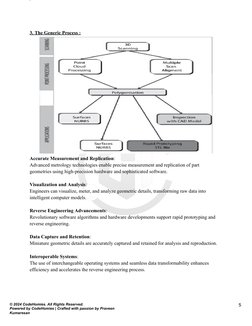


You might also like
- Lakshmi Publications Contact & Book ListNo ratings yetLakshmi Publications Contact & Book List11 pages
- Digital Manufacturing and Smart FactoriesNo ratings yetDigital Manufacturing and Smart Factories12 pages
- Reverse Engineering and CAD Modeling Techniques70% (10)Reverse Engineering and CAD Modeling Techniques59 pages
- Industry 4.0: Transforming Engineering EducationNo ratings yetIndustry 4.0: Transforming Engineering Education49 pages
- Computer Integrated Manufacturing GuideNo ratings yetComputer Integrated Manufacturing Guide18 pages
- Computer Integrated Manufacturing BasicsNo ratings yetComputer Integrated Manufacturing Basics4 pages
- Digital Manufacturing in Mechanical Engineering100% (4)Digital Manufacturing in Mechanical Engineering55 pages
- CAD CAM Computer Aided Design and Manufacturing PDF100% (1)CAD CAM Computer Aided Design and Manufacturing PDF427 pages
- Advanced Manufacturing Processes OverviewNo ratings yetAdvanced Manufacturing Processes Overview11 pages
- CC4102 Computer Aided Tools For Manufacturing Dec 2022100% (1)CC4102 Computer Aided Tools For Manufacturing Dec 20222 pages
- Mechatronics: Sensors and Actuators OverviewNo ratings yetMechatronics: Sensors and Actuators Overview31 pages
- ME8451 - Manufacturing Technology - II (Ripped From Amazon Kindle Ebooks by Sai Seena)No ratings yetME8451 - Manufacturing Technology - II (Ripped From Amazon Kindle Ebooks by Sai Seena)598 pages
- Fluid Mechanics and Machinery: June 2018No ratings yetFluid Mechanics and Machinery: June 201819 pages
- Overview of Computer Aided ManufacturingNo ratings yetOverview of Computer Aided Manufacturing273 pages
- ME3493 Manufacturing Technology SyllabusNo ratings yetME3493 Manufacturing Technology Syllabus2 pages
- Manufacturing Systems Simulation Exam GuideNo ratings yetManufacturing Systems Simulation Exam Guide8 pages
- Computer Applications in Design OverviewNo ratings yetComputer Applications in Design Overview12 pages
- Reverse Engineering: Process & ApplicationsNo ratings yetReverse Engineering: Process & Applications25 pages
- Understanding Reverse Engineering BasicsNo ratings yetUnderstanding Reverse Engineering Basics13 pages
- Understanding Reverse Engineering ProcessNo ratings yetUnderstanding Reverse Engineering Process8 pages
- Shear Friction in High-Strength ConcreteNo ratings yetShear Friction in High-Strength Concrete10 pages
- Ferritic Malleable Iron Castings Spec. SA-47No ratings yetFerritic Malleable Iron Castings Spec. SA-478 pages
- Mechanical Properties of Solids WorksheetNo ratings yetMechanical Properties of Solids Worksheet1 page
- Flexural Capacity of U-Shaped Steel BeamNo ratings yetFlexural Capacity of U-Shaped Steel Beam13 pages
- Fracture Verification for Subsea PipelinesNo ratings yetFracture Verification for Subsea Pipelines16 pages
- Performance of Laterally Loaded Piles Co PDFNo ratings yetPerformance of Laterally Loaded Piles Co PDF30 pages
- Mechanical Engineering Question Paper SetNo ratings yetMechanical Engineering Question Paper Set39 pages
- FEA Simulation and Optimization of Connecting Rod0% (1)FEA Simulation and Optimization of Connecting Rod22 pages
- Steel and Concrete Material Properties ReportNo ratings yetSteel and Concrete Material Properties Report12 pages
- Material Science Question Paper Summer2019No ratings yetMaterial Science Question Paper Summer201949 pages
- Understanding Force Vectors and Stress TensorsNo ratings yetUnderstanding Force Vectors and Stress Tensors125 pages
- Micro Mechanics of One-Dimensional CompressionNo ratings yetMicro Mechanics of One-Dimensional Compression14 pages


