Centrosomes - Structure, Function, Location, and FAQs
Last Updated :
23 Jul, 2025
Centrosomes are cell organelles which play a crucial role in cell division and organization. The centrosome location is near the nucleus. The structure of centrosomes consists of two centrioles surrounded by pericentriolar material. They are present in animal and plant cells.
Centrosomes in plant cells are not as well-defined as in animal cells but still play a role in microtubule organization and cell division. In this article, we will understand the structure and function of centrosomes along with centrosome location, more in detail.
Centrosomes Meaning
Centrosomes are cell organelles that serve as the main place for sorting microtubules in animal cells. Two barrel-shaped microtubule clusters, known as "centrioles," and a collection of proteins that help in the shaping of more microtubules are used to create centrosomes. Centrosomes are not found in plant cells. Instead, plant cells use other structures to organize their microtubules.
Centrosomes Location
Centrosomes are usually found close to the nucleus inside animal cells. They act as the cell's organizing center. They help to arrange structures called microtubules during cell division.
Structure of the Centrosomes
The mother centriole and the daughter centriole, which are perpendicular to one another and connected by interconnecting fibers, make up the centrosome. It is made up of a protein complex that helps in the production of extra microtubules. The centrioles are encased in an amorphous pericentriolar matrix. Cytoplasmic microtubules are formed and anchored as a result of it.
Animal cells' centrosomes closely resemble DNA. One centrosome from the parent cell is transmitted to each daughter cell during cell division. Centrosome division begins in proliferating cells before the S-phase does. The newly formed centrosomes organize the mitotic spindles. The centrosome arranges an astral ray of microtubules during interphase, which helps in intracellular transport, cell adhesion, cell polarity, etc. The mother centriole and daughter centriole, which are the mature and immature centrioles, respectively, in post-mitotic cells, make up the centrosome.
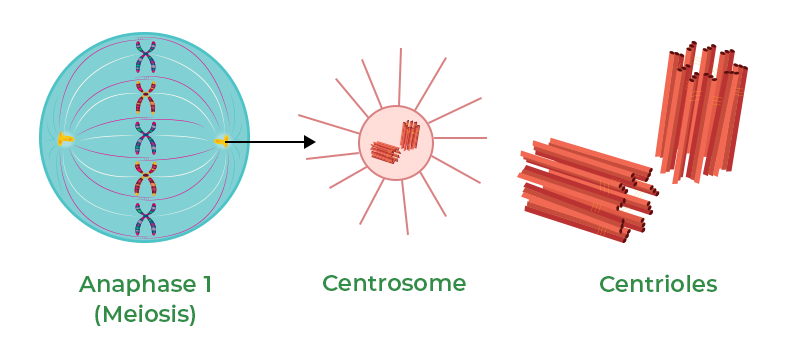
Centrosome Cycle
There are four stages in the centrosome cycle:
- Centrosome duplication takes place at the G1 stage.
- The centrosome develops during the G2 stage.
- Where centrosome division takes place during the mitotic phase.
- Where the chromosomal confusion occurs, late mitotic stage.
Centrosomes Function
The major function of centrosome are given below:
- Microtubule Organization: Centrosomes act as the main microtubule-organizing centers (MTOCs), helping to organize the microtubule network within the cell.
- Cell Division: They play a crucial role in forming the mitotic spindle during cell division, ensuring proper segregation of chromosomes.
- Chromosome Number Monitoring: Centrosomes help to monitor and maintain the correct chromosome number during cell division.
- Cytoskeletal Arrangement: They control the movement and arrangement of cytoskeletal elements, facilitating changes in cell shape and structure.
- Cell Polarity and Motility: Centrosomes contribute to establishing cell polarity and directing cell movement.
- Intracellular Transport: They help in the intracellular transport of organelles and vesicles by organizing microtubules as tracks for motor proteins.
Centrosomes in Animal Cell
Animal cells include centrosomes. When cells divide, centrioles play a significant role. The centrioles and various centrosome segments are duplicated during the interphase of an animal cell, however, it is unclear how this duplication takes place at this time. The two sets of centrioles are initially close together, but as mitosis progresses, the first centrosome separates, and the sets are split apart, resulting in one pair of centrioles being located in each of the new microtubule-sorting centers. Asters, star-shaped clusters of microtubules, emerge from these new foci.
The centrioles help the microtubules form an axle-shaped development that travels the length of the cell as the Astros migrate to constrict the cell shafts. The organization of the chromosomes as they separate later on during cell division is helped by these shaft strands. The centrosome helps in the formation of the mitotic spindle but does not participate in cell division in the majority of animal cells. Due to chromosome instability or the capacity of cancer cells to spread through the body, centrosome malfunction in humans can result in cancer. However, there isn't any solid proof to support this.
Centrosomes in Plant Cells
Plant cells include centrosomes In order to organize microtubules, plants and other growths without centrosomes need MTOC structures. Except for the male gametes, which are completely present in a few blooming plants, plant cells do not include axle post bodies or centrioles (conifers).
The crucial MTOC abilities for shaft attachment and microtubule nucleation give off the impression of being absorbed by the plant cell's atomic envelope during mitosis.
Both fungi and plants lack centrosomes. Except for the flagellated male gametes that are exclusively seen in a few flowering plants, plant cells do not have spindle pole bodies or centrioles. The nuclear envelope appears to perform the primary role of MTOC for spindle organization and microtubule nucleation during plant cell mitosis.
The primary cytoskeletal components that help in the regulated movement are shared by animal and plant cells. Plants lack organelle-like centrosomes, but they can generate spindles and have cytoskeletal arrays including the preprophase band, cortical arrays, and phragmoplast that are involved in the basic growth processes.
Centrosome - Microtubules Organizing Centre
During cell division, the spindle fibers made of microtubules are crucial. It is not a component of every cell because they are not present in plant cells. As the primary microtubule-organizing center (MTOC) in animal cells, the centrosome coordinates interphase cell movement, bonding, and polarity and helps mitotic spindle pole organization.
Centrosome - Mitosis During Fertilization
A new cell called a zygote is created during fertilization when the sperm and egg cells join. Chromosomes from both the sperm and the egg cells are present in the zygote. After conception, the zygote continues to go through cell division, and after a few weeks, it grows into a human embryo, ultimately becoming a baby.
Centrosome Alterations in Cancer Cells
Centrosomes are the major organizing centers of microtubules in mammalian cells and form spindle poles during mitosis. Centrosome defects have been implicated in disease and tumor progression and are associated with defects in the p53 tumor suppressor gene. In our current ultrastructural analysis of 31 human breast tumors, we found that the centrosomes of most tumors displayed significant alterations compared to those of normal breast tissue. These changes include:
- Excess centrioles,
- Excess pericentrosomal material,
- Disturbance of the centriole barrel structure,
- Unintegrated microtubule complexes,
- Centrosomes of abnormal length,
- The centriole, which functions as the ciliary basal body, and
- Wrong centrosome.
These changes are associated with altered cell polarity, altered cell and tissue differentiation, and chromosome missegregation due to multipolar mitosis. Importantly, the presence of excess pericentrosomal material was associated with the highest frequency of abnormal mitosis. Centrosome abnormalities can confer a mutator phenotype on tumors, and occasionally cells with a selective advantage emerge and proliferate, driving the tumor into a more aggressive state.
Centrosomes vs Centriole - Difference Between Centrosomes and Centriole
The difference between centrosomes and centriole are:
| Feature | Centrosomes | Centrioles |
|---|
| Structure | Non-membranous organelles composed of protein fibers | Cylinder-shaped structures made of microtubules |
| Location | Typically found near the nucleus in animal cells | Usually located within the centrosome in animal cells |
| Function | Organize microtubules during cell division | help in the formation of spindle fibers during cell division |
| Composition | Consist of two centrioles and pericentriolar material | Composed of nine triplets of microtubules |
| Replication | Replicates during the S phase of the cell cycle | Duplicate during cell division |
| Role in cell division | Serve as microtubule-organizing centers | Form spindle fibers that separate chromosomes |
| Role in cilia formation | Centrioles are involved in the formation of cilia and flagella | Centrioles serve as basal bodies for cilia formation |
| Importance | Crucial for cell division and organization of the cytoskeleton | Essential for the formation of the mitotic spindle and proper cell division |
Conclusion - Centrosomes
Centrosomes play a critical role in organizing microtubules and ensuring proper cell division in animal cells. They are composed of centrioles and a protein complex that facilitates the formation of additional microtubules. While essential in animals, centrosomes are absent in plant cells, which utilize other structures for microtubule organization. The dysfunction of centrosomes can lead to severe consequences, such as cancer, due to chromosome missegregation and cell polarity disruptions. Understanding the function and structure of centrosomes is vital for comprehending cellular processes and the implications of centrosome abnormalities in diseases.
Also Read:
Explore
Biology
7 min read
Cell
Human Physiology
Plant Physiology
Genetics and Evolution
Health and Diseases