A hybrid cloud combines public and private cloud services, giving businesses the best of both worlds—scalability from public clouds and security from private clouds. This setup allows companies to store sensitive data privately while using cost-effective public cloud resources for non-sensitive workloads.
For example, in software development, teams often use a public cloud to host projects and a private cloud for secure testing. This approach offers flexibility, cost savings, and better control over data and applications.
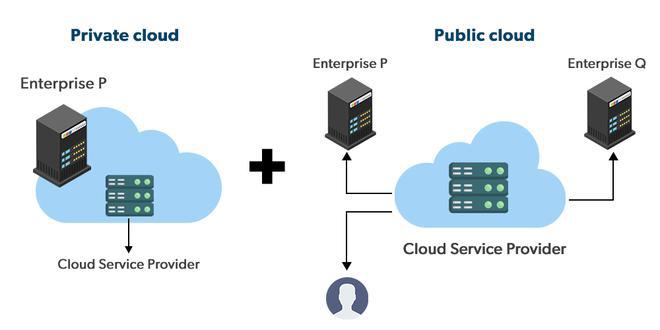 Hybrid Cloud
In this guide, we’ll break down how hybrid cloud works, its key benefits, challenges, and why businesses are adopting it for a more efficient, secure, and scalable IT infrastructure.
How Does Hybrid Cloud Work?
As we know, in a hybrid cloud, there are two clouds: public and private. The public cloud is responsible for sending data to the private cloud. As we see in COVID-19, many businesses use a hybrid cloud environment that uses both the private and public clouds for sensitive information.
1. Finance
In the finance industry, hybrid cloud plays an important role, where the public cloud is responsible for showing live trade analysis and private cloud trade orders are placed. It provides flexibility, scalability, and connectivity.
2. Education
In the education sector, hybrid cloud computing is rapidly increasing in COVID-19. Hybrid clouds support virtual lectures and classrooms. It is most supportive to those who don't go to college due to financial situations.
3. Healthcare
Hybrid cloud computing is rapidly increasing in the healthcare industry. It takes the healthcare pipeline to the next level. The hybrid cloud offers a stable solution for healthcare stakeholders to easily manage and access the data or server.
4. Retail
Hybrid clouds are also popular in the retail industry due to high traffic periods. Hybrid cloud enables retailers to use data analysis to design any products that customers request. It allows us to solve problems and increase sales.
How to Set Up a Hybrid Cloud
Setting up a hybrid cloud infrastructure is a smart way for businesses to combine the security of private cloud environments with the scalability of public cloud services. A well-designed hybrid cloud setup allows organizations to optimize costs, enhance performance, and maintain data security while benefiting from cloud-based innovations. Here’s a simple step-by-step guide to getting started.
1. Define your hybrid cloud goals
Before jumping in, determine:
- Which workloads should stay in a private cloud? (Sensitive data, compliance-heavy applications)
- Which tasks should move to the public cloud? (Scalable applications, AI/ML workloads, testing environments)
- What are your key priorities? (Cost savings, performance, disaster recovery, security)
2. Choose the right cloud providers
A successful hybrid cloud solution requires seamless integration between public and private cloud environments. Consider:
- Public Cloud Providers: AWS, Microsoft Azure, Google Cloud, IBM Cloud, Oracle Cloud – each offers unique services and pricing models.
- Private Cloud Options: On-premise data centers, VMware, OpenStack, or enterprise-grade cloud platforms.
- Ensure compatibility between cloud providers for smooth operations.
3. Set up secure cloud connectivity
For your hybrid cloud architecture to function efficiently, you need a strong networking setup:
- Use Hybrid Cloud Networking Tools: AWS Direct Connect, Azure ExpressRoute, Google Cloud Interconnect for fast and reliable connectivity.
- Implement VPN & SD-WAN solutions to ensure secure and seamless data transfer.
- Optimize network latency for better performance and faster access to cloud resources.
4. Manage access & security properly
Security is critical in a hybrid cloud environment. Protect your data with:
5. Use hybrid cloud management tools
To keep both public and private cloud environments running smoothly:
- Kubernetes & Docker: Manage containerized applications efficiently.
- Terraform & Ansible: Automate infrastructure deployment and scaling.
- Cloud Monitoring Tools: AWS CloudWatch, Azure Monitor, Google Cloud Operations Suite to track performance and security.
6. Optimize workloads & automate operations
- Automatically distribute workloads across public and private clouds based on usage patterns.
- Leverage AI-driven cloud automation for smarter resource allocation and cost optimization.
- Set up auto-scaling policies to handle peak traffic loads without downtime.
7. Implement Backup & Disaster Recovery
A hybrid cloud disaster recovery plan ensures business continuity by:
- Storing backups securely in a private or public cloud for redundancy.
- Using real-time failover mechanisms to minimize downtime.
- Encrypting critical data for better protection.
8. Monitor, Optimize & Improve
Once your hybrid cloud strategy is in place:
- Analyze cloud usage & costs to avoid overspending.
- Fine-tune cloud configurations for better efficiency.
- Upgrade security & compliance protocols to stay ahead of risks.
Top Cloud Service Providers
When choosing a cloud service provider, it’s important to understand what each one offers and how they fit different business needs. Here’s a simple breakdown of the top cloud platforms and what makes them unique:
Cloud Provider | Key Features | Best For | Notable Services |
|---|
AWS (Amazon Web Services) | Largest cloud provider with extensive services. Highly rated customer support. Scalable for businesses of all sizes. | Enterprises, Startups, Cloud Cost Management | EC2, S3, Lambda, RDS, CloudFront |
|---|
Microsoft Azure | Supports 100+ services for app development, deployment, and security. Compatible with multiple coding languages & frameworks. | Small & Midsize Businesses, Enterprises | Virtual Machines, Azure Kubernetes Service (AKS), Cosmos DB, AI & Machine Learning |
|---|
Oracle Cloud | Designed for businesses with limited coding expertise. Runs on Oracle's bare metal servers. Supports database management & analytics. | Enterprises, Database Management, Cross-Functional Teams | Oracle Cloud Infrastructure (OCI), Autonomous Database, Cloud Applications |
|---|
IBM Cloud | Uses AI for business cloud operations. Offers over 170+ services. Strong DevOps support with discounts on long-term subscriptions. | AI & Machine Learning, DevOps, Enterprise Solutions | IBM Watson, Kubernetes, Blockchain, Cloud Foundry |
|---|
Cisco Cloud | Works across public & private cloud platforms. Partners with Google, AT&T, and Accenture for hybrid cloud solutions. | Hybrid Cloud Solutions, Enterprise Networking | Cisco Intersight, Hybrid Cloud Management, Security & Networking Solutions |
|---|
Use Cases of Hybrid Cloud Computing
The following are the most important use cases of hybrid cloud computing:
1. Scalable Application Deployment
- Businesses use hybrid cloud computing to deploy and scale applications efficiently.
- Public clouds handle high-traffic loads, while private clouds store business-critical data securely.
2. Disaster Recovery & Business Continuity
- A hybrid cloud strategy ensures quick data recovery in case of system failures or cyber threats.
- Companies store backups in a private cloud while using a public cloud for rapid recovery and minimal downtime.
3. Data Security & Compliance
- Organizations in finance, healthcare, and legal industries use private clouds for data privacy and regulatory compliance while benefiting from public cloud scalability.
- Ensures data encryption, controlled access, and secure cloud storage.
4. Development & Testing
- Developers use public cloud services for cost-effective testing and staging environments while deploying final applications in a private cloud.
- Reduces infrastructure costs and accelerates software development cycles.
5. Big Data Processing & AI/ML Workloads
- AI/ML applications, analytics, and real-time data processing require powerful cloud computing resources.
- Businesses run big data analytics in a public cloud while keeping sensitive business insights secure in a private cloud.
Advantages of Hybrid Cloud
The following are some of the most important advantages of hybrid cloud:
- Flexibility: It provides flexibility to use both cloud environments, such as public and private cloud.
- Security: It provides a private cloud to secure sensitive data or information.
- Cost effective: Hybrid cloud costs are less than those of private cloud. It helps the business or organization save money, which is useful for both application support and infrastructure.
- Risk management: In risk management, we easily handle and manage the risks that occur in the hybrid cloud environment.
- Accessibility: It provided accessibility to easily manage the resources anywhere in the world.
Disadvantages of Hybrid Cloud
The following are some disadvantages we faced while using hybrid cloud:
- Slow Internet connection: The internet is complex because of public and private clouds. There is too much load on the server.
- Visibility: There is a visibility issue because of the complications of cloud environments. It breaks the environment into multiple clouds, making it tough to view.
- Implementation: In hybrid clouds, the implementation is difficult because storage and servers are required. That's why the implementation takes a lot of time because of the private and public clouds.
Explore
Basics Of Cloud Computing
Cloud Deployment Models
Cloud Service Models
Cloud Virtualization
Cloud Service Provider
Advanced Concepts of Cloud