Equivalent Serial Schedule of Conflict Serializable Schedule in DBMS
Last Updated :
23 Jul, 2025
Prerequisite: Conflict Serializability, Precedence Graph
Conflict Serializable Schedule: A schedule is called conflict serializable if it can be transformed into a serial schedule by swapping non-conflicting operations. The serial schedule of the Conflict Serializable Schedule can be found by applying topological Sorting on the Precedence Graph of the Conflict Serializable Schedule.
Note: Precedence Graph of Conflict Serial Schedule is always directed acyclic graph.
Approach: Follow to below steps to find topological sorting of Precedence Graph:
- Find the indegree of all nodes for the given Precedence Graph and store it in an auxiliary array.
- Now For each node having indegree 0 perform the following:
- Print the current node T as the order of the topological sort.
- Let the node T be the node with in-degree 0.
- Remove T and all edges connecting to T from the graph.
- Update indegree of all nodes after the above steps.
- After the above steps, the topological sort of the given precedence graph can be calculated.
Below is the illustration of the above approach:
Let, the Conflict Serial Schedule be S: R2(A) W2(A) R3(C) W2(B) W3(A) W3(C) R1(A) R2(B) W1(A) W2(B)
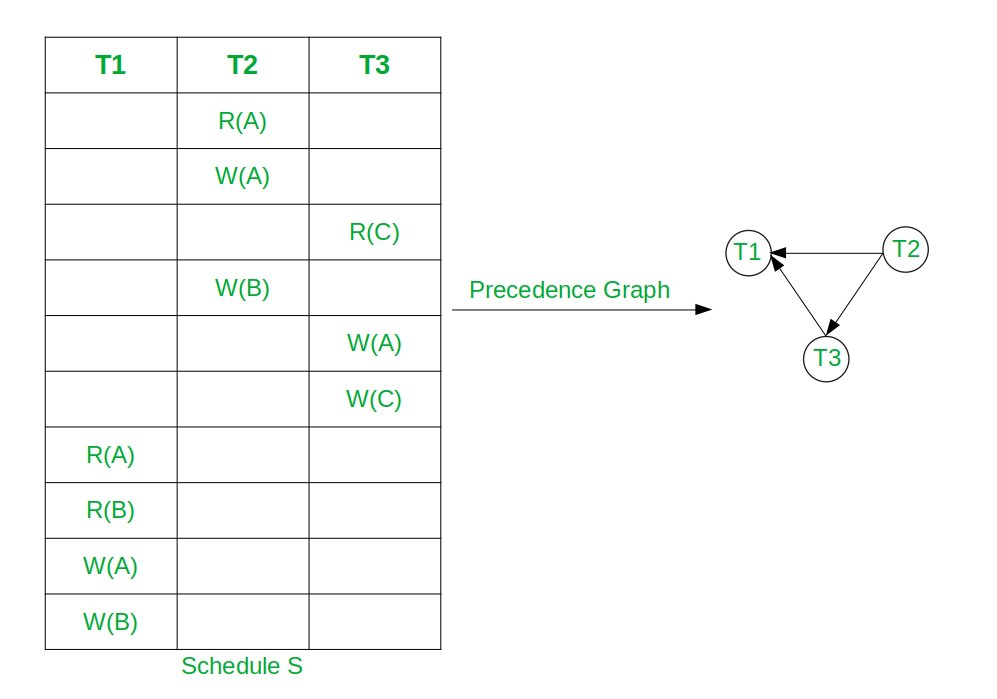
- Here node T2 has indegree 0.
- So, select T2 and remove T2 and all edges connecting from it.
- Now T3 has indegree 0. So, select T3 and remove the edge T3→T1.
- At the end select T3. So the topological Sorting is T2, T3, T1.
- Hence, the equivalent serial schedule of given conflict serializable schedule is T2→T3→T1, i.e., S2: R2(A) W2(A) W2(B) R3(C) W3(A) W3(C) R1(A) R2(B) W1(A) W1(B).
There may be more than one equivalent serial schedule of the conflict serializable schedule.
Below is the implementation to get the Serial Schedule of CSS using Topological Sorting:
C++
// C++ program to print serial schedule
// of CSS using Topological sorting
#include <bits/stdc++.h>
using namespace std;

class PrecedenceGraph {

    // No. of vertices
    int V;

    // Pointer to an array containing
    // adjacency vector
    vector<int>* adj;

    // Vector to store SerialSchedule
    vector<int> serialSchedule;

    // Function  declarations
    void computeIndegree(int* indegree);
    int findZeroIndegree(int* indegree,
                         bool* visited);

public:
    // Constructor
    PrecedenceGraph(int V);

    // Function declarations
    void addEdge(int v, int w);
    void topologicalSort();
    void printSchedule();
};

// Function to create the precedence
// graph
PrecedenceGraph::PrecedenceGraph(int V)
{
    this->V = V;
    adj = new vector<int>[V];
}

// Function to add the edge to the
// precedence graph
void PrecedenceGraph::addEdge(int v,
                              int w)
{
    adj[v].push_back(w);
}

// Function to compute indegree of nodes
void PrecedenceGraph::computeIndegree(
    int* indegree)
{
    for (int i = 1; i < V; i++) {

        // Traverse the adjacency list
        // of node i
        for (int j = 0;
             j < adj[i].size(); j++) {
            int node = adj[i][j];

            // Update the indegree
            // of node
            indegree[node]++;
        }
    }
}

// Function to find node with
// zero indegree
int PrecedenceGraph::findZeroIndegree(
    int* indegree, bool* visited)
{
    for (int i = 1; i < V; i++) {

        // If node is not visited
        // and have indegree 0
        if (!visited[i]
            && indegree[i] == 0) {

            // Mark node visited
            visited[i] = true;

            // Return node
            return i;
        }
    }

    // All nodes are visited
    return -1;
}

// Function to find the topological
// Sorting of the given graph
void PrecedenceGraph::topologicalSort()
{
    // Create and initialize
    // visited array
    bool* visited = new bool[V]();

    // Create and initialize
    // indegree array
    int* indegree = new int[V]();

    computeIndegree(indegree);

    // Check if the node with
    // indegree 0 is available
    int node = findZeroIndegree(
        indegree, visited);

    bool nodeAvailable = false;

    if (node != -1) {
        nodeAvailable = true;
    }
    while (nodeAvailable) {

        // Add node to serial schedule
        serialSchedule.push_back(node);

        for (int i = 0;
             i < adj[node].size(); i++) {

            // Delete all edges of current
            // node and update indegree
            indegree[adj[node][i]]--;
        }

        // Find next node with indegree 0
        node = findZeroIndegree(indegree,
                                visited);

        if (node == -1) {

            // Node with zero indegree
            // not available
            nodeAvailable = false;
        }
    }
}

// Function to print the serial schedule
void PrecedenceGraph::printSchedule()
{
    for (int i : serialSchedule) {
        cout << "T" << i << " ";
    }
}

// Driver Code
int main()
{
    // Create a precedence graph
    // given in the above diagram
    PrecedenceGraph graph(4);
    graph.addEdge(2, 1);
    graph.addEdge(2, 3);
    graph.addEdge(3, 1);

    // Find topological ordereing
    graph.topologicalSort();

    // Print Schedule
    cout << "Equivalent Serial"
         << " Schedule is :";
    graph.printSchedule();
}
// Java program to print serial schedule
// of CSS using Topological sorting

import java.util.*;

class PrecedenceGraph {
    // No. of vertices
private int V;

// Pointer to an array containing
// adjacency vector
private ArrayList<Integer>[] adj;

// Vector to store SerialSchedule
private ArrayList<Integer> serialSchedule;

// Function to create the precedence
// graph
PrecedenceGraph(int V) {
    this.V = V;
    adj = new ArrayList[V];
    for (int i = 0; i < V; i++) {
        adj[i] = new ArrayList<>();
    }
    serialSchedule = new ArrayList<>();
}

// Function to add the edge to the
// precedence graph
void addEdge(int v, int w) {
    adj[v].add(w);
}

// Function to compute indegree of nodes
void computeIndegree(int[] indegree) {
    for (int i = 1; i < V; i++) {
        // Traverse the adjacency list
        // of node i
        for (int j = 0; j < adj[i].size(); j++) {
            int node = adj[i].get(j);

            // Update the indegree
            // of node
            indegree[node]++;
        }
    }
}

// Function to find node with
// zero indegree
int findZeroIndegree(int[] indegree, boolean[] visited) {
    for (int i = 1; i < V; i++) {
        // If node is not visited
        // and have indegree 0
        if (!visited[i] && indegree[i] == 0) {
            // Mark node visited
            visited[i] = true;
            // Return node
            return i;
        }
    }
    // All nodes are visited
    return -1;
}

// Function to find the topological
// Sorting of the given graph
void topologicalSort() {
    // Create and initialize
    // visited array
    boolean[] visited = new boolean[V];

    // Create and initialize
    // indegree array
    int[] indegree = new int[V];

    computeIndegree(indegree);

    // Check if the node with indegree 0 is available
    int node = findZeroIndegree(indegree, visited);

    boolean nodeAvailable = false;

    if (node != -1) {
        nodeAvailable = true;
    }
    while (nodeAvailable) {
        // Add node to serial schedule
        serialSchedule.add(node);

        for (int i = 0; i < adj[node].size(); i++) {
            // Delete all edges of current
            // node and update indegree
            indegree[adj[node].get(i)]--;
        }

        // Find next node with indegree 0
        node = findZeroIndegree(indegree, visited);

        if (node == -1) {
            // Node with zero indegree
            // not available
            nodeAvailable = false;
        }
    }
}

// Function to print the serial schedule
void printSchedule() {
    for (int i : serialSchedule) {
        System.out.print("T" + i + " ");
    }
    System.out.println();
}
}

// Driver Code
class Main {
public static void main(String[] args) {
// Create a precedence graph
// given in the above diagram
PrecedenceGraph graph = new PrecedenceGraph(4);
graph.addEdge(2, 1);
graph.addEdge(2, 3);
graph.addEdge(3, 1);

    // Find topological ordereing
    graph.topologicalSort();

    // Print Schedule
    System.out.print("Equivalent Serial Schedule is :");
    graph.printSchedule();

}
}

// This code is contributed by Pushpesh Raj.
# Python program to print serial schedule of CSS using Topological sorting
from collections import defaultdict

class PrecedenceGraph:
    # Constructor
    def __init__(self, V):
        self.V = V
        self.adj = defaultdict(list)
        self.serialSchedule = []

    # Function to add the edge to the precedence graph
    def addEdge(self, v, w):
        self.adj[v].append(w)

    # Function to compute indegree of nodes
    def computeIndegree(self, indegree):
        for i in range(1, self.V):
            for node in self.adj[i]:
                # Update the indegree of node
                indegree[node] += 1

    # Function to find node with zero indegree
    def findZeroIndegree(self, indegree, visited):
        for i in range(1, self.V):
            # If node is not visited and have indegree 0
            if not visited[i] and indegree[i] == 0:
                # Mark node visited
                visited[i] = True
                # Return node
                return i
        # All nodes are visited
        return -1

    # Function to find the topological Sorting of the given graph
    def topologicalSort(self):
        # Create and initialize visited array
        visited = [False for i in range(self.V)]

        # Create and initialize indegree array
        indegree = [0 for i in range(self.V)]

        self.computeIndegree(indegree)

        # Check if the node with indegree 0 is available
        node = self.findZeroIndegree(indegree, visited)
        nodeAvailable = False
        if node != -1:
            nodeAvailable = True

        while nodeAvailable:
            # Add node to serial schedule
            self.serialSchedule.append(node)
            for next_node in self.adj[node]:
                # Delete all edges of current node and update indegree
                indegree[next_node] -= 1

            # Find next node with indegree 0
            node = self.findZeroIndegree(indegree, visited)

            if node == -1:
                # Node with zero indegree not available
                nodeAvailable = False

    # Function to print the serial schedule
    def printSchedule(self):
        print("Equivalent Serial Schedule is: ", end="")
        for i in self.serialSchedule:
            print("T{} ".format(i), end="")

# Driver Code
if __name__ == "__main__":
    # Create a precedence graph given in the above diagram
    graph = PrecedenceGraph(4)
    graph.addEdge(2, 1)
    graph.addEdge(2, 3)
    graph.addEdge(3, 1)

    # Find topological ordereing
    graph.topologicalSort()

    # Print Schedule
    graph.printSchedule()
using System;
using System.Collections.Generic;

public class PrecedenceGraph
{

    // No. of vertices
    private int V;

    // Pointer to an array containing
    // adjacency vector
    private List<int>[] adj;

    // Vector to store SerialSchedule
    private List<int> serialSchedule = new List<int>();

    // Constructor
    public PrecedenceGraph(int V)
    {
        this.V = V;
        adj = new List<int>[ V ];
        for (int i = 0; i < V; i++) {
            adj[i] = new List<int>();
        }
    }

    // Function to add the edge to the
    // precedence graph
    public void addEdge(int v, int w) { adj[v].Add(w); }

    // Function to compute indegree of nodes
    private void computeIndegree(int[] indegree)
    {
        for (int i = 1; i < V; i++) {
            // Traverse the adjacency list
            // of node i
            foreach(int node in adj[i])
            {
                // Update the indegree
                // of node
                indegree[node]++;
            }
        }
    }

    // Function to find node with
    // zero indegree
    private int findZeroIndegree(int[] indegree,
                                 bool[] visited)
    {
        for (int i = 1; i < V; i++) {
            // If node is not visited
            // and have indegree 0
            if (!visited[i] && indegree[i] == 0) {
                // Mark node visited
                visited[i] = true;

                // Return node
                return i;
            }
        }

        // All nodes are visited
        return -1;
    }

    // Function to find the topological
    // Sorting of the given graph
    public void topologicalSort()
    {
        // Create and initialize
        // visited array
        bool[] visited = new bool[V];

        // Create and initialize
        // indegree array
        int[] indegree = new int[V];

        computeIndegree(indegree);

        // Check if the node with
        // indegree 0 is available
        int node = findZeroIndegree(indegree, visited);

        bool nodeAvailable = false;

        if (node != -1) {
            nodeAvailable = true;
        }

        while (nodeAvailable) {
            // Add node to serial schedule
            serialSchedule.Add(node);

            foreach(int i in adj[node])
            {
                // Delete all edges of current
                // node and update indegree
                indegree[i]--;
            }

            // Find next node with indegree 0
            node = findZeroIndegree(indegree, visited);

            if (node == -1) {
                // Node with zero indegree
                // not available
                nodeAvailable = false;
            }
        }
    }

    // Function to print the serial schedule
    public void printSchedule()
    {
        foreach(int i in serialSchedule)
        {
            Console.Write("T" + i + " ");
        }
    }
}

public class Program {
    public static void Main(string[] args)
    {
        // Create a precedence graph
        // given in the above diagram
        PrecedenceGraph graph = new PrecedenceGraph(4);
        graph.addEdge(2, 1);
        graph.addEdge(2, 3);
        graph.addEdge(3, 1);

        // Find topological ordering
        graph.topologicalSort();

        // Print Schedule
        Console.Write("Equivalent Serial Schedule is: ");
        graph.printSchedule();
    }
}
class PrecedenceGraph {
  // Constructor
  constructor(V) {
    this.V = V;
    this.adj = new Map();
    this.serialSchedule = [];
  }

  // Function to add the edge to the precedence graph
  addEdge(v, w) {
    if (!this.adj.has(v)) {
      this.adj.set(v, []);
    }
    this.adj.get(v).push(w);
  }

  // Function to compute indegree of nodes
  computeIndegree(indegree) {
    for (let i = 1; i < this.V; i++) {
      // Check if the current node exists in the adjacency list
      if (!this.adj.has(i)) {
        continue;
      }
      // Update the indegree of all adjacent nodes
      for (const node of this.adj.get(i)) {
        indegree[node] += 1;
      }
    }
  }

  // Function to find node with zero indegree
  findZeroIndegree(indegree, visited) {
    for (let i = 1; i < this.V; i++) {
      // If node is not visited and have indegree 0
      if (!visited[i] && indegree[i] === 0) {
        // Mark node visited
        visited[i] = true;
        // Return node
        return i;
      }
    }
    // All nodes are visited
    return -1;
  }

  // Function to find the topological Sorting of the given graph
  topologicalSort() {
    // Create and initialize visited array
    const visited = new Array(this.V).fill(false);

    // Create and initialize indegree array
    const indegree = new Array(this.V).fill(0);

    // Compute indegree of nodes
    this.computeIndegree(indegree);

    // Check if the node with indegree 0 is available
    let node = this.findZeroIndegree(indegree, visited);
    let nodeAvailable = false;
    if (node !== -1) {
      nodeAvailable = true;
    }

    while (nodeAvailable) {
      // Add node to serial schedule
      this.serialSchedule.push(node);
      // Delete all edges of current node and update indegree
      if (this.adj.has(node)) {
        for (const nextNode of this.adj.get(node)) {
          indegree[nextNode] -= 1;
        }
      }
      // Find next node with indegree 0
      node = this.findZeroIndegree(indegree, visited);
      if (node === -1) {
        // Node with zero indegree not available
        nodeAvailable = false;
      }
    }
  }

  // Function to print the serial schedule
  printSchedule() {
    let result = "Equivalent Serial Schedule is: ";
    for (const i of this.serialSchedule) {
      result += `T${i} `;
    }
    console.log(result);
  }
}

// Driver Code
const graph = new PrecedenceGraph(4);
graph.addEdge(2, 1);
graph.addEdge(2, 3);
graph.addEdge(3, 1);
graph.topologicalSort();
graph.printSchedule();
Output: Equivalent Serial Schedule is :T2 T3 T1
Time Complexity: O(N)
Auxiliary Space: O(N)
Explore
Basics of DBMS
ER & Relational Model
Relational Algebra
Functional Dependencies & Normalisation
Transactions & Concurrency Control
Advanced DBMS
Practice Questions