Count the nodes in the given tree whose weight is even parity
Last Updated :
11 Jul, 2025
Given a tree and the weights of all the nodes, the task is to count the number of nodes whose weights are even parity i.e. whether the count of set bits in them is even.
Examples:
Input:
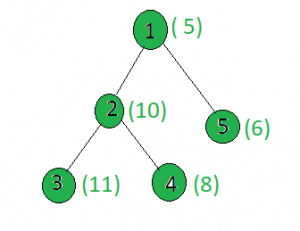
Output: 3
| Weight | Binary Representation | Parity |
|---|
| 5 | 0101 | Even |
| 10 | 1010 | Even |
| 11 | 1011 | Odd |
| 8 | 1000 | Odd |
| 6 | 0110 | Even |
Approach: Perform dfs on the tree and for every node, check if its weight is even parity or not. If yes then increment count.
Steps to solve the problem:
- Initialize ans to 0.
- Define a function isEvenParity(x) that takes an integer x and returns true if the count of set bits in x is even and false otherwise.
- Define a function dfs(node, parent) that performs depth-first search on the graph.
- Within the dfs function:
a. Check if the weight of the current node has even parity using the isEvenParity function. If it does, increment ans by 1.
b. For each neighbor to of node in the graph, if it is not equal to the parent, recursively call dfs with to as the node and node as the parent. - Return ans as the final result.
Below is the implementation of the above approach:
C++
// C++ implementation of the approach
#include <bits/stdc++.h>
using namespace std;

int ans = 0;

vector<int> graph[100];
vector<int> weight(100);

// Function that returns true if count
// of set bits in x is even
bool isEvenParity(int x)
{
    // parity will store the
    // count of set bits
    int parity = 0;
    while (x != 0) {
        x = x & (x - 1);
        parity++;
    }

    if (parity % 2 == 0)
        return true;
    else
        return false;
}

// Function to perform dfs
void dfs(int node, int parent)
{
    // If weight of the current
    // node has even parity
    if (isEvenParity(weight[node]))
        ans += 1;

    for (int to : graph[node]) {
        if (to == parent)
            continue;
        dfs(to, node);
    }
}

// Driver code
int main()
{
    // Weights of the node
    weight[1] = 5;
    weight[2] = 10;
    weight[3] = 11;
    weight[4] = 8;
    weight[5] = 6;

    // Edges of the tree
    graph[1].push_back(2);
    graph[2].push_back(3);
    graph[2].push_back(4);
    graph[1].push_back(5);

    dfs(1, 1);

    cout << ans;

    return 0;
}
// Java implementation of the approach
import java.util.*;

class GFG
{

static int ans = 0;

static Vector<Vector<Integer>> graph = new Vector<Vector<Integer>>();
static Vector<Integer> weight = new Vector<Integer>();

// Function that returns true if count
// of set bits in x is even
static boolean isEvenParity(int x)
{
    // parity will store the
    // count of set bits
    int parity = 0;
    while (x != 0)
    {
        x = x & (x - 1);
        parity++;
    }

    if (parity % 2 == 0)
        return true;
    else
        return false;
}

// Function to perform dfs
static void dfs(int node, int parent)
{
    // If weight of the current
    // node has even parity
    if (isEvenParity(weight.get(node) ))
        ans += 1;

    for (int i = 0; i < graph.get(node).size(); i++)
    {
        if (graph.get(node).get(i) == parent)
            continue;
        dfs(graph.get(node).get(i) , node);
    }
}

// Driver code
public static void main(String args[])
{
    // Weights of the node
    weight.add( 0);
    weight.add( 5);
    weight.add( 10);;
    weight.add( 11);;
    weight.add( 8);
    weight.add( 6);

    for(int i=0;i<100;i++)
    graph.add(new Vector<Integer>());

    // Edges of the tree
    graph.get(1).add(2);
    graph.get(2).add(3);
    graph.get(2).add(4);
    graph.get(1).add(5);

    dfs(1, 1);

    System.out.println( ans );

}
}

// This code is contributed by Arnab Kundu
# Python3 implementation of the approach
ans = 0

graph = [[] for i in range(100)]
weight = [0]*100

# Function that returns True if count
# of set bits in x is even
def isEvenParity(x):

    # parity will store the
    # count of set bits
    parity = 0
    while (x != 0):
        x = x & (x - 1)
        parity += 1

    if (parity % 2 == 0):
        return True
    else:
        return False

# Function to perform dfs
def dfs(node, parent):
    global ans

    # If weight of the current
    # node has even parity
    if (isEvenParity(weight[node])):
        ans += 1

    for to in graph[node]:
        if (to == parent):
            continue
        dfs(to, node)

# Driver code

# Weights of the node
weight[1] = 5
weight[2] = 10
weight[3] = 11
weight[4] = 8
weight[5] = 6

# Edges of the tree
graph[1].append(2)
graph[2].append(3)
graph[2].append(4)
graph[1].append(5)

dfs(1, 1)
print(ans)

# This code is contributed by SHUBHAMSINGH10
// C# implementation of the approach
using System;
using System.Collections.Generic;

class GFG
{

static int ans = 0;

static List<List<int>> graph = new List<List<int>>();
static List<int> weight = new List<int>();

// Function that returns true if count
// of set bits in x is even
static bool isEvenParity(int x)
{
    // parity will store the
    // count of set bits
    int parity = 0;
    while (x != 0)
    {
        x = x & (x - 1);
        parity++;
    }

    if (parity % 2 == 0)
        return true;
    else
        return false;
}

// Function to perform dfs
static void dfs(int node, int parent)
{
    // If weight of the current
    // node has even parity
    if (isEvenParity(weight[node]))
        ans += 1;

    for (int i = 0; i < graph[node].Count; i++)
    {
        if (graph[node][i] == parent)
            continue;
        dfs(graph[node][i] , node);
    }
}

// Driver code
static void Main()
{
    // Weights of the node
    weight.Add(0);
    weight.Add(5);
    weight.Add(10);
    weight.Add(11);
    weight.Add(8);
    weight.Add(6);

    for(int i = 0; i < 100; i++)
    graph.Add(new List<int>());

    // Edges of the tree
    graph[1].Add(2);
    graph[2].Add(3);
    graph[2].Add(4);
    graph[1].Add(5);

    dfs(1, 1);

    Console.WriteLine( ans );
}
}

// This code is contributed by mits
<script>

// Javascript implementation of the approach

let ans = 0;

let graph = new Array(100);
let weight = new Array(100);
for(let i = 0; i < 100; i++)
{
    graph[i] = [];
    weight[i] = 0;
}

// Function that returns true if count
// of set bits in x is even
function isEvenParity(x)
{
    // parity will store the
    // count of set bits
    let parity = 0;
    while (x != 0) {
        x = x & (x - 1);
        parity++;
    }

    if (parity % 2 == 0)
        return true;
    else
        return false;
}

// Function to perform dfs
function dfs(node, parent)
{
    // If weight of the current
    // node has even parity
    if (isEvenParity(weight[node]))
        ans += 1;

    for(let to=0;to<graph[node].length;to++) {
        if(graph[node][to] == parent)
            continue
        dfs(graph[node][to], node);
    }
}

// Driver code
    // Weights of the node
    weight[1] = 5;
    weight[2] = 10;
    weight[3] = 11;
    weight[4] = 8;
    weight[5] = 6;

    // Edges of the tree
    graph[1].push(2);
    graph[2].push(3);
    graph[2].push(4);
    graph[1].push(5);

    dfs(1, 1);

    document.write(ans);

    // This code is contributed by Dharanendra L V.

</script>
Complexity Analysis:
- Time Complexity: O(N).
In DFS, every node of the tree is processed once and hence the complexity due to the DFS is O(N) for N nodes in the tree. Therefore, the time complexity is O(N). - Auxiliary Space: O(1).
Any extra space is not required, so the space complexity is constant.
Explore
DSA Fundamentals
Data Structures
Algorithms
Advanced
Interview Preparation
Practice Problem