Paths to travel each nodes using each edge (Seven Bridges of Königsberg)
Last Updated :
29 Aug, 2025
Given n nodes and m edges (bridges) represented as a square adjacency matrix adj[][] of size n x n, where a value 1 indicates a bridge between two nodes. The task is to determine a path that uses each edge exactly once, visiting nodes accordingly. If such a path exists, print the path; otherwise, print -1.
Examples :
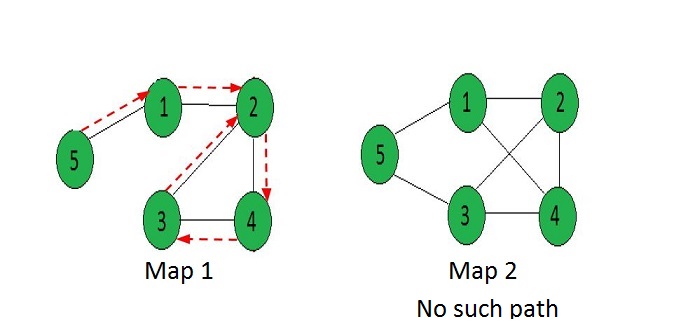
Input: adj[][] = [[0, 1, 0, 0, 1],
[1, 0, 1, 1, 0],
[0, 1, 0, 1, 0],
[0, 1, 1, 0, 0],
[1, 0, 0, 0, 0]]
Output: 5 -> 1 -> 2 -> 3 -> 4 -> 2
Explanation: This path uses every edge exactly once. Each step transitions across an edge in the adjacency matrix, no edge is repeated.
Input: adj[][] = [[0, 1, 0, 1, 1],
[1, 0, 1, 1, 0],
[0, 1, 0, 1, 1],
[1, 1, 1, 0, 0],
[1, 0, 1, 0, 0]]
Output: -1
Explanation: No path exists here.
This is one of the most famous problems in Graph Theory, known as the "Seven Bridges of Königsberg". It was solved by the renowned mathematician Leonhard Euler in 1735 and is widely regarded as the origin of Graph Theory as a mathematical discipline.
The original problem asked: Given seven bridges connecting four land masses in the city of Königsberg (then in Prussia), is it possible to start from any land area and cross each bridge exactly once without repeating?
To address this, Euler abstracted the land masses as nodes and the bridges as edges of a graph. He then examined whether an Eulerian Path existed, a path that visits every edge exactly once. Euler proved that such a path is only possible under specific conditions regarding the degrees of the nodes (land masses). The problem we're dealing with here is a generalized version of Euler’s original problem, where the graph can have any number of nodes and edges. The goal remains the same: determine whether there is an Eulerian path that uses each edge exactly once. If such a path exists, output the sequence of nodes visited; otherwise, report that no such path is possible.
Approach:
The idea is to determine if an Eulerian Path exists in an undirected graph using degree properties. The thought process begins by checking if the number of nodes with odd degree is either 0 or 2, which is a key condition. We then use DFS to traverse the graph, reducing edge counts to avoid repetition and building the path. Finally, we validate if the path covers all edges exactly once and convert it to 1-based indexing for output.
Steps to implement the above idea:
- Create a function to check for Eulerian Path by counting nodes with odd degree and setting the start node.
- Count total edges before traversal by summing upper triangle of the adjacency matrix for accurate validation.
- Implement a DFS function that explores all edges from a node while decrementing the used edges in adj matrix.
- Push the current node to the path only after exploring all its connecting edges to build path in reverse.
- After DFS, check if the size of path is equal to total edges plus one to ensure correctness.
- Convert the result from 0-based to 1-based indexing for user-friendly output formatting.
- If no valid path exists or edge count mismatch, return {-1} to indicate the Eulerian path is not possible.
C++
// C++ program to return Eulerian Path
// from an undirected graph
#include <iostream>
#include <vector>
#include <algorithm>
using namespace std;

// Check if the graph has an Eulerian path
// and set starting node
bool hasEulerianPath(vector<vector<int>>& adj,
                            int& start, int n) {
    int odd = 0;

    for (int i = 0; i < n; i++) {
        int deg = 0;
        for (int j = 0; j < n; j++) {
            deg += adj[i][j];
        }

        if (deg % 2 != 0) {
            odd++;
            start = i;
        }
    }

    return (odd == 0 || odd == 2);
}

// Perform DFS and build the Eulerian path
void dfs(int u, vector<vector<int>>& adj,
               vector<int>& path, int n) {

    for (int v = 0; v < n; v++) {
        while (adj[u][v] > 0) {
            adj[u][v]--;
            adj[v][u]--;
            dfs(v, adj, path, n);
        }
    }

    path.push_back(u);
}

// Return the Eulerian path or {-1} if not possible
vector<int> findEulerianPath(vector<vector<int>> adj) {
    int n = adj.size();
    int start = 0;

    if (!hasEulerianPath(adj, start, n)) {
        return {-1};
    }

    // Count total edges BEFORE DFS
    int edgeCount = 0;
    for (int i = 0; i < n; i++)
        for (int j = i; j < n; j++)
            edgeCount += adj[i][j];

    vector<int> path;
    dfs(start, adj, path, n);

    // Eulerian path must use all edges exactly once
    if ((int)path.size() != edgeCount + 1) {
        return {-1};
    }

    // Convert to 1-based indexing
    for (int& x : path) {
        x += 1;
    }

    reverse(path.begin(), path.end());
    return path;
}

int main() {
    vector<vector<int>> adj = {
        {0, 1, 0, 0, 1},
        {1, 0, 1, 1, 0},
        {0, 1, 0, 1, 0},
        {0, 1, 1, 0, 0},
        {1, 0, 0, 0, 0}
    };

    vector<int> res = findEulerianPath(adj);

    if (res.size() == 1 && res[0] == -1) {
        cout << -1;
    } else {
        for (int i = 0; i < res.size(); i++) {
            cout << res[i];
            if (i < res.size() - 1) {
                cout << " -> ";
            }
        }
    }

    return 0;
}
// Java program to return Eulerian Path
// from an undirected graph
import java.util.*;

class GfG {

    // Check if the graph has an Eulerian path
    // and set starting node
    static boolean hasEulerianPath(int[][] adj, int[] start, int n) {
        int odd = 0;

        for (int i = 0; i < n; i++) {
            int deg = 0;
            for (int j = 0; j < n; j++) {
                deg += adj[i][j];
            }

            if (deg % 2 != 0) {
                odd++;
                start[0] = i;
            }
        }

        return (odd == 0 || odd == 2);
    }

    // Perform DFS and build the Eulerian path
    static void dfs(int u, int[][] adj,
                    List<Integer> path, int n) {

        for (int v = 0; v < n; v++) {
            while (adj[u][v] > 0) {
                adj[u][v]--;
                adj[v][u]--;
                dfs(v, adj, path, n);
            }
        }

        path.add(u);
    }

    // Return the Eulerian path or [-1] if not possible
    static List<Integer> findEulerianPath(int[][] adj) {
        int n = adj.length;
        int[] start = new int[1];

        if (!hasEulerianPath(adj, start, n)) {
            return Arrays.asList(-1);
        }

        // Count total edges BEFORE DFS
        int edgeCount = 0;
        for (int i = 0; i < n; i++)
            for (int j = i; j < n; j++)
                edgeCount += adj[i][j];

        List<Integer> path = new ArrayList<>();
        dfs(start[0], adj, path, n);

        // Eulerian path must use all edges exactly once
        if (path.size() != edgeCount + 1) {
            return Arrays.asList(-1);
        }

        // Convert to 1-based indexing
        for (int i = 0; i < path.size(); i++) {
            path.set(i, path.get(i) + 1);
        }

        Collections.reverse(path);
        return path;
    }

    public static void main(String[] args) {
        int[][] adj = {
            {0, 1, 0, 0, 1},
            {1, 0, 1, 1, 0},
            {0, 1, 0, 1, 0},
            {0, 1, 1, 0, 0},
            {1, 0, 0, 0, 0}
        };

        List<Integer> res = findEulerianPath(adj);

        if (res.size() == 1 && res.get(0) == -1) {
            System.out.print(-1);
        } else {
            for (int i = 0; i < res.size(); i++) {
                System.out.print(res.get(i));
                if (i < res.size() - 1) {
                    System.out.print(" -> ");
                }
            }
        }
    }
}
# Python program to return Eulerian Path
# from an undirected graph

# Check if the graph has an Eulerian path
# and set starting node
def hasEulerianPath(adj, start, n):
    odd = 0

    for i in range(n):
        deg = sum(adj[i])

        if deg % 2 != 0:
            odd += 1
            start[0] = i

    return (odd == 0 or odd == 2)

# Perform DFS and build the Eulerian path
def dfs(u, adj, path, n):
    for v in range(n):
        while adj[u][v] > 0:
            adj[u][v] -= 1
            adj[v][u] -= 1
            dfs(v, adj, path, n)

    path.append(u)

# Return the Eulerian path or [-1] if not possible
def findEulerianPath(adj):
    n = len(adj)
    start = [0]

    if not hasEulerianPath(adj, start, n):
        return [-1]

    # Count total edges BEFORE DFS
    edgeCount = 0
    for i in range(n):
        for j in range(i, n):
            edgeCount += adj[i][j]

    path = []
    dfs(start[0], adj, path, n)

    # Eulerian path must use all edges exactly once
    if len(path) != edgeCount + 1:
        return [-1]

    # Convert to 1-based indexing
    path = [x + 1 for x in path]

    path.reverse()
    return path

if __name__ == "__main__":
    adj = [
        [0, 1, 0, 0, 1],
        [1, 0, 1, 1, 0],
        [0, 1, 0, 1, 0],
        [0, 1, 1, 0, 0],
        [1, 0, 0, 0, 0]
    ]

    res = findEulerianPath(adj)

    if len(res) == 1 and res[0] == -1:
        print(-1)
    else:
        for i in range(len(res)):
            print(res[i], end="")
            if i < len(res) - 1:
                print(" -> ", end="")
// C# program to return Eulerian Path
// from an undirected graph
using System;
using System.Collections.Generic;

class GfG {

    // Check if the graph has an Eulerian path
    // and set starting node
    static bool hasEulerianPath(int[,] adj,
                                 ref int start, int n) {
        int odd = 0;

        for (int i = 0; i < n; i++) {
            int deg = 0;
            for (int j = 0; j < n; j++) {
                deg += adj[i, j];
            }

            if (deg % 2 != 0) {
                odd++;
                start = i;
            }
        }

        return (odd == 0 || odd == 2);
    }

    // Perform DFS and build the Eulerian path
    static void dfs(int u, int[,] adj,
                    List<int> path, int n) {

        for (int v = 0; v < n; v++) {
            while (adj[u, v] > 0) {
                adj[u, v]--;
                adj[v, u]--;
                dfs(v, adj, path, n);
            }
        }

        path.Add(u);
    }

    // Return the Eulerian path or [-1] if not possible
    static List<int> findEulerianPath(int[,] adj) {
        int n = adj.GetLength(0);
        int start = 0;

        if (!hasEulerianPath(adj, ref start, n)) {
            return new List<int> { -1 };
        }

        // Count total edges BEFORE DFS
        int edgeCount = 0;
        for (int i = 0; i < n; i++)
            for (int j = i; j < n; j++)
                edgeCount += adj[i, j];

        List<int> path = new List<int>();
        dfs(start, adj, path, n);

        // Eulerian path must use all edges exactly once
        if (path.Count != edgeCount + 1) {
            return new List<int> { -1 };
        }

        // Convert to 1-based indexing
        for (int i = 0; i < path.Count; i++) {
            path[i] += 1;
        }

        path.Reverse();
        return path;
    }

    static void Main() {
        int[,] adj = {
            {0, 1, 0, 0, 1},
            {1, 0, 1, 1, 0},
            {0, 1, 0, 1, 0},
            {0, 1, 1, 0, 0},
            {1, 0, 0, 0, 0}
        };

        List<int> res = findEulerianPath(adj);

        if (res.Count == 1 && res[0] == -1) {
            Console.Write(-1);
        } else {
            for (int i = 0; i < res.Count; i++) {
                Console.Write(res[i]);
                if (i < res.Count - 1) {
                    Console.Write(" -> ");
                }
            }
        }
    }
}
// JavaScript program to return Eulerian Path
// from an undirected graph

// Check if the graph has an Eulerian path
// and set starting node
function hasEulerianPath(adj, start, n) {
    let odd = 0;

    for (let i = 0; i < n; i++) {
        let deg = 0;
        for (let j = 0; j < n; j++) {
            deg += adj[i][j];
        }

        if (deg % 2 !== 0) {
            odd++;
            start[0] = i;
        }
    }

    return (odd === 0 || odd === 2);
}

// Perform DFS and build the Eulerian path
function dfs(u, adj, path, n) {
    for (let v = 0; v < n; v++) {
        while (adj[u][v] > 0) {
            adj[u][v]--;
            adj[v][u]--;
            dfs(v, adj, path, n);
        }
    }

    path.push(u);
}

// Return the Eulerian path or [-1] if not possible
function findEulerianPath(adj) {
    const n = adj.length;
    const start = [0];

    if (!hasEulerianPath(adj, start, n)) {
        return [-1];
    }

    // Count total edges BEFORE DFS
    let edgeCount = 0;
    for (let i = 0; i < n; i++)
        for (let j = i; j < n; j++)
            edgeCount += adj[i][j];

    const path = [];
    dfs(start[0], adj, path, n);

    // Eulerian path must use all edges exactly once
    if (path.length !== edgeCount + 1) {
        return [-1];
    }

    // Convert to 1-based indexing
    for (let i = 0; i < path.length; i++) {
        path[i]++;
    }

    path.reverse();
    return path;
}

// Driver Code
const adj = [
    [0, 1, 0, 0, 1],
    [1, 0, 1, 1, 0],
    [0, 1, 0, 1, 0],
    [0, 1, 1, 0, 0],
    [1, 0, 0, 0, 0]
];

const res = findEulerianPath(adj);

if (res.length === 1 && res[0] === -1) {
    console.log(-1);
} else {
    let out = "";
    for (let i = 0; i < res.length; i++) {
        out += res[i];
        if (i < res.length - 1) {
            out += " -> ";
        }
    }
    console.log(out);
}
Output5 -> 1 -> 2 -> 3 -> 4 -> 2
Time Complexity: O(e + v²), DFS traverses all edges; degree checks scan adjacency matrix of size v*v.
Space Complexity: O(v + e), recursion and path list need O(v + e) extra space.
Explore
DSA Fundamentals
Data Structures
Algorithms
Advanced
Interview Preparation
Practice Problem