Tree Traversal Techniques
Last Updated :
06 Dec, 2025
Tree traversal refers to the process of visiting or accessing each node of a tree exactly once in a specific order. Unlike linear data structures such as arrays, linked lists, or queues (which have only one logical way of traversal), trees offer multiple ways to traverse their nodes.
Tree traversals are broadly classified into two categories:

Depth-First Traversal (DFT)
- Explores as far as possible along a branch before exploring the next branch.
- Types: Inorder, Preorder, Postorder
Breadth-First Traversal (BFT)
- Explores nodes level by level from top to bottom.
- Type: Level Order Traversal.
- The level order traversal of the above tree is 1, 2, 3, 4, 5, 6, and 7.

Inorder Traversal
Inorder traversal visits the node in the order: Left -> Root -> Right
Algorithm for Inorder Traversal
Inorder(tree )
● Traverse the left subtree, i.e., call Inorder(left->subtree)
● Visit the root.
● Traverse the right subtree, i.e., call Inorder(right->subtree)
Uses of Inorder Traversal
- In the case of binary search trees (BST), Inorder traversal gives nodes in non-decreasing order.
- To get nodes of BST in non-increasing order, a variation of Inorder traversal where Inorder traversal is reversed can be used.
- Inorder traversal can be used to evaluate arithmetic expressions stored in expression trees.
Also Check: Refer Inorder Traversal of Binary Tree for more
Preorder Traversal
Preorder traversal visits the node in the order: Root -> Left -> Right
Algorithm for Preorder Traversal
Preorder(tree)
● Visit the root.
● Traverse the left subtree, i.e., call Preorder(left->subtree)
● Traverse the right subtree, i.e., call Preorder(right->subtree)
Uses of Preorder Traversal
- Preorder traversal is used to create a copy of the tree.
- Preorder traversal is also used to get prefix expressions on an expression tree.
Also Check: Refer Preorder Traversal of Binary Tree for more
Postorder Traversal
Postorder traversal visits the node in the order: Left -> Right -> Root
Algorithm for Postorder Traversal:
Postorder(tree)
●Traverse the left subtree, i.e., call Postorder(left->subtree)
● Traverse the right subtree, i.e., call Postorder(right->subtree)
● Visit the root
Uses of Postorder Traversal
- Postorder traversal is used to delete the tree.
- Postorder traversal is also useful to get the postfix expression of an expression tree.
- Postorder traversal can help in garbage collection algorithms, particularly in systems where manual memory management is used.
Also Check: Refer Postorder Traversal of Binary Tree for more
Level Order Traversal
Level Order Traversal visits all nodes present in the same level completely before visiting the next level.
Algorithm for Level Order Traversal
LevelOrder(tree)
● Create an empty queue Q
● Enqueue the root node of the tree to Q
● Loop while Q is not empty
○Dequeue a node from Q and visit it
○ Enqueue the left child of the dequeued node if it exists
○ Enqueue the right child of the dequeued node if it exists .
Uses of Level Traversal
- Level-wise node processing, like finding maximum/minimum at each level.
- Tree serialization/deserialization for efficient storage and reconstruction.
- Solving problems like calculating the "maximum width of a tree" by processing nodes level by level.
Also Check: Refer Level Order Traversal (Breadth First Search or BFS) of Binary Tree for more
Other Tree Traversals
- Boundary Traversal
- Diagonal Traversal
1. Boundary Traversal
Boundary Traversal of a Tree includes
- left boundary (nodes on left excluding leaf nodes)
- leaves (consist of only the leaf nodes)
- right boundary (nodes on right excluding leaf nodes)

Also Check: Refer Boundary Traversal of binary tree for more
2. Diagonal Traversal
In the Diagonal Traversal of a Tree, all the nodes in a single diagonal will be printed one by one.
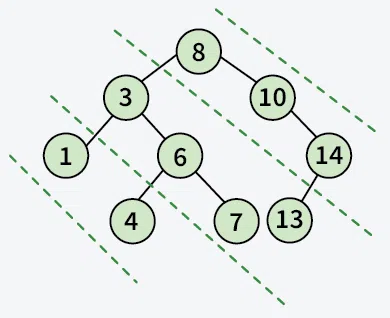
Also Check: Refer Diagonal Traversal of Binary Tree for more
Related Articles
Tree Traversal
Inorder Traversal of Binary Tree
Preorder Traversal in Python
Postorder Traversal in Python
Explore
DSA Fundamentals
Data Structures
Algorithms
Advanced
Interview Preparation
Practice Problem