Possessive Noun - Meaning, Usage, Rules and Examples
Last Updated :
06 Aug, 2025
A possessive noun is an important part of the English language and writing. They play an important role to indicate ownership or possession. You can express relationships with people, things, and ideas. In this article, we will learn about the concepts of Possessive Noun, their meaning, usage, rules, and examples.
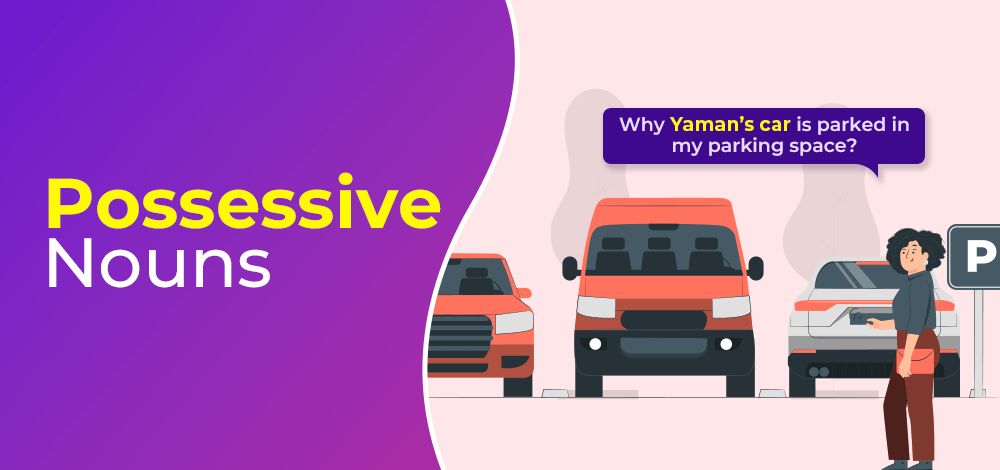
What is a Possessive Noun?
The Possessive nouns are nouns that indicate ownership or possession. It indicates that something belongs to someone or something else. In many cases, possessive nouns are formed by adding an apostrophe and "s"('s) to the noun, but different exceptions to this possessive noun rules. The common rule to indicate possession of an object is by adding "s" to the end.
Definition of a Possessive Pronoun
A possessive pronoun is "a pronoun such as'mine', 'theirs', or 'yours' that shows who something relates to or belongs to," according to the Macmillan Dictionary. "Mine" refers to "my problems" in the sentence "He has his problems and I have mine," whereas "ours" refers to "our house" in the statement "They want to buy the house next door to ours." A possessive pronoun is defined as "a pronoun or a form of a word that expresses the fact that something belongs to somebody/something" by the Oxford Learners' Dictionary.
Possessive Nouns Examples
- Teacher - To whom does this watch belong?
- Ross - it is Mona's watch
The term Mona’s is an example of a possessive noun that indicates ownership of the watch in the sentence "It is Mona's watch".
As a general rule mentioned earlier, an apostrophe and an "s" are added to the end of the noun to which the object belongs to indicate possession.
Possessive Nouns Examples for Grade 4
- Sarah's cat is fluffy.
- The teacher's desk is tidy.
- The dog's bone is buried in the backyard.
- My brother's bike is red.
- The sun's rays warm the earth.
- The bird's nest is high in the tree.
- Dad's car is parked in the garage.
- The baby's crib is in the nursery.
- The girl's doll has a pretty dress.
- The farmer's cows graze in the field.
To form a possessive noun, you generally add an apostrophe and or an "s"('s) to the noun. For example:
- The dog's toy
- Nisha's car
- The company's success
Types of Possessive Nouns
Based on the different types of usages of the possessive noun, there are following four types of possessive nouns which have been explained below in detail
1. Singular Possessive Nouns
The singular possessive noun is the most fundamental type of possessive noun.
In this type, “s” and an apostrophe are added to the singular nouns to make them possessive. It is important to note here that S-ending nouns, especially proper nouns, can be quite confusing. However, if the word is singular (the boss's chair), it's acceptable to add an 's after an s.
Singular possessive nouns = 's (apostrophe ‘s’) + [singular noun]
Example:
- For the occasion, I used Rahul's jacket.
- The Malayalam film’s review is rather good.
- Can you bring Harris' luggage to me?
2. Plural Possessive Nouns
Possessive plural nouns are those that denote ownership of plural nouns. To show possession with regular plural nouns that end with "s," simply add an apostrophe at the end.
The fact that plural nouns already have a “s” at the end makes them more challenging to render possessive.
Plural possessive nouns = ' (apostrophe) and [plural noun]
Example:
- The tasks were organized by the students’ roll numbers.
- The boys' clubs have intense rivalries.
- All the clocks’ hands need to be replaced.
3. Irregular Possessive Nouns
To indicate possession, an irregular possessive noun alters its spelling. A word that does not adhere to the fundamental guidelines for pluralization is said to be irregular.
The majority of nouns may be made plural by simply adding an s at the end of the word.
For instance, boy changes into boys.
Example:
- A child becomes children, and the tooth turns into teeth.
The modifications for these irregular nouns must simply be remembered because they do not adhere to any specific grammatical rules.
4. Multiple Possessive Nouns
To indicate multiple persons or things having ownership of that particular thing then that is known as multiple possessive nouns. by adding an apostrophe and "S" you can make these types of nouns in the group of nouns.
Example:
- Nisha, Madhur, and Anushka's journey began in highly bad circumstances.
Rules for possessive noun
- In the case of Singular Nouns: An apostrophe and s ('s) are required to make the possessive of a single noun, such as "Building."
- In the case of a Plural Noun: Add simply an apostrophe (') = cats = cats' to a plural noun ending in s to create the possessive form.
Add an apostrophe and s ('s) to make mice into mice's to construct the possessive of a plural word that doesn't finish in s.
- In the case of Multiple Nouns: Apostrophes and an "s" should only be added to the last noun in a collection of nouns that share ownership of the same object.
- In the case of Hyphenated or Compound Nouns: Make sure to add the apostrophe and the letter "s" to the end of the compound word or the word after the hyphen when making a hyphenated or compound noun into a possessive noun.
Possessive Pronoun Exercises
Now that you have learned everything about possessive nouns in detail, it is time to test your knowledge. Solve the exercises given below based on the concepts given above.
Instruction: The term that is underlined should be written on the line with an apostrophe or apostrophes to indicate its possessive form.
- Shalini's favorite book is stolen.
- Children saw the king's crown at the museum.
- Bring Nina Easter eggs from the shop.
- The joker's faces were painted.
- All of the women's voices were heard.
- Today is my birthday and you all are invited.
- My brother's bike is the latest model which has been recently launched.
- The girl's rooms are going to be cleaned today.
- The dog's bark was loud.
- That bird’s feathers are blue and yellow.
Also Check:
Explore
Noun
Proper Noun - Definition, Examples, & Rules
6 min read
Common Noun - Definition, Examples, List & Usage
6 min read
Plural Noun - Rules and Examples
9 min read
Possessive Noun - Meaning, Usage, Rules and Examples
7 min read
What is Collective Noun? List of Examples, Uses and Exercises
9 min read
Abstract Nouns - Definition, Examples, List, Usage
4 min read
What is a Compound Noun? Definition, Types & Examples
7 min read
What are Countable Noun?
11 min read
What are Uncountable Noun - How to use them?
7 min read
Material Noun: Definition, Examples, Rules & Exercises
7 min read
Pronoun
Verb
Adjective
Adverb
Conjunction
Interjection