Subordinating Conjunction - Meaning, Definition, Types and Examples
Last Updated :
23 Jul, 2025
It is a very useful topic for joining two sentences in English and also important for all students, especially for those who are preparing for competitive examinations. A few questions on this topic are asked in every competitive examination.
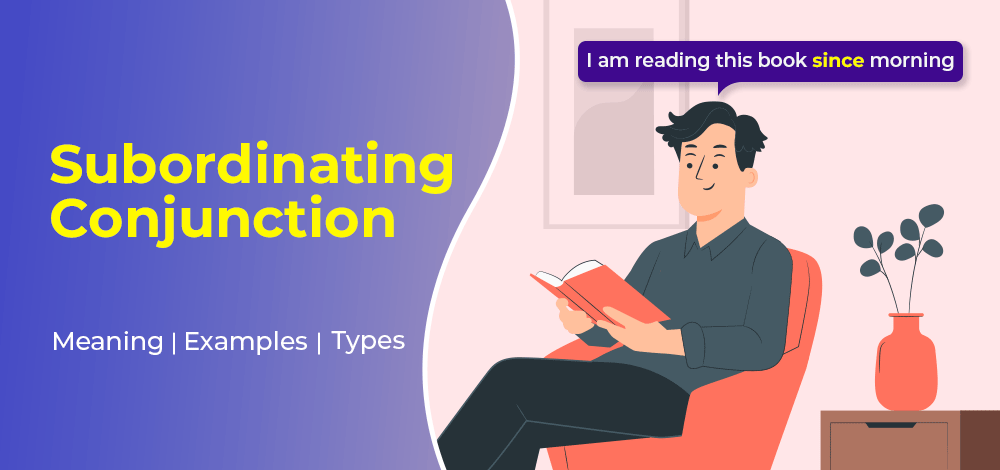
What is a Subordinating Conjunction?
Subordinating Conjunction is used to join a subordinate clause (or dependent clause) to a main clause (or independent clause). Subordinating Conjunction gives a clear idea about the sentence like time, conditions or causes. It always comes in front of the dependent clause. Subordinating Conjunctions can be one, two, three or more words long.
Definition of Subordinating Conjunction
A word or phrase that helps to connect a dependent clause to a main clause is called Subordinating Conjunction. It is also known as transition words.
Subordinating Conjunctions Examples
There are a lot of Subordinating Conjunctions in the English language. The examples of Subordinating Conjunctions are given below.
| After | Before | If |
| As | In order to | Unless |
| Until | Where | When |
| Then | That | Once |
| Since | Even though | Although |
| Because | Why | While |
| Even if | So that | Whenever |
| Whether | Assuming that | In case |
| Provided that | Whereas | Everywhere |
Ways to Use Subordinating Conjunctions
Subordinating Conjunctions are used in the following ways -
1. Comma is not used when the Subordinating Conjunction follows the main clause. When the Subordinating Conjunction is used in the middle of the sentence and it follows a main clause, there is no need to use a comma.
Example: you can win any situation if you can take the right decision.
2. Use a comma when a subordinate clause begins a sentence. When the subordinate clause starts a sentence, a comma is used after it, but before the main clause.
Example : If you can take the right decision, you can will any situation.
Types of Subordinating Conjunctions
We can see a few types of Subordinating Conjunction in the English language. These types are given below.
Time
Subordinating Conjunction of time establishes the time relation in a sentence. It is placed at the beginning of the subordinate clause. Subordinating Conjunctions of time is also known as adverb clause of time.
Examples : After, before, Until, till, by the time, while, as soon as, when, whenever etc.
Place
Subordinating Conjunctions of place help to connect the independent clause to the subordinate clause and establish a place relation. It is known as the adverb clause of place.
Examples : Where, whereas, everywhere.
Reason ( cause and effect)
It shows an action or the result of an action that is happening in a sentence.
Examples : Because, in order that, so that, as, so, since.
Condition
It gives the idea of a condition that is happening in the main clause.
Examples : if, only if, unless, provided that, assuming that.
Concession
Subordinating Conjunctions of concession provide the idea of the fact that something happens despite something else in the main clause.
Examples : Though, although, even though.
Manner
It identify the manner of the main verb of the main clause.
Examples : as if, like, as, as though.
Comparison
It is used to compare two or more.
Examples : than, whereas.
Subordinating Conjunctions vs Relative Pronouns
Relative Pronouns and Subordinating Conjunctions both are used to connect two clauses. Relative pronouns are “that,” “who” and “which.” But they have a few differences. Relative pronouns are not only joining two clauses but also acting as the subject of a dependent clause. Subordinating conjunctions do not act as subjects. It only acts as Conjunction. Subordinating conjunctions are followed by the subject of the clause.
Subordinating Conjunction Exercise
To evaluate your preparation and accuracy on Subordinating Conjunction, you must solve these practice questions which are given below. Fill the blanks with appropriate Subordinating Conjunctions [ after, because, in order that, of, wherever, though, unless, even though, like, than]
1. We will go there _________ the work finishes.
2. She will go _________ she wants.
3. He did not come to the birthday party ________ he was out of town.
4. His parents took her to a private school _________ he becomes a good student and learn discipline.
5. My parents promised me to give a MacBook _______ I qualified for the entrance exam.
6. The old man is not going back home _______ he recovers fully.
7. The teacher punished him ________ he didn't do anything wrong.
8. __________ he studied very well, he failed in the examination.
9. They are acting ________ they have seen something unexpected thing.
10. My friend was talking to me _______ he didn't know me.
11. He is stronger _______ I.
Answer :
1. after
2. wherever
3. Because
4. in order that
5. if
6. unless
7. though
8. Even though
9. as if
10. like
11. than
Also Check:
Explore
Noun
Proper Noun - Definition, Examples, & Rules
6 min read
Common Noun - Definition, Examples, List & Usage
6 min read
Plural Noun - Rules and Examples
9 min read
Possessive Noun - Meaning, Usage, Rules and Examples
7 min read
What is Collective Noun? List of Examples, Uses and Exercises
9 min read
Abstract Nouns - Definition, Examples, List, Usage
4 min read
What is a Compound Noun? Definition, Types & Examples
7 min read
What are Countable Noun?
11 min read
What are Uncountable Noun - How to use them?
7 min read
Material Noun: Definition, Examples, Rules & Exercises
7 min read
Pronoun
Verb
Adjective
Adverb
Conjunction
Interjection