Cardinal numbers are used for counting various objects. They are also called counting numbers or natural numbers.
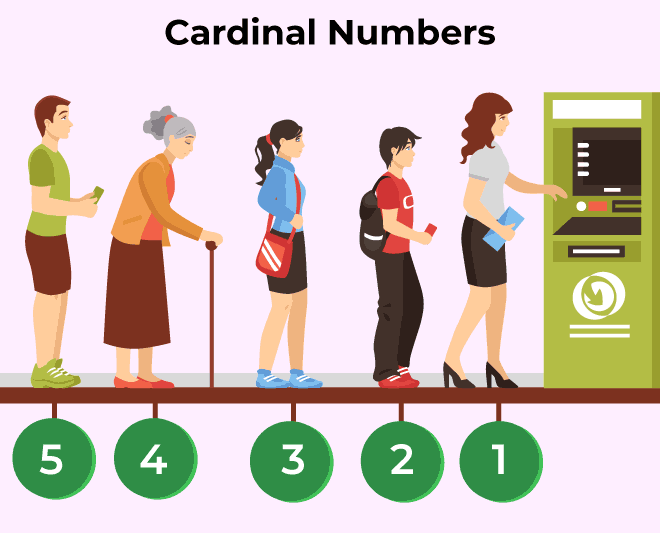
Let's learn more about Cardinal Numbers, in detail, including its Examples and Difference from Ordinal Numbers.
What are Cardinal Numbers?
Cardinal Numbers are the numbers that answer the question "How many".
If we have to find the answer to the question, How many players play for a cricket team, the answer is 11 (eleven) players. Now, 11 (eleven) used here is a cardinal number.
Also, the numbers that are used to specify the position of something, i.e. Position of people standing in a line, the position of students in a class test, etc are called cardinal numbers.

Define Cardinal Numbers
Cardinal numbers are used to count and quantify objects or entities.
Cardinal Number Examples
Cardinal Numbers also called counting numbers include the number that is used for counting and also to answer the questions of "how many" type.
Some of these questions and their answers are as follows:
"How many continents are in the World?"
Answer: Seven(7)
"How many planets are in the solar system?"
Answer: Eight(8)
Here both 7 and 8 are cardinal numbers, as 7 here is used to count the number of continents, and 8 is used to count the number of planets.
Some of the first and consecutive examples of cardinal numbers are 1, 2, 3, 4, 5, 6, 7, 8, 9, 10, 11, 12, 13, 14, 15, . . .. We can see here that the smallest cardinal number is 1 as we don't use 0 for counting.
What is Cardinality?
Cardinality is nothing but the cardinal number of the set, it is nothing but the total number of the elements in the set. For example, for the set A = {even number less than 10} = {0, 2, 4, 6, 8}, then the cardinality of A is 5 i.e., n(A) = 5.
Cardinal Numbers in English
Cardinal Numbers are used to count various things and we also use the cardinal number in the English language as,
- Seven days a Week
- Five Oceans in the World, etc.
Here, Seven and Five are cardinal Numbers used in English.
The First 10(ten) Cardinal Numbers in English are,
Cardinal Numbers
| Cardinal Number in English
|
|---|
1
| One
|
2
| Two
|
3
| Three
|
4
| Four
|
5
| Five
|
6
| Six
|
7
| Seven
|
8
| Eight
|
9
| Nine
|
10
| Ten
|
Cardinal Numbers from 1 to 100
Cardinal Numbers can be written to infinity which means there are never-ending numbers of cardinal numbers. Cardinal Numbers from 1 to 100 are natural numbers from 1 to 100.
The table added below shows Cardinal Numbers from 1 to 50:
Cardinal Numbers 1 to 50
|
| 1 (One) | 11 (Eleven) | 21 (Twenty-One) | 31 (Thirty-One) | 41 (Forty-One) |
| 2 (Two) | 12 (Twelve) | 22 (Twenty-Two) | 32 (Thirty-Two) | 42 (Forty-Two) |
| 3 (Three) | 13 (Thirteen) | 23 (Twenty-Three) | 33 (Thirty-Three) | 43 (Forty-Three) |
| 4 (Four) | 14 (Fourteen) | 24 (Twenty-Four) | 34 (Thirty-Four) | 44 (Forty-Four) |
| 5 (Five) | 15 (Fifteen) | 25 (Twenty-Five) | 35 (Thirty-Five) | 45 (Forty-Five) |
| 6 (Six) | 16 (Sixteen) | 26 (Twenty-Six) | 36 (Thirty-Six) | 46 (Forty-Six) |
| 7 (Seven) | 17 (Seventeen) | 27 (Twenty-Seven) | 37 (Thirty-Seven) | 47 (Forty-Seven) |
| 8 (Eight) | 18 (Eighteen) | 28 (Twenty-Eight) | 38 (Thirty-Eight) | 48 (Forty-Eight) |
| 9 (Nine) | 19 (Nineteen) | 29 (Twenty-Nine) | 39 (Thirty-Nine) | 49 (Forty-Nine) |
| 10 (Ten) | 20 (Twenty) | 30 (Thirty) | 40 (Forty) | 50 (Fifty) |
The table added below shows Cardinal Numbers from 51 to 100 :
Cardinal Numbers 51 to 100
|
| 51 (Fifty-One) | 61 (Sixty-One) | 71 (Seventy-One) | 81 (Eighty-One) | 91 (Ninety-One) |
| 52 (Fifty-Two) | 62 (Sixty-Two) | 72 (Seventy-Two) | 82 (Eighty-Two) | 92 (Ninety-Two) |
| 53 (Fifty-Three) | 63 (Sixty-Three) | 73 (Seventy-Three) | 83 (Eighty-Three) | 93 (Ninety-Three) |
| 54 (Fifty-Four) | 64 (Sixty-Four) | 74 (Seventy-Four) | 84 (Eighty-Four) | 94 (Ninety-Four) |
| 55 (Fifty-Five) | 65 (Sixty-Five) | 75 (Seventy-Five) | 85 (Eighty-Five) | 95 (Ninety-Five) |
| 56 (Fifty-Six) | 66 (Sixty-Six) | 76 (Seventy-Six) | 86 (Eighty-Six) | 96 (Ninety-Six) |
| 57 (Fifty-Seven) | 67 (Sixty-Seven) | 77 (Seventy-Seven) | 87 (Eighty-Seven) | 97 (Ninety-Seven) |
| 58 (Fifty-Eight) | 68 (Sixty-Eight) | 78 (Seventy-Eight) | 88 (Eighty-Eight) | 98 (Ninety-Eight) |
| 59 (Fifty-Nine) | 69 (Sixty-Nine) | 79 (Seventy-Nine) | 89 (Eighty-Nine) | 99 (Ninety-Nine) |
| 60 (Sixty) | 70 (Seventy) | 80 (Eighty) | 90 (Ninety) | 100 (One Hundred) |
Cardinal Number Chart
A cardinal number chart helps visualize the counting numbers and their corresponding words. Below is a chart listing cardinal numbers from 1 to 100.
.webp)
Cardinal and Ordinal Numbers
Cardinal numbers are counting numbers and are used to count various objects, whereas ordinal numbers are numbers that represent the position of anything.
- Examples of cardinal Numbers are 1, 2, 3, 4, 5,... 10, etc.
- Examples of ordinal Numbers are 1st, 2nd, 3rd, 4th, 5th,.. 10th, etc.
Difference between Cardinal and Ordinal Numbers
Difference between Cardinal, Ordinal, and Nominal Number is discussed in the table below,
Cardinal Numbers Vs Ordinal Numbers
|
|---|
Cardinal Numbers
| Ordinal Numbers
|
|---|
| Cardinal numbers are used to represent the counting of anything. | Ordinal numbers are the numbers that are used to represent the position of anything. |
The answer to "How many" is given using Cardinal Number.
For example, How many students are in the class?
| The answer to "Where" is given using Ordinal Number.
For example, Where is Kabir standing in the line?
|
| Examples of cardinal Numbers are 1, 2, 3, 4, 5,... 10, etc. | Examples of ordinal Numbers are 1st, 2nd, 3rd, 4th, 5th,.. 10th, etc. |
Cardinal Numbers of a Set
Cardinal Number of a set is the number of elements in the set. For a finite set, if it has N elements then its cardinality is N. For any set A with N elements then its cardinality is N. For empty set A, the cardinality is Zero(0)
Example: Find the cardinality of set A = {1, 3, 5, 7, 9. 11}.
Given,
Set A = {1, 3, 5, 7, 9, 11}
It has six(6) elements.
Thus, the cardinality of set A is 6.
Related :
Explore
Basic Arithmetic
Algebra
Geometry
Trigonometry & Vector Algebra
Calculus
Probability and Statistics
Practice