Class 12 RD Sharma Solutions - Chapter 23 Algebra of Vectors - Exercise 23.3
Last Updated :
30 Aug, 2024
Question 1. Find the position vector of a point R which divides the line joining the two points P and Q with position vectors \vec{OP}=2\vec{a}+\vec{b} and \vec{OQ}=\vec{a}-2\vec{b} respectively in the ratio 1:2 internally and externally.
Solution:
The point R divides the line joining points P and Q in the ratio 1:2 internally.
The position vector of R = \frac{\vec{a}-2\vec{b}+2(2\vec{a}+\vec{b})}{1+2} = \frac{5\vec{a}}{3}
Point R divides the line joining P and Q in the ratio 1:2 externally.
The position vector of R = \frac{\vec{a}-2\vec{b}-2(2\vec{a}+\vec{b})}{1-2}
= \frac{-3\vec{a}-4\vec{b}}{-1}
= 3\vec{a}+4\vec{b}
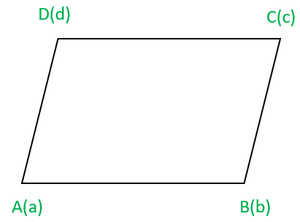
Question 2. Let \vec{a},\vec{b},\vec{c} and \vec{d} be the position vectors of the four distinct points A, B, C, D. If \vec{b}-\vec{a}=\vec{c}-\vec{d} then show that ABCD is a parallelogram.
Solution:
Given that are the position vectors of the four distinct points A, B, C, D
such that \vec{b}-\vec{a} = \vec{c}-\vec{d}
Given that,
\vec{b}-\vec{a} = \vec{c}-\vec{d}
\vec{AB} = \vec{CD}
So, AB is parallel and equal to DC
Hence, ABCD is a parallelogram.
Question 3. If \vec{a},\vec{b} are the position vectors of A, B respectively, find the position vector of a point C in AB produced such that AC = 3AB and that a point D in BA produced such that BD = 2BA.
Solution:
Given that \vec{a},\vec{b} are the position vector of A and B
Let C be a point in AB produced such that AC = 3AB.
From the given data we can say that point C divides the line AB in
Ratio 3:2 externally. So, the position vector of point C can be written as
\vec{c} = \frac{ m\vec{b}-n\vec{a}}{m-n}
= \frac{3\vec{b}-2\vec{a}}{3-2}
= 3\vec{b}-2\vec{a}
D be a point in BA produced such that BD = 2BA
It is clear that point D divides the line in 1:2 externally.
Then the position vector \vec{d} can be written as
\vec{d} = \frac{m\vec{a}-n{b}}{m-n}
= \frac{2\vec{a}-\vec{b}}{2-1}
\vec{d} = 2\vec{a}-\vec{b}
Hence \vec{c} =3\vec{b}-2\vec{a} and \vec{d} = 2\vec{a}-\vec{b}
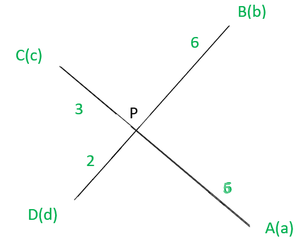
Question 4. Show that the four points A, B, C, D with position vectors \vec{a},\vec{b},\vec{c} and \vec{d} respectively such that 3\vec{a}-2\vec{b}+5\vec{c}-6\vec{d} =\vec{0} are coplanar. Also, find the position vector of the point of intersection of the lines AC and BD.
Solution:
Given that 3\vec{a}-2\vec{b}+5\vec{c}-6\vec{d} =\vec{0}
3\vec{a}+5\vec{c} = 2\vec{b}+6\vec{d}
Sum of the coefficients on both sides of the given equation is 8
so, divide the equation by 8 on both the sides
\frac{3\vec{a}+5\vec{c}}{8} = \frac{2\vec{b}+6\vec{d}}{8}
\frac{3\vec{a}+5\vec{c}}{3+5} = \frac{2\vec{b}+6\vec{d}}{2+6}
It is clear that the position vector of a point P dividing Ac in the
Ratio 3:5 is same as that of point P diving BD in the ratio 2:6.
Point P is common to AC and BD. Hence, P is the point of intersection of AC and BD.
Therefore, A, B, C and D are coplanar.
The position vector of point P can be written as
\frac{3\vec{a}+5\vec{c}}{8} or \frac{2\vec{b}+6\vec{d}}{8}
Question 5: Show that the four points P, Q, R, S with position vectors \vec{p},\vec{q},\vec{r} and \vec{s} respectively such that 5\vec{p}-2\vec{q}+6\vec{r}-9\vec{s} = 0 are coplanar. Also, find the position vector of the point of intersection of the lines PR and QS.
Solution:
Given that 5\vec{p}-2\vec{q}+6\vec{r}-9\vec{s} = 0
Here \vec{p}, \vec{q}, \vec{r}, and \vec{s}
are the position vectors of point P, Q, R, S
5\vec{p}+6\vec{r} = 2\vec{q}+9\vec{s} -(1)
Sum of the coefficients on both the sides of the equation (1) is 11.
So divide the equation (1) by 11 on both sides.
\frac{5\vec{p}+6\vec{r}}{11} = \frac{2\vec{q}+9\vec{s}}{11}
\frac{5\vec{p}+6\vec{r}}{5+6} = \frac{2\vec{q}+9\vec{s}}{2+9}
It shows that position vector of a point A dividing PR in the ratio of 6:5 and
QS in the ratio 9:2. So A is the common point to PR and QS.
Therefore, P, Q, R and S are coplanar.
The position vector of point A is given by
\frac{5\vec{p}+6\vec{q}}{11} or \frac{2\vec{q}+9\vec{s}}{11}
Question 6: The vertices A, B, C of triangle ABC have respectively position vectors \vec{a},\vec{b},\vec{c} with respect to a given origin O. Show that the point D where the bisector of \angle{A} meets BC has position vector \vec{d}=\frac{\beta\vec{b}+\gamma\vec{c}}{\beta+\gamma} where \beta=|\vec{c}-\vec{a}| = \gamma=|\vec{b}-\vec{a}| . Hence deduce that the incentre I has position vector \frac{\alpha\vec{a}+\beta\vec{b}+\gamma\vec{c}}{\alpha+\beta+\gamma} where \alpha = |\vec{b}-\vec{c}|
Solution:
Let ABC be a triangle and the position vectors of A, B, C with respect to some origin say O be
Let D be the point on BC where the bisector of \angle{A} meets.
\vec{d} be the position vector of D which divides BC internally in the ratio \beta
and \gamma where \beta = |\vec{AC}| and \gamma = {\vec{b}-\vec{a}}
Thus, \beta=|\vec{c}-\vec{a}| and \gamma=|\vec{b}-\vec{a}|
Therefore, by section formula, the position vector of D is given by
\vec{OD} = \frac{\beta\vec{b}+\gamma\vec{c}}{\beta+\gamma}
Let \alpha = |\vec{b}-\vec{c}|
Incentre is the concurrent point of angle bisectors.
Summary
Exercise 23.3 in RD Sharma's Class 12 textbook typically focuses on the dot product (scalar product) of vectors. This exercise explores the properties and applications of the dot product, including its definition, geometric interpretation, and algebraic manipulation. Students learn to calculate dot products, find angles between vectors, determine orthogonality, and solve problems involving work and force in physics. The exercise also covers the use of dot products in proving vector identities and understanding projections of one vector onto another. It emphasizes the importance of this operation in both pure mathematics and applied sciences, particularly in physics and engineering.
Explore
Basic Arithmetic
Algebra
Geometry
Trigonometry & Vector Algebra
Calculus
Probability and Statistics
Practice