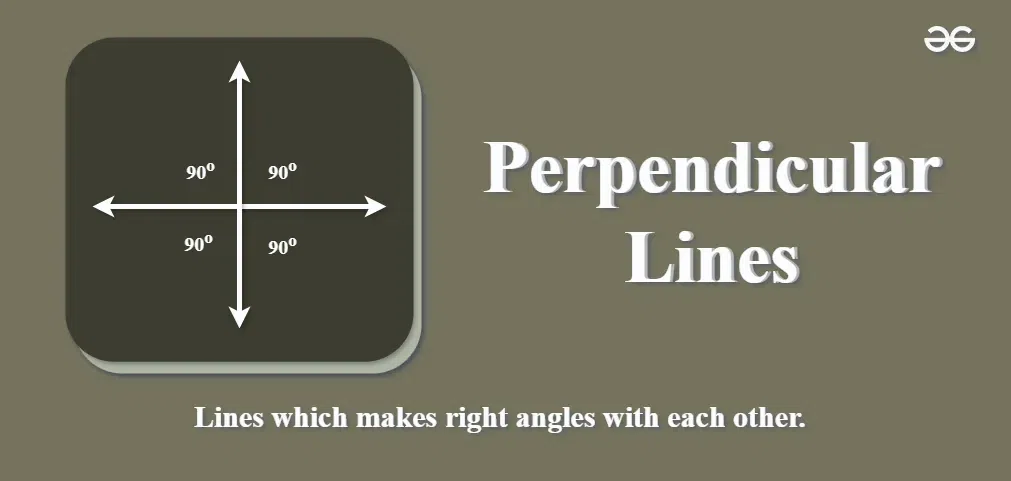
Perpendicular Lines in Mathematics are pairs of lines that always intersect each other at right angles, i.e. perpendicular lines are always intersect at 90°. The perpendicular lines are readily seen by us, the corners of the walls, the corners of the desk, and others represent the perpendicular line. Understanding the properties and relationships of perpendicular lines helps in solving complex geometric problems.
In this article, we will explore the definition, properties, and applications of perpendicular lines, along with their importance and uses in both academics and real life.
What are Perpendicular Lines?
Perpendicular refers to a relationship between two lines or line segments that intersect to form a right angle, which is 90 degrees.
When two lines are perpendicular:
- They intersect at a right angle, creating a perfect "L" shape at their intersection.
- Each line is said to be perpendicular to the other.

Perpendicular Lines refers to the lines that intersect each other at an angle equal to 90 degrees i.e. if two lines meet at a right angle they are called Perpendicular lines. Take the figure added below here, the line l and line m intersect each other at point O and the angle made by them is 90 degrees.

Thus, we can say that l is a line perpendicular to m line or line m is Perpendicular to line l. We represent this condition as, l ⊥ m. Now any line parallel to line l is perpendicular to the line m. The shortest distance between the point and the line is always the perpendicular distance between them.
Note: Not all the intersecting lines are perpendicular lines but all the perpendicular lines are intersecting lines.
Perpendicular Sign
Perpendicular lines are represented using the symbol, ‘⊥‘. If lines l and m are perpendicular to each other, i.e. they intersect each other at 90 degrees then they are called perpendicular lines and they are represented as:
l ⊥ m ( which means l is perpendicular to m ) .
The point of intersection is called the foot of the perpendicular.
Properties of Perpendicular Lines
Any two intersecting lines intersecting at an angle of 90 degrees are called perpendicular lines. Perpendicular lines have different properties than the intersecting lines and the general properties of the intersecting lines are,
- Perpendicular lines are the lines that always intersect each other at the right angle.
- If two lines are perpendicular to the same line, then these two lines are always parallel to each other.
Slope of Perpendicular Lines
The slope of any line is the tan of the angle formed by the line with the positive x-axis and the slope in the case of the perpendicular lines has a particular relation between them.
Statement: The product of the slope of two perpendicular lines is equal to -1.
Suppose we have two lines PQ and RS that are perpendicular to each other. Now, the slope of line PQ is say m1 and the slope of line RS is say m2, then the product of the slopes is equal to the -1. The statement for the same is,
This can be represented as,
m1.m2 = -1
The two basic methods to check if the lines are perpendicular,
Method 1: The product of the Slope of a Perpendicular line with the Slope of the Original line is always -1.
Proof:
Lets the original line makes an angle of θ with the X-axis.
Then, the line perpendicular to the line will make an angle of θ + 90° or θ - 90° with the X-axis.
Now, the slope of the original line is equal to tan θ
The slope of the perpendicular line is equal to either tan (θ + 90o) or tan (θ - 90o)
tan (θ + 90o) = tan (θ - 90o) = -cot θ
Thus, the slope of the perpendicular line is -cot θ
Now,
Product of Slopes = tan θ × (-cot θ) = -1
Hence Proved
Method 2: If the equation of a line is ax + by + c = 0
Then the equation of a line perpendicular to the given line is,
- bx + ay + d = 0
where, c and d are any constant values
Proof:
Equation of line is ax + by + c = 0
Slope of the line is -a/b
Let slope of the perpendicular line is m
We know that product of slope of two perpendicular lines is -1
m × (-a / b) = - 1
m = b / a
Now, if the perpendicular line passes through a point (x1, y1), then the equation of the perpendicular line is,
(y - y1) / (x - x1) = b / a
y - y1 = (b / a) × (x - x1)
ay - ay1 = bx - bx1
- bx + ay + (bx1 - ay1) = 0 {let bx1 - ay1 = d}
Thus, required equation of the line is,
- bx + ay + d = 0
How to Draw Perpendicular Lines?
We can easily construct the pair of the perpendicular line, by using the Protractor and the Compass.
Drawing Perpendicular Lines using Protractor
For drawing a pair of perpendicular lines follow the steps discussed below,
Step 1: First draw a horizontal line AB on the paper using a ruler.
Step 2: Mark any point P on line AB from which we have to draw the perpendicular line.
Step 3: Place the protector on the line and match the midpoint of the protector with point P on the line.
Step 4: Mark the 90-degree angle using the protector.
Step 5: Join the line using any ruler with the 90 degrees angle, to get a pair of perpendicular line.
Drawing Perpendicular Line using Compass
Following are the steps to make perpendicular lines using a compass
Step 1: Draw a line on the paper using a ruler
Step 2: Take a point on the line and place the needle of the compass on it.
Step 3: Draw an arc (a semicircle) on one side of the line.
Step 4: Without changing the radius of the compass now place the needle on one end of the diameter of the semicircle.
Step 5: Trisect the semicircular arc by cutting it two times. The first cut marks 60° and the second cut marks 120°
Step 6: There is a difference of 60° between the first and second cut. Bisect this gap using the compass without changing its radius.
Step 7: Now join the point of bisection of 60 and 120 with the point assumed initially to draw the semicircular arc.
Step 8: The line so drawn is perpendicular to the initial line.
Perpendicular Lines Example in Real Life
Perpendicular lines are the lines that always meet each other at 90 degrees. We see various examples of parallel lines in real life, some of them are,
- The corners of the rooms are perpendicular to each other.
- The hands of the clock represent perpendicular lines at 3' o clock.
- The corners of the table and the desk represents the perpendicular lines.
What are Parallel Lines?
Parallel lines in Geometry are defined as the lines that do not meet each other in the 2-D plane, i.e. they never intersect each other in the 2-D plane. The distance between the two parallel lines is always constant. The image added below shows two pairs of parallel lines.

The lines a, b, and x, and y are parallel to each other.
Difference Between Parallel Lines and Perpendicular Lines
Parallel lines Vs Perpendicular lines are discussed in the table below.
Parallel Lines | Perpendicular Lines |
|---|
| The lines that do not intersect each other in the 2-D planes are called parallel lines. The distance between two parallel lines is always constant. | The lines that intersect each other at 90 degrees in the 2-D planes are called perpendicular lines. |
| The “||” symbol is used to represent the parallel line. | The “⊥” symbol is used to represent perpendicular lines. |
| The parallel line never intersects each other. | The perpendicular line intersects each other at 90 degrees. |
| Examples of Parallel Lines: Opposite sides of a square. | Examples of Perpendicular Lines: Adjacent sides of a square. |
Slope of parallel lines is same. | Product of the slope of perpendicular lines is equal to -1. ( m1m2 = -1) |
Equation : If E1 and E2 are parallel lines then E1 = ax + by + c = 0 E2 = ax + by + d = 0 | Equation : If E1 and E2 are perpendicular lines then E1 = ax + by + c = 0 E2 = -bx + ax + d = 0 |
Read More,
Perpendicular Lines Solved Examples
Example 1: Are the lines 3x + 2y + 5 = 0 and 2x - 3y + 8 = 0 perpendicular?
Solution:
Slope of the line ax + by + c = 0 is -a/b
- Slope of the line 3x + 2y + 5 = 0 is m1 = - 3 / 2.
- Slope of the line 2x - 3y + 8 = 0 is m2 = -2 / (-3) = 2 / 3
We know that lines are perpendicular if their slopes have the condition.
m1 × m2 = -1
Now from the above condition,
= (- 3 / 2) × (2 / 3)
= -1
The product of the slopes is -1 and thus the lines are perpendicular.
Example 2: Determine whether the lines y = 3x + 4 and y = -\frac{1}{3}x - 2are perpendicular.
Solution:
Slope of the first line y = 3x + 4 is m1 = 3.
Slope of the second line y=−(1/3)x − 2 is m2 = −1/3.
for perpendicular lines m1 ⨯ m2 = -1
m1 × m2 = 3 \times (-\frac{1}{3}) = −1
Since the product of the slopes is -1, the lines are perpendicular.
The lines y=3x+4 and y = -\frac{1}{3}x - 2 are perpendicular.
Example 3: Find the line perpendicular to the line x + 2y + 5 = 0 and pass through the point (2, 5).
Solution:
We know that equation of a line perpendicular to the line ax + by + c = 0 is - bx + ay + d = 0.
Given equation of line is x + 2y + 5 = 0
Comparing the line x + 2y + 5 = 0 with ax + by + c = 0 we get,
Thus, the equation of any line perpendicular to this line is - 2x + y + d = 0...(i)
Given, this line passes through (2, 5),
Thus putting (2, 5) in this equation of the perpendicular line
-2 × 2 + 5 + d = 0
⇒ d = -1
Substituting the value of d in equation (i), we get
-2x + y + (-1) = 0
Thus, the equation of the perpendicular line is -2x + y - 1 = 0
Example 4: Find the slope of the line perpendicular to the line 3x + 9y + 7 = 0.
Solution:
Given,
Equation of the line is 3x + 9y + 7 = 0
Slope of this line = -a/b = - 3 / 9 = - 1 / 3
Let slope of line perpendicular to above line is m
Now using the perpendicular line formula
m × (- 1 / 3) = - 1
⇒ m = 3
Thus, the slope of the line perpendicular to the given line is 3.
Example 5: Find the angle of a line perpendicular to the line x + y + 3 = 0.
Solution:
Given line,
x + y + 3 = 0
Slope of given line = -a/b = - 1 / 1 = - 1
Lets, slope of line perpendicular to the above line is m
From perpendicular line formula,
m × -1 = - 1
⇒ m = 1
Angle of line perpendicular to the given line is θ, then
m = tan θ
⇒ tan θ = 1
⇒ θ = tan-1(1) = 45°
Hence, the angle made by perpendicular line with X-axis is 45°.
Practice Problems on Perpendicular Lines
Q1. Find the equation of a line perpendicular to the line 3x + 9y - 11 = 0.
Q2. If a line passes through the points (11, –4) and (–1, 8) and another line passes through the points (8, 3) and (–1, -3). Check whether these lines parallel or perpendicular.
Q3. Find the equation for the line that is perpendicular to 5x − 7y = 5 and passing through point (-1, 8).
Q4. Find the equation of line passing through (2, 3) and perpendicular to x-axis.
Q5. Find the slope of the line perpendicular to the line with a slope of 5/4.
Q6. Find the equation of the line that is perpendicular to y = 4x + 7 and passes through the point (3, -2).
Answers to practice Problems |
|---|
1. 3x − 9y + 11 = 0 | 2. Yes, The lines are perpendicular | 3. 7x + 5y = 43. |
|---|
4. x = 2. | 5. −5/4 | 6. y = −1/4x − 1/4 |
|---|
Explore
Basic Arithmetic
Algebra
Geometry
Trigonometry & Vector Algebra
Calculus
Probability and Statistics
Practice