The roots of a quadratic equation are the values of x that satisfy the equation — that is, the values that make the equation equal to zero. These roots are also called the zeros of the quadratic equation.
A quadratic equation is generally written in the form:
ax2 + bx + c = 0
Where a, b, and c are constants (with a ≠ 0).
Example
Consider the quadratic equation 2x2 + 3x - 2 = 0.
The roots of this equation are x = 1/2 and x = -2
- When x is 1/2: 2(1/2)2 + 3(1/2) - 2 = 0
- When x is 2: 2(-2)2 + 3(-2) - 2 = 0'
Thus, both values satisfy the equation.
A quadratic equation is an equation in which the maximum power of a variable is 2. Hence, there can be a maximum of two possible zeros or roots or solutions of a quadratic equation.
Methods to Find Roots of a Quadratic Equation
The methods to find Roots or Zeros of a Quadratic Equation are :
To find the roots (solutions) of the quadratic equation, you can use the quadratic formula, also called as Sridhar Acharya formula:
 Quadratic Formula or Sridharacharya formula
Example: The length of sides of a rectangle is given by x - 3 and x - 5 and the area of the rectangle is 3 unit2. Find the sides of the rectangle.
Solution:
Area of rectangle = length × breadth = (x - 3)(x - 5) = 3
Area = x2 - 8x + 15 = 3
= x2 - 8x + 12 = 0
Discriminant = b2 - 4ac = 64 - (4(1)(12)) = 64 - 48 = 16
x = [-b ± √(b2-4ac)]/2a = [-(-8) ± √16]/2 = (8±4)/2
x = 12/2 or 4/2
x = 2 or 6
When x is 2, sides are x - 3 = 2 - 3 = -1 and x - 5 = 2 - 5 = -3.
Since the length of sides cannot be equal therefore x = 2 is not a valid answer.
When x is 6, sides are x - 3 = 6 - 3 = 3 and x - 5= 6 - 5 =1.
Therefore, x = 6 is the valid answer and the sides are 3 and 1.
Roots of Quadratic Equation by Factoring
A quadratic equation can be considered a factor of two terms. Like ax2 + bx + c = 0 can be written as (x - x1)(x - x2) = 0 where x1 and x2 are roots of quadratic equation.
Example: Find the roots of the quadratic equation x2 + 3x = 18
Solution:
x2 + 3x - 18 = 0
Step 1: 6 and -3 are the numbers whose sum is equal to b and the product is equal to a.c.
Step 2: x2 + (6-3)x - 18 = x2 + 6x -3x - 18 =0
Step 3: x(x + 6) - 3(x + 6) = 0
Step 4: Take (x + 6) as common.
(x + 6)(x - 3) = 0
x = -6 or x = 3
In a factorizing method, you don't need to always find these two numbers easily(especially in the case when roots are imaginary or irrational) so it is better to use the quadratic formula.
Finding the Roots by Completing the Square
To find the roots (solutions) of the quadratic equation, you can use Completing the Square method, This is the easy way to find the roots of the equations.
Example: Use completing the square method to solve: x2 + 4x – 21 = 0.
Solution:
We have, a = 1, b = 4 and c = –21.
Find the value of m and n.
m = 4/2 = 2
n = –21 – (16/4) = –21 – 4 = –25
So, the equation is solved as,
(x + 2)2 – 25 = 0
x + 2 = ±5
x = 3, –7
Finding the Roots by Graphical Method
To find the roots (solutions) of the quadratic equation, you can use Graphical Method method.
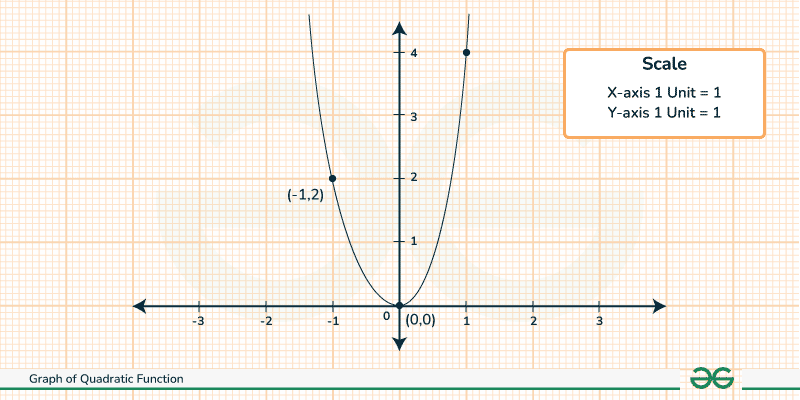
Example 1: Draw the graph of quadratic equation y = 3x2 + x.
Solution:
We have the equation: y = 3x2 + x, on comparing it with f(x) = ax2 + bx + c
we have, a = 3, b = 1 and c = 0.
The vertex of the above equation is:
x = -b/(2a)
x = -1/(2(3))
x = -1/ 6
x = -0.166
Now put x = -0.166 in the equation y = 3x2 + x
y= 3(-0.166)2 + (-0.166).
y = 3(0.0275) – 0.166
y = 0.0825 – 0.166
y = -0.0835
The vertex of the above equation is (-0.166, -0.0835)
Now, find the different values of x and y by solving the equation:
Plot the graph with these coordinates, the graph thus obtained will be a parabola opening upwards as a = 3 >0.
The sum of Roots of Quadratic Equation
The sum of the roots of a quadratic equation of the form ax2 +bx + c = 0 can be derived directly from the coefficients of the equation. The sum of the roots is denoted by α + β is given by:
α + β = -b/a
This relationship comes from Vieta's formulas, which relate the coefficients of a polynomial to sums and products of its roots. In the case of a quadratic equation:
- The sum of the roots α + β is equal to -b/a.
- The product of roots α.β is equal to c/a.
Nature of Roots
Nature of Roots of a Quadratic Equation depends on the discriminant of the quadratic equation. The discriminant of a quadratic equation is given by b2 - 4ac. It is so because in the quadratic formula square root of the discriminant is there.

Case 1: If b2 - 4ac > 0 roots are real and different. As the discriminant is greater than 0 then the square root of it will real and unequal.
- If b2 - 4ac is a perfect square then roots are rational. As the discriminant is a perfect square, so we will have an integer as a square root of the discriminant. Hence, the roots are rational numbers.
Example: Let the quadratic equation be x2- 5x + 6 = 0.
Then the discriminant of the given equation is b2 - 4ac = (-5)2 - 4×1×6 = 25-24 = 1
According to Shridhar Acharaya formula
x = [-b±√(b2-4ac)]/2a = x = [-(-5) ± √1]/2
x1 = [-(-5) + √1]/2 = 6/2 = 3
x2 = [-(-5) - √1]/2 = 4/2 = 2
Therefore, the roots are 3,2. Both are rational and different.
If b2 - 4ac is not a perfect square then the square root of the discriminant is irrational hence roots are irrational and occur in pairs.
Example: Let the quadratic equation be x2-7x+8 = 0.
Then the discriminant of the given equation is
b2 - 4ac = (-7)2 - 4×1×8 = 49-32 = 17
According to Shridhar Acharaya formula
x = [-b±√(b2-4ac)]/2a = x = [-(-7) ± √17]/2
x1 = [-(-7) + √17]/2 = [7 + √17]/2
x2 = [-(-7) - √17]/2 = [7 - √17]/2
Therefore, the roots are [7 + √17]/2,[7 - √17]/2. Both are irrational and in pairs.
Case 2: If b2 - 4ac = 0 roots are real and equal.
Example: Let the quadratic equation be 3x2-6x+3=0.
Then the discriminant of the given equation is
b2 - 4ac=(-6)2 - 4×3×3 = 36 - 36 = 0
According to Shridhar Acharaya formula
x = [-b±√(b2-4ac)]/2a = x = [-(-6) ± √0]/[(2)(3)]
x1 = [-(-6) + √0]/2 = 6/6 = 1
x2 = [-(-6) - √0]/2 = 6/6 = 1
Therefore, the roots are 1,1. Both are real and equal.
Case 3: If b2 - 4ac < 0 roots are imaginary, or you can say complex roots. It is imaginary because the term under the square root is negative. These complex roots will always occur in pairs i.e., both the roots are conjugate of each other.
Example: Let the quadratic equation be x2+6x+11=0.
Then the discriminant of the given equation is
b2 - 4ac=(6)2 - 4×1×11 = 36-44 = -8
According to Shridharacharaya formula
x = [-b±√(b2-4ac)]/2a = x = [-(6) ± √(-8)]/2
x1 = [-(6) + √(-8)]/2 = [-6 + √8i]/2 = 2[-3 + √2i]/2 = -3 + √2i
x2 = [-(6) - √(-8)]/2 = [-6 - √8i]/2 = 2[-3 - √2i]/2 = -3 - √2i
Therefore, the roots are 3,2. Both are imaginary and conjugate of each other(in pairs).
Graphs for Roots of Quadratic Equation
The maximum/minimum value of the quadratic function is found at x = -b/2a
Proof:
We get maxima or minima when d(f(x))/dx = 0
On differentiating quadratic function f(x) = ax2 + bx + c
We get,
2ax + b = 0
x = -b/2a
This x is either maxima(a < 0) or minima(a > 0).
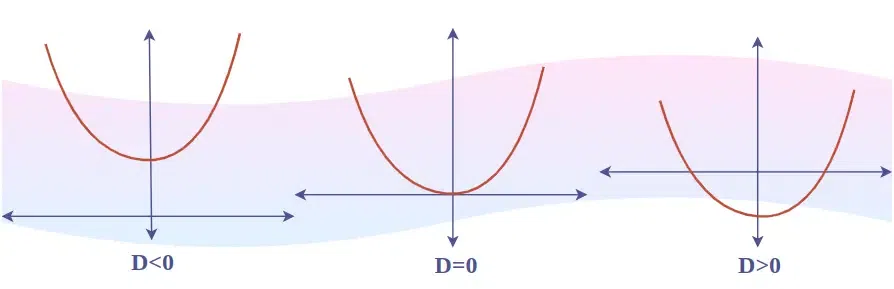
1. When D > 0
In the case of D > 0, the graph of the quadratic equation ax2 + bx + c = 0 touches the x-axis at two distinct points which indicates two possible values of x i.e. real and unequal roots. Graph of b2- 4ac > 0 is in the image shown below:
2. When D = 0
In the case of D = 0, the graph of the quadratic equation ax2 + bx + c = 0 touches the x-axis at only one point which indicates one unique value of x i.e. real and equal roots. Graph of b2- 4ac = 0 is shown in the image added below:
3. When D < 0
In the case of D < 0, the graph of the quadratic equation ax2 + bx + c = 0 doesn't touch the x-axis which indicates no possible values of x i.e. no real roots. Graph of b2- 4ac < 0 is shown in the image below:
Solved Examples of Roots of Quadratic Equation
Example 1. The height of a triangle is less than 4 cm than the base. The area of triangle is 30 cm2. Find the height and base of the triangle.
Solution:
Let the base of triangle be x cm then height is x-4 cm
Area of triangle = 1/2*height*base = 1/2*(x)(x - 4)=30
Area = x2 - 4x = 30*2
= x2 - 4x = 60
= x2 - 4x - 60 = 0
Discriminant = (-4)2 - 4(1)(-60) = 16+240 = 256
x = [-b±√(b2 - 4ac)]/2a = [-(-4)±√256]/2 = (4±16)/2
x = 20/2 or -12/2
x = 10 or -6
As side cannot be negative, therefore -6 is not correct.
So, when x is 10, base =10 cm and height =x - 4 = 10 - 4 = 6 cm
Therefore, x = 10 is the valid answer and the base and height of the triangle are 10 and 6 respectively.
Example 2. The volume of a box is 600 inches2. The length of the box is 2 inches less than the width. The height of the box is 5 inches. Find the dimensions of the box.
Solution:
Let the width of box be x inches then length = x - 2 inches.
Volume of box =Length* Width *Height = (x-2)(x)5= 600
x2 - 2x = 120 => x2 - 2x -120 = 0
x2 + 10x - 12x - 120 = 0
x(x + 10) - 12(x + 10)=0
(x - 12)(x + 10)=0
x = 12 or x = -10
As width can not be negative, therefore, -10 is not correct.
When x = 12, width = 12 inches, length = x - 2 = 12 - 2 = 10 inches, height = 5 inches
Example 3. A ball is thrown from the top of a building. Its height in meters above the ground as a function of time is given by h(t) = -4t2 + 24t + 3.
a) How much time does it take to reach the maximum height and what is the maximum height?
b) Find also the time at which the ball hits the ground.
Solution:
a) Since a<0, therefore the time to reach maximum height is = -b/2a.
t = -24/(2(-4)) = -24/-8
t = 3 sec.
Height = h(t) = -4(3)2 +24(3)+3 = 39 meters.
b) When the ball hits the ground h(t) = 0.
-4t2 + 24t + 3 = 0
The discriminant of the given equation is
b2 - 4ac=(24)2 - 4×(-4)×3 = 576 + 48 = 624
According to Quadratic Formula
x = [-b±√(b2-4ac)]/2a = x = [-(24) ± √624]/[(2)(-4)]
x1 = [-24 + √624]/-8= 4 [-6 + √39]/-8 = [-6 + √39]/-2 = [6 - √39]/2 = -0.122499 = -0.1225(approx)
x2 = [-24 - √624]/-8= 4 [-6 - √39]/-8 = [-6 - √39]/-2 = [6 + √39]/2 = 6.122499 = 6.1225(approx)
As time can not be negative, therefore, [6 - √39]/2 sec is not correct.
Therefore, the ball hits the ground at [6 + √39]/2 = 6.122499 = 6.1225 sec
Practice Problems on Roots of Quadratic Equations
Problem 1: Find the roots of the following Quadratic Equations:
- 3x2 - 7x + 2 = 0
- x2 + 4x + 4 = 0
- 2x2 + 5x - 3 = 0
- 4x2 - 12x + 9 = 0
- x2 - 6x + 9 = 0
Problem 2: The sum of two consecutive integers is 31. Find the two integers.
Problem 3: A quadratic equation of the form ax2 + bx + c = 0 has roots x = 3 and x = -2. Find the values of a, b, and c.
Problem 4: A ball is thrown into the air from a height of 5 feet with an initial velocity of 40 feet per second. The height h of the ball above the ground after t seconds can be modeled by the quadratic equation h(t) = -16t2 + 40t + 5. How long does it take for the ball to reach its maximum height?
Explore
Basic Arithmetic
Algebra
Geometry
Trigonometry & Vector Algebra
Calculus
Probability and Statistics
Practice